

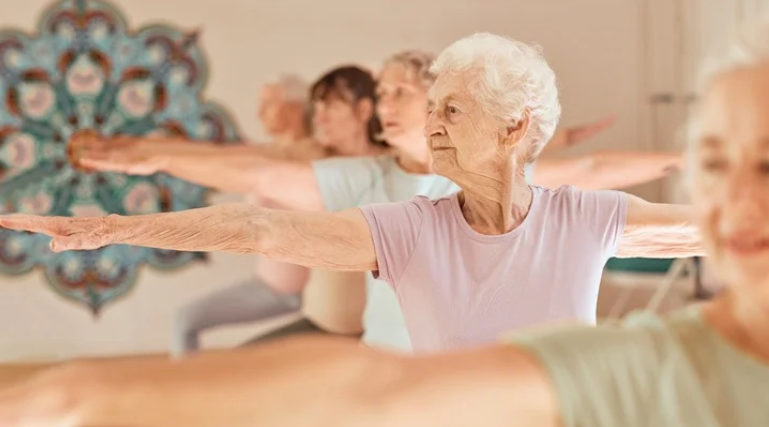
7 September 2026 Punjab Khabarnama Bureau : A new randomized trial suggests that yoga may offer cognitive as well as physical benefits for older adults, with a modified form of the practice that combines movement with faster, externally cued exercises showing particularly interesting results in memory and physical performance.
The study, published in Scientific Reports, compared 24 weeks of high-speed, cued yoga—called YogaCue—with traditional Hatha yoga in 34 cognitively healthy older adults. Both groups showed improvements in several measures of cognitive function, while the YogaCue group showed additional gains in verbal and episodic memory.
What Is ‘Cognitive’ About This Form of Yoga?
The intervention was not simply traditional slow-paced yoga.
YogaCue incorporated faster movements performed in response to external cues, adding an element of attention, reaction and coordination to the physical activity. Researchers compared it directly with conventional Hatha yoga over six months.
The idea is that combining physical movement with the need to pay attention, respond to cues and coordinate actions could engage both the body and cognitive systems.
Both Yoga Groups Showed Cognitive Improvements
Researchers assessed participants using several established cognitive tests, including the NIH Cognitive Toolbox, Hopkins Verbal Learning Test and Trail-Making Tests.
Both YogaCue and Hatha yoga groups improved on the NIH List Sorting Test, which assesses working memory, as well as the Flanker Test, which measures aspects of attention and executive control. Both groups also improved their overall Fluid Composite Score.
These findings suggest that the potential cognitive benefits were not limited to the more demanding YogaCue format.
YogaCue Stood Out for Memory
The most interesting difference appeared in verbal memory.
Only participants in the YogaCue group showed significant improvements on the Hopkins Verbal Learning Test, including total recall, delayed recall and the percentage of information retained.
That suggests the cognitively demanding version of yoga may have provided an additional benefit in some aspects of memory, although the researchers caution that the findings need to be confirmed in larger studies.
Physical Benefits Were Also Seen
The trial found improvements beyond cognition.
Both groups showed gains in lower-limb strength and chest-press performance, while aerobic fitness improved in both groups and the gains were more pronounced in the YogaCue group.
YogaCue also produced improvements in lower-limb power, while the traditional Hatha group showed an improvement in the Timed Up & Go test, an assessment commonly used to evaluate functional mobility.
Why Movement May Matter for the Brain
Yoga combines several elements that may be relevant to healthy ageing, including physical activity, balance, coordination, breathing and focused attention.
Earlier randomized studies have also reported improvements in attention, processing speed, executive function and memory among older adults following yoga interventions. One eight-week trial involving 118 older adults found improvements in attention and information-processing measures after Hatha yoga.
Another study found that improvements in executive function following yoga were associated with reduced stress and a lower cortisol response.
Evidence Is Promising but Not Conclusive
The broader scientific evidence remains encouraging but mixed.
A systematic review of randomized trials in healthy adults aged 60 and above found that four of six included studies reported significant positive effects on cognition, including memory and executive functions. However, the researchers noted methodological limitations and called for larger, better-designed trials with longer follow-up periods.
That means yoga should not currently be viewed as a proven treatment for cognitive decline or dementia.
A Small Trial With Interesting Signals
One important limitation of the new study is its small sample size: just 34 participants.
The participants were cognitively healthy older adults, so the findings cannot automatically be applied to people with dementia or significant cognitive impairment.
The study nevertheless provides an interesting direction for future research: whether exercise programmes that deliberately combine physical activity with cognitive demands can produce greater benefits than conventional exercise alone.
Yoga and Healthy Ageing
The findings fit into a growing body of research examining yoga as part of healthy ageing.
The World Health Organization has noted increasing scientific interest in yoga’s potential effects on brain health, including memory and cognitive decline, alongside its established physical and mental-health benefits.
For older adults, activities that simultaneously encourage movement, balance, attention and social engagement may offer broader benefits than focusing on fitness alone.
What the Study Really Shows
The new research does not prove that yoga can prevent dementia or reverse age-related cognitive decline.
What it does show is that 24 weeks of structured yoga were associated with improvements in several cognitive and physical measures, and that the faster, cue-based version produced additional improvements in selected memory measures.
The results make a case for further research into exercise programmes that challenge both the body and brain.