

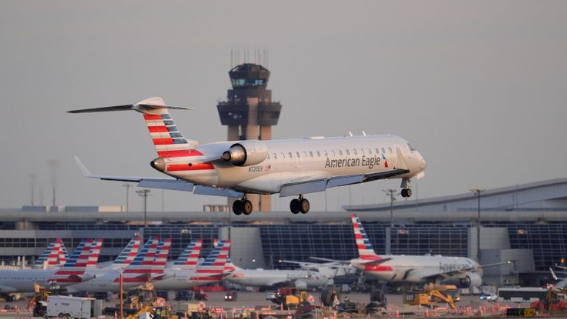
16 November 2026 Punjab Khabarnama Bureau : Air travel across the United States continued to face major disruptions for the third consecutive day on Sunday, November 15, with more than 11,500 flights cancelled or delayed nationwide. Thousands of passengers experienced travel difficulties as airlines struggled to restore normal operations following a nationwide ground stop issued by the Federal Aviation Administration (FAA) on Friday.
According to aviation data tracker FlightAware, approximately 2,100 flights were cancelled and 9,400 were delayed across the United States on Sunday. The disruption followed an already difficult Saturday, when airlines cancelled nearly 6,700 flights and delayed more than 9,100 services.
The situation created significant pressure on airlines, airport authorities and passengers, with several major airports experiencing operational difficulties. Airlines were working to reposition aircraft, arrange crew schedules and clear the backlog of passengers affected by cancellations and delays.
US Transportation Secretary Sean Duffy expressed confidence that air travel operations would gradually return to normal. Speaking on ABC’s programme ‘This Week’, Duffy said that airlines could recover their schedules by Monday, November 16. He also stressed that passenger safety remained the top priority for the FAA.
The disruptions began on Friday after the FAA imposed a nationwide ground stop that halted nearly all departing flights for almost five hours. The suspension was issued following problems involving the country’s air traffic control communication systems.
The incident was described as the longest nationwide halt to US air travel since the September 11, 2001, terrorist attacks. Although the ground stop was eventually lifted, its impact continued over the weekend as aircraft and airline crews were left out of position.
Router Problems Trigger Nationwide Flight Disruptions
Preliminary findings indicate that problems involving routers installed at air traffic control facilities contributed to the nationwide disruption. According to officials, maintenance work carried out by FAA contractor L3Harris triggered a technical problem that affected communication systems at multiple air traffic control centres.
Duffy explained that the replacement of a router at an FAA facility in El Dorado, Arkansas, triggered problems involving another recently replaced router in Amarillo, Texas. The affected equipment began transmitting excessive amounts of data, overwhelming routers at other air traffic control centres.
This created communication difficulties across the network and affected the FAA’s ability to manage normal air traffic operations.
The FAA subsequently disabled the functionality of the routers believed to have originated the problem. Officials also took similar action involving approximately 60 comparable routers operating within the air traffic control system.
However, investigators have not yet established the precise technical cause of the failure. Officials said that similar maintenance work had been performed thousands of times previously without producing such problems.
Duffy also said there was no evidence suggesting that the incident resulted from a cyberattack or deliberate sabotage. He indicated that the worker involved in installing the router was believed to be a military veteran and that investigators had not identified any indication of malicious intent.
Two people familiar with the investigation also indicated that the router installation itself had been completed successfully. The communication problems reportedly emerged after the facility was handed back to the FAA following the maintenance work.
JetBlue and American Airlines Among Worst-Affected Carriers
Several major American airlines experienced significant operational difficulties during the disruption.
JetBlue was among the worst-affected carriers, with approximately 28 per cent of its flights cancelled on Sunday. American Airlines also faced substantial disruption, with cancellations affecting around 20 per cent of its scheduled services.
United Airlines, Southwest Airlines and Delta Air Lines reported comparatively lower cancellation rates, ranging between 3 and 5 per cent.
The disruption forced airlines to reorganise their schedules and manage passengers whose journeys had been affected. Flights were delayed as airlines attempted to bring aircraft and crew members back to their assigned locations.
The outlook for Monday appeared considerably better. FlightAware reported that only 88 cancellations had been recorded for Monday as of 8:28 pm Eastern Time on Sunday. This represented a significant improvement compared with the previous two days.
Nevertheless, airlines remained focused on clearing remaining disruptions and ensuring that passengers could complete their journeys without further difficulties.
US Government Seeks $50 Billion to Modernise Air Traffic Control
The incident has renewed concerns about the condition of America’s air traffic control infrastructure, particularly its ageing technology and communication equipment.
Duffy has called for $50 billion in additional funding to modernise the country’s air traffic control systems. His latest demand is higher than his earlier request of $30 billion.
According to Duffy, some of the routers involved in the disruption were purchased in 2001 and had become obsolete by 2006. The incident has highlighted the risks associated with depending on outdated equipment to manage a complex national aviation network.
US President Donald Trump also supported the demand for additional funding. In his public comments on Sunday, Trump urged Congress to approve the proposed investment, arguing that the modernisation work should be completed together rather than through smaller, gradual allocations.
However, the funding proposal has faced questions from Democratic lawmakers. Representatives Rick Larsen and André Carson pointed out that approximately $11 billion of the $12.5 billion approved by Congress in 2025 for air traffic control improvements remained unspent.
They questioned why the administration was seeking additional funding when a substantial portion of the previously approved amount had not yet been utilised.
Responding to the criticism, Duffy said the earlier allocation was intended for specific infrastructure improvements and did not include funding for new software required to manage the country’s airspace.
Aviation industry representatives have also called for greater private investment to strengthen airport infrastructure and modernise air traffic management systems. They believe that government funding alone may not be sufficient to meet the growing demands of the aviation sector.
Concerns Over Ageing Infrastructure and Passenger Safety
The latest disruption has once again brought attention to the challenges facing the US aviation industry. An ageing air traffic control network, communication equipment problems and a shortage of several thousand air traffic controllers have increased pressure on the system.
The incident has also raised questions about the need for stronger backup systems and improved technical monitoring to prevent similar disruptions in the future.
With global air passenger traffic expected to grow substantially over the coming decades, aviation authorities face increasing pressure to ensure that airports and air traffic management systems can handle rising demand.
According to the International Air Transport Association, global passenger traffic is projected to more than double by 2050, making infrastructure investment increasingly important.
For now, the immediate priority for American airlines is to restore normal schedules, assist affected passengers and prevent further cancellations.
Although officials expect operations to return to normal, the investigation into the technical failure remains ongoing. The findings could play an important role in determining what changes are required to prevent another nationwide aviation disruption.
The incident has served as a major warning about the importance of reliable technology, modern communication networks and adequate investment in aviation infrastructure.