

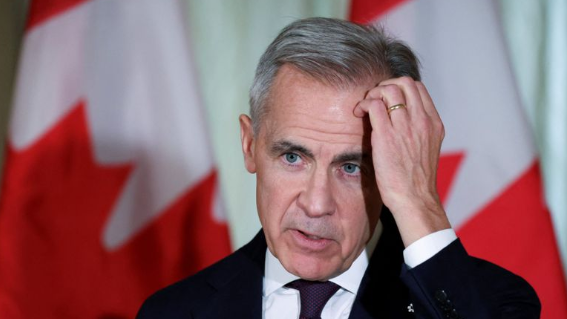
16 November 2026 Punjab Khabarnama Bureau : Canadian Prime Minister Mark Carney has indicated that Canada could explore partnerships with Chinese automakers if ongoing trade negotiations with US President Donald Trump fail to protect the country’s automobile industry. His remarks come amid growing trade tensions between Washington and Ottawa over tariffs, manufacturing and the future of the North American automotive sector.
Speaking to reporters in Phnom Penh, Cambodia, on November 16, Carney said negotiations with the United States remained his government’s priority. However, he made it clear that Canada was prepared to explore alternative partnerships with manufacturers from China, Europe and Japan if an acceptable agreement could not be reached with Washington.
Carney said Canada’s automobile workers deserved opportunities to work within a strong and integrated North American market. However, US trade measures had weakened the integration of the regional automobile industry, creating uncertainty for manufacturers and workers.
The Canadian prime minister stressed that his government wanted to protect domestic manufacturing capacity and ensure that Canadian workers continued to benefit from the country’s established automotive infrastructure.
When asked whether the possibility of Chinese investment was being used as leverage in negotiations with the United States, Carney rejected the suggestion. He described the situation as a matter of action and reaction, indicating that Canada would have to respond to changing trade conditions.
He also said that Canada would move forward regardless of the outcome of negotiations with the Trump administration.
US Tariffs Create Uncertainty for Canada’s Auto Industry
Canada’s automotive industry is closely connected to the manufacturing networks of the United States and Mexico. Major companies, including Ford, General Motors and Stellantis, operate factories across the three countries.
Automotive components frequently cross international borders multiple times before a finished vehicle reaches the market. This integrated manufacturing system has allowed companies to manage costs, improve production efficiency and maintain a competitive position in the global automobile industry.
However, President Donald Trump’s trade policies and tariffs on imported vehicles and automotive components have created challenges for this cross-border arrangement.
Trump has repeatedly encouraged automobile manufacturers to shift production facilities from Canada to the United States. His administration has argued that increasing domestic manufacturing would strengthen American industry and create employment opportunities.
These policies have raised concerns in Canada, where the automotive sector depends heavily on exports and cross-border supply chains.
Carney has maintained that any trade agreement with Washington must protect the long-term viability of Canada’s automobile industry. He has indicated that his government will not accept an arrangement that leaves Canadian manufacturing workers and factories at a disadvantage.
In recent discussions, Carney also confirmed that he had held a lengthy conversation with Trump and senior US officials. Although both countries were making progress towards a possible trade agreement, significant differences remained.
Canada Sets Conditions for Chinese Automotive Investment
Carney’s comments have also drawn attention because Canada has already taken steps to improve its economic relationship with China.
Under an agreement reached in January 2026, Canada reduced its tariff on Chinese electric vehicles from 100 per cent to 6.1 per cent. The arrangement initially allows up to 49,000 Chinese electric vehicles to enter the Canadian market annually, with the permitted number expected to increase over time.
In return, China agreed to reduce tariffs on several Canadian agricultural products, including canola.
The agreement was designed to encourage greater trade between the two countries and attract investment in Canada’s automotive manufacturing sector.
However, Carney has clarified that any future Chinese investment must involve substantial manufacturing activity within Canada. Simply importing vehicle components and assembling them locally would not meet the government’s expectations.
He said potential investments would need to include proper manufacturing facilities, acceptable labour standards and the development of domestic supply chains.
The Canadian government also wants the country’s critical minerals to become an important part of the electric vehicle manufacturing process. Canada possesses significant resources that could support battery production and other advanced automotive technologies.
Carney’s position suggests that the government is interested in attracting long-term industrial investment rather than simply increasing imports of foreign-made vehicles.
Meeting With Chinese President Xi Jinping Could Strengthen Trade Relations
Carney’s remarks came ahead of his scheduled meeting with Chinese President Xi Jinping on November 17 in Shenzhen, China. Automotive manufacturing is expected to be among the important subjects discussed during the meeting.
The two leaders had previously reached an agreement in January to improve trade relations, particularly in the electric vehicle and agricultural sectors.
Canada is looking to expand economic cooperation with China in several areas, including manufacturing, energy, financial services and food security.
The proposed automotive cooperation could create opportunities for Chinese companies interested in establishing production facilities in Canada. Such investments could also help Canadian manufacturers access new technologies and strengthen their position in the electric vehicle market.
However, the possibility of deeper cooperation with China has raised concerns among some Canadian political leaders, particularly in Ontario, which is the centre of Canada’s automotive manufacturing industry.
Ontario Premier Doug Ford has criticised the decision to allow more Chinese electric vehicles into the Canadian market. He has warned that increased imports could threaten domestic employment and potentially create difficulties for Canada’s relationship with the United States.
Stellantis Dispute Adds to Automotive Industry Concerns
Canada’s concerns about its automotive industry have intensified following developments involving Stellantis.
The automaker recently moved its planned production of the Jeep Compass from Brampton, Ontario, to Illinois in the United States. It also agreed to sell its inactive Canadian assembly plant to defence contractor Roshel.
The decision raised concerns among Canadian officials and automotive workers about the future of manufacturing jobs in the country.
Carney has expressed dissatisfaction with Stellantis, arguing that the company must honour its commitments to Canadian workers and the government after receiving public financial support.
The dispute highlights the challenges Canada faces in maintaining its automotive manufacturing base amid changing trade policies and investment decisions by international companies.
Canada Wants to Protect Jobs and Manufacturing Capacity
The Canadian government’s approach reflects an effort to reduce its dependence on a single trading partner while maintaining strong economic relationships with traditional allies.
The automobile sector is particularly important because it supports thousands of manufacturing jobs and contributes significantly to Canada’s industrial economy.
Carney believes that partnerships with international manufacturers could help Canada maintain production facilities, attract investment and create new employment opportunities.
However, the government wants any partnership to deliver measurable economic benefits within Canada.
The coming discussions with China and the ongoing negotiations with the United States could therefore shape the future direction of Canada’s automobile industry.
For now, Carney has maintained that an integrated North American automotive market remains the preferred outcome. However, his latest comments indicate that Canada is prepared to explore alternative partnerships if US trade negotiations fail.
The decision could have significant implications for international automobile manufacturers, electric vehicle companies and the broader North American supply chain.