

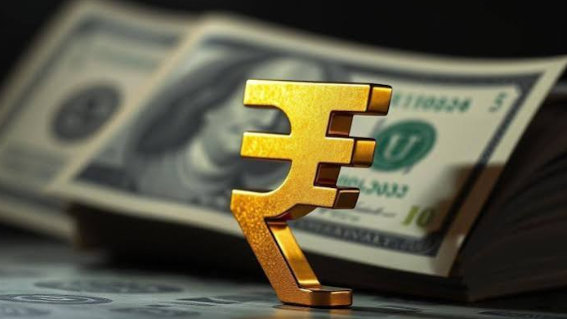
16 November 2026 Punjab Khabarnama Bureau : The Indian rupee has shown signs of recovery against the US dollar after facing significant pressure throughout 2026. The currency, which fell to a record low of around ₹96 per dollar in March and came close to revisiting that level last month, recently strengthened to ₹93.63, its best position in six months. The improvement has raised questions about whether the Reserve Bank of India (RBI) has successfully stabilised the currency or whether the recovery is only temporary.
The RBI has taken several measures to control excessive fluctuations in the foreign exchange market and prevent a sharp decline in the rupee. These interventions have included selling dollars, introducing special foreign currency facilities and restricting certain speculative transactions.
However, financial analysts believe that the recent recovery should not automatically be interpreted as a long-term improvement in the rupee’s fundamentals. External factors such as crude oil prices, foreign investment flows, India’s trade deficit and movements in the US dollar continue to influence the currency.
According to a November 16 analysis published by Finshots, understanding the rupee’s actual position requires looking beyond its exchange rate against the US dollar.
Rupee Recovery: What Has Changed?
For much of 2026, the Indian currency remained under pressure because of rising international oil prices, geopolitical uncertainty and foreign investor withdrawals from Indian financial markets.
The situation became particularly challenging when the rupee approached the ₹96-per-dollar level. The RBI responded by increasing its intervention in the foreign exchange market to prevent excessive volatility.
More recently, the currency has received support from improving export performance and renewed foreign investment in Indian equities.
India’s merchandise exports increased by 23 per cent year-on-year in September, crossing $44 billion. Import growth was comparatively lower, helping narrow the merchandise trade deficit to approximately $30 billion from $33 billion in September last year.
The improvement in exports has helped ease some pressure on the country’s demand for foreign currency.
Foreign portfolio investment has also provided support. Overseas investors purchased more than $8 billion worth of Indian equities during November, helping improve demand for the rupee.
According to Reuters, foreign equity inflows and corporate dollar selling helped the rupee rise to ₹94.1250 per dollar on November 16.
These developments suggest that the currency’s recovery is being supported by both central bank intervention and improvements in market conditions.
How the RBI Has Defended the Rupee
The RBI has used several tools to manage pressure on the Indian currency.
One of its most important methods has been selling US dollars from its foreign exchange reserves. By increasing the availability of dollars in the domestic market, the central bank attempts to reduce demand pressures and limit sharp movements in the exchange rate.
The RBI has also introduced special measures to attract foreign currency deposits and strengthen its foreign exchange reserves.
In addition, the central bank has taken steps to control speculative activity in the foreign exchange market. These measures are intended to discourage excessive dollar purchases and reduce pressure created by forward market transactions.
In October, the RBI introduced a special facility allowing oil companies to purchase dollars directly from the central bank rather than increasing demand in the open market.
It also introduced additional cash margin requirements for certain forward dollar transactions.
These measures helped improve the rupee’s short-term performance, although they also created challenges for banks, importers and other market participants.
Is the Rupee Really Becoming Stronger?
One important measure used by economists to assess a currency’s competitiveness is the Real Effective Exchange Rate (REER).
Unlike the normal exchange rate, which compares the rupee with a single currency such as the US dollar, REER compares it with a basket of currencies belonging to India’s major trading partners. It also adjusts for differences in inflation.
This measure provides a broader picture of the rupee’s international competitiveness.
The REER indicates that the Indian currency has become considerably cheaper in real terms over the past year. This means that even though the rupee has recently recovered against the dollar, its overall position in international trade remains different from what the headline exchange rate suggests.
A weaker real exchange rate can make Indian exports more competitive in international markets. However, it can also increase the cost of imported products, particularly crude oil, electronics and industrial equipment.
Therefore, a recovery against the dollar does not necessarily mean that India’s currency has regained all its lost strength.
RBI Intervention Comes With a Cost
Although the RBI’s intervention has helped control currency fluctuations, defending the rupee has required substantial financial resources.
According to a Reuters report published in October, economists and banking officials estimated that the RBI had deployed approximately $75 billion to $80 billion through direct dollar sales and currency swaps since its special measures to attract foreign currency inflows began in June.
India’s foreign exchange reserves also experienced pressure, declining from their September peak as the central bank intervened in the market.
Another concern is the RBI’s forward dollar position, which represents foreign currency commitments for future settlement. These obligations can influence the central bank’s future ability to manage currency movements.
The situation demonstrates that maintaining a particular exchange rate range can become expensive if underlying economic pressures remain unchanged.
Market experts have also warned that aggressive intervention can reduce liquidity in parts of the foreign exchange market and increase hedging costs for businesses.
A report published by Business Standard in October highlighted that the RBI’s measures had helped curb speculative dollar demand but had also increased pressure on foreign exchange liquidity and bond markets.
Oil Prices and Foreign Investment Remain Major Challenges
India imports a substantial portion of its crude oil requirements, making international energy prices an important factor in determining the rupee’s performance.
When crude oil prices rise, Indian companies need more dollars to purchase energy supplies. This increases demand for the US currency and can put downward pressure on the rupee.
Foreign investment is another important factor.
When international investors withdraw money from Indian equities and bonds, they generally convert their rupee holdings into foreign currencies. This can increase dollar demand and weaken the domestic currency.
The situation improved during November as overseas investors returned to Indian financial markets. However, uncertainty surrounding US interest rates, global geopolitical developments and oil prices continues to influence investor sentiment.
Reuters reported on November 13 that rising oil prices and expectations of a more hawkish US Federal Reserve had weakened the rupee despite strong foreign investment inflows.
This shows that improvements in one area of the economy may not be sufficient to guarantee sustained currency stability.
Can the RBI Maintain This Stability?
The biggest question is whether the RBI can maintain the rupee’s improved position without putting excessive pressure on foreign exchange reserves and domestic financial markets.
The central bank has repeatedly clarified that it does not target a particular exchange rate. Its objective is to reduce excessive volatility and ensure orderly functioning of the foreign exchange market.
This approach allows the rupee to respond to international economic conditions while preventing sudden and disruptive movements.
Economists believe that long-term currency stability will require improvements in India’s economic fundamentals rather than relying entirely on central bank intervention.
Higher exports, stronger foreign investment, controlled inflation, stable crude oil prices and a healthier trade balance could provide more sustainable support to the rupee.
The RBI will also need to maintain sufficient foreign exchange reserves to manage unexpected global economic shocks.
What Lies Ahead for the Indian Rupee?
The recent recovery offers some relief to policymakers, businesses and investors after several months of currency weakness. However, the improvement does not necessarily indicate that the underlying challenges have disappeared.
India continues to face external pressures from energy imports, global interest rate movements and changing international investment patterns.
The RBI’s interventions have helped slow the rupee’s decline and reduce excessive volatility, but maintaining that stability over an extended period could prove challenging.
The real test will be whether the currency can remain relatively stable even when the central bank reduces its market intervention.
Ultimately, the RBI may have succeeded in buying time for the rupee, but a lasting recovery will depend on stronger economic fundamentals, improved capital inflows and a more favourable global environment.
The question, therefore, is not simply whether the RBI has stabilised the rupee, but whether India can sustain that stability without continuously spending its foreign exchange resources.