

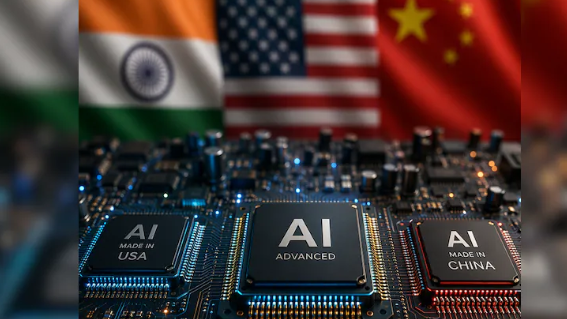
16 November 2026 Punjab Khabarnama Bureau : India has joined a US-led international initiative aimed at protecting critical artificial intelligence (AI) technologies and securing global supply chains amid growing competition with China. The move comes at a time when Washington is increasing scrutiny of advanced semiconductor exports and concerns surrounding Nvidia chips have intensified the debate over technology security.
According to a report by the Financial Times, India has signed the San Francisco Declaration on the Secure Foundations of Enduring Prosperity alongside the United States and several other countries. The agreement aims to strengthen cooperation among participating nations to protect sensitive technologies, semiconductor infrastructure and other resources essential to the development of advanced artificial intelligence.
The declaration has been signed by the United States, India, Japan, Australia, Israel, the United Kingdom, South Korea, Qatar, Singapore and the United Arab Emirates. It is part of the broader Pax Silica initiative, launched by Washington to build more reliable and diversified supply chains for the global AI industry.
The agreement reflects growing concerns among the United States and its partners about excessive dependence on Chinese-controlled supply chains, particularly in critical minerals, semiconductor materials and other strategic technologies.
US Under-Secretary of State for Economic Affairs Jacob Helberg said the initiative recognises that AI supply chains extend across several countries. The technology used to design a semiconductor, the machinery required to manufacture it and the infrastructure used to transport it may all be located in different parts of the world.
He said the participating countries had agreed to treat the security of these technologies and supporting infrastructure as a shared responsibility.
What Is the Pax Silica Initiative?
Pax Silica is a US-led international initiative focused on strengthening cooperation in the global technology supply chain. It covers several strategic sectors, including semiconductor manufacturing, critical minerals, advanced manufacturing, energy infrastructure and artificial intelligence.
The initiative was launched in December 2025 with the objective of reducing vulnerabilities in the supply chains supporting advanced technologies.
The latest San Francisco Declaration represents another step towards establishing a coordinated framework for protecting these resources. Participating countries have agreed to identify sensitive technologies and critical infrastructure that require stronger safeguards.
The agreement also focuses on preventing the theft, unauthorised transfer or acquisition of technologies that could provide military or intelligence advantages to hostile actors.
Under the framework, participating nations will establish working groups to identify vulnerabilities, exchange information and coordinate policies related to supply-chain security.
The proposed cooperation will also explore the development of economic and industrial hubs capable of attracting investment in AI-related sectors.
The declaration covers not only semiconductor chips but also the wider infrastructure required for artificial intelligence, including ports, transportation networks, communication systems, energy facilities and data centres.
Why India’s Participation Matters
India’s participation is significant because the country is seeking to become a major global destination for semiconductor manufacturing and artificial intelligence investment.
The government has been working to strengthen domestic capabilities in chip production, semiconductor assembly, testing and packaging. Various initiatives have been introduced to attract international manufacturers and develop a stronger electronics manufacturing ecosystem.
India formally joined the Pax Silica coalition on February 20, 2026, during the India AI Impact Summit in New Delhi. The latest declaration further strengthens its participation in international efforts to secure technology supply chains.
The partnership could create opportunities for Indian companies to work with international semiconductor manufacturers, technology providers and investors.
It could also help India improve access to critical materials, manufacturing equipment and advanced technologies required to support its growing digital economy.
However, participation in the initiative does not automatically guarantee domestic semiconductor self-sufficiency. India will still need to expand its manufacturing capacity, develop specialised technical expertise and improve access to essential raw materials.
AI and technology infrastructure are expected to become increasingly important to India’s economic growth, making international cooperation a significant part of its long-term strategy.
Nvidia Controversy Raises Concerns Over AI Chip Exports
The agreement comes amid increasing scrutiny of Nvidia and the international movement of advanced artificial intelligence chips.
Nvidia is one of the world’s leading semiconductor companies, producing graphics processing units (GPUs) that power advanced AI models, cloud computing platforms and large data centres.
The United States has imposed export restrictions on certain high-performance semiconductor chips to prevent sensitive technologies from reaching Chinese companies and potentially strengthening China’s military and technological capabilities.
However, reports of possible attempts to bypass these restrictions have raised concerns among US policymakers.
Recent allegations involving the movement of advanced Nvidia chips to Chinese entities have increased pressure on Washington to strengthen export controls and improve monitoring of international semiconductor supply chains.
The controversy has also intensified political debate over the security implications of advanced AI technology. US lawmakers have called for stricter monitoring of chip shipments and greater coordination with international partners.
The issue is particularly sensitive because China is working to strengthen its domestic semiconductor industry and reduce dependence on American technology.
US Wants to Reduce Dependence on Chinese Supply Chains
Washington’s latest initiative reflects its broader strategy of reducing dependence on China for materials and components essential to advanced technology.
China has a significant position in the global processing and refining of rare earth elements and other critical minerals. These materials are required for manufacturing semiconductors, electric vehicles, batteries and advanced electronic equipment.
The United States and its partners are therefore exploring alternative sources of these resources and encouraging investment in domestic manufacturing capabilities.
Through Pax Silica, Washington wants participating countries to develop a more diversified technology ecosystem.
Japan, South Korea and Australia are particularly important partners because of their capabilities in semiconductor manufacturing, advanced materials and critical mineral supplies.
India’s participation adds another major economy to the initiative, offering opportunities for cooperation in manufacturing, technology development and infrastructure investment.
India-US Technology Cooperation Expands
The latest agreement also reflects expanding cooperation between India and the United States in strategic technology sectors.
Earlier in November, foreign ministers of the Quad grouping, comprising India, the United States, Japan and Australia, announced plans to provide more than $85 million in technical and financial assistance to improve access to trusted AI infrastructure across the Indo-Pacific region.
Washington also announced a separate $10 million allocation to support critical mineral recycling initiatives in India and ASEAN countries.
These developments indicate that AI infrastructure, semiconductor manufacturing and critical mineral security are becoming important areas of international cooperation.
For India, these partnerships could help attract investment, strengthen domestic manufacturing and provide opportunities for Indian technology companies to participate in global supply chains.
China-US Technology Rivalry Could Intensify
The declaration comes ahead of the expected meeting between US President Donald Trump and Chinese President Xi Jinping at the Asia-Pacific Economic Cooperation summit in Shenzhen on November 18-19.
Technology exports, trade restrictions and access to critical minerals are expected to remain important issues in the broader relationship between the two countries.
The growing competition over artificial intelligence has made semiconductor technology a strategic priority for both Washington and Beijing.
While the United States seeks to maintain its leadership in advanced chips and AI infrastructure, China is investing heavily in domestic semiconductor production and artificial intelligence development.
The latest agreement signals that Washington wants its international partners to play a more active role in protecting critical technology networks.
For India, the initiative presents an opportunity to strengthen its position as a trusted technology and manufacturing partner. However, building a competitive domestic semiconductor ecosystem will require substantial investment, research and technological expertise.
As global competition over artificial intelligence intensifies, India’s participation in the US-led initiative could become an important part of its strategy to expand its role in the international technology industry.