

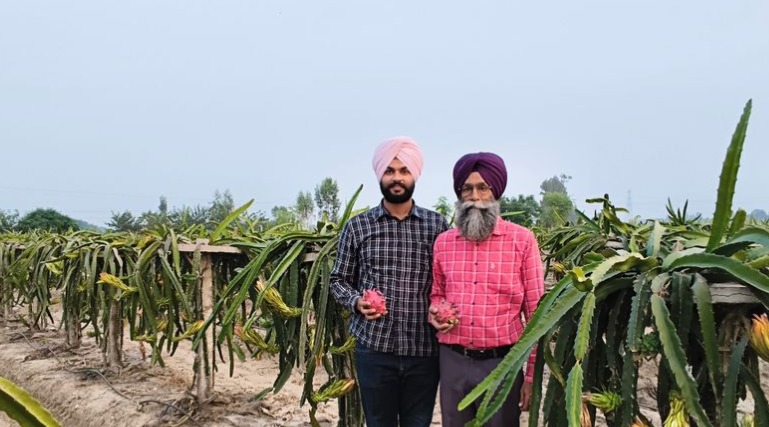
5 October 2026 Punjab Khabarnama Bureau : A teacher from Punjab’s Kapurthala district has taken an unconventional path by leaving his teaching job and turning to dragon fruit farming to fulfil a dream cherished by his father for years. His decision reflects a growing interest among educated rural youth in modern and alternative forms of agriculture.
The farmer, who had been working as a teacher, chose to step away from his profession and devote himself to farming. Instead of continuing with conventional crops, he opted for dragon fruit cultivation, a crop that has gained increasing attention among farmers in different parts of India because of its market potential and comparatively different cultivation requirements.
For him, however, the decision was about more than agricultural experimentation. It was closely connected to his father’s lifelong aspiration to establish a successful farming venture. By taking up dragon fruit cultivation, he sought to turn that long-held family dream into reality.
Punjab has traditionally been associated with crops such as wheat and paddy, which form the backbone of the state’s agricultural economy. However, rising input costs, groundwater concerns, changing weather patterns and the need for better returns have encouraged some farmers to explore crop diversification.
Dragon fruit has emerged as one such alternative. The crop is generally associated with warmer climates and requires suitable soil, irrigation and proper farm management. Farmers have increasingly experimented with its cultivation in parts of northern India, including Punjab.
The Kapurthala teacher’s decision highlights how educated individuals are also becoming involved in agricultural entrepreneurship. Rather than viewing farming only as a traditional occupation, a new generation of farmers is increasingly approaching it as a business that requires planning, technology, market research and long-term investment.
Leaving a stable teaching job to enter farming is nevertheless a major decision. Teaching offers a predictable professional career, while agriculture is influenced by weather, market prices, input costs, crop diseases and other uncertainties.
The teacher’s choice therefore reflects both personal motivation and confidence in the potential of his farming venture. His father’s dream provided an emotional reason for making the transition, while dragon fruit offered an opportunity to explore a crop outside Punjab’s conventional agricultural pattern.
Crop diversification has become an important subject in Punjab because of the state’s dependence on water-intensive crops. Paddy cultivation in particular places considerable pressure on groundwater resources. Encouraging farmers to move toward alternative crops is considered one way of reducing dependence on traditional crop cycles.
Dragon fruit cultivation can require significant initial investment, particularly for setting up support structures and irrigation systems. Farmers also need to understand planting material, pruning, fertilisation, pest management and harvesting techniques.
For a first-generation or newly diversified farmer, learning these practices can be challenging. The Kapurthala farmer’s background as a teacher may have helped him approach the new venture with an emphasis on research, planning and systematic learning.
The story also demonstrates the role of family aspirations in agricultural decisions. His father’s desire to establish or expand a farming venture remained unfulfilled for years, and the younger generation eventually took responsibility for carrying it forward.
Such stories are increasingly relevant in Punjab, where many young people have traditionally looked toward government jobs, private-sector employment or opportunities abroad. The decision of an educated professional to return to or focus on agriculture offers a different example of how rural entrepreneurship can develop.
Modern farming can provide opportunities beyond simply growing crops. Farmers can explore direct marketing, farm tourism, food processing, online sales and value-added products. High-value crops such as fruits and vegetables can also provide alternatives to conventional grain cultivation when managed effectively.
Dragon fruit is particularly attractive to some farmers because of its growing popularity among consumers. The fruit is known for its distinctive appearance and nutritional profile and has found a place in urban retail markets.
However, agricultural success cannot be guaranteed by choosing a high-value crop alone. Market demand, production costs, yield, transportation, storage and access to buyers all influence profitability. Farmers considering diversification therefore need to evaluate local conditions carefully.
The Kapurthala teacher’s experience offers an example of how individual farmers are experimenting with alternative agricultural models. His journey also reflects the changing image of farming, where education and professional experience can be combined with agricultural entrepreneurship.
For his family, the venture carries an additional significance because it represents the fulfilment of his father’s long-standing dream. What began as a personal aspiration has now become a farming project that could potentially inspire others in the region.
Punjab’s agricultural future is increasingly linked to diversification and sustainable resource use. Farmers are being encouraged to consider crops and practices that can reduce pressure on groundwater while creating new income opportunities.
The story from Kapurthala illustrates this transition at an individual level. A teacher who once spent his working days in a classroom has now chosen fields as his new workplace, taking on the risks and opportunities associated with modern farming.
His decision may also encourage other educated Punjabis to look at agriculture differently. With access to information, technology and markets, farming can become a professionally managed enterprise rather than simply a continuation of traditional practices.
Ultimately, the Kapurthala farmer’s journey is driven by both family values and a willingness to take a calculated risk. By leaving his teaching career and embracing dragon fruit cultivation, he has attempted to give his father’s lifelong dream a new beginning while exploring an alternative future in Punjab’s agricultural sector.