

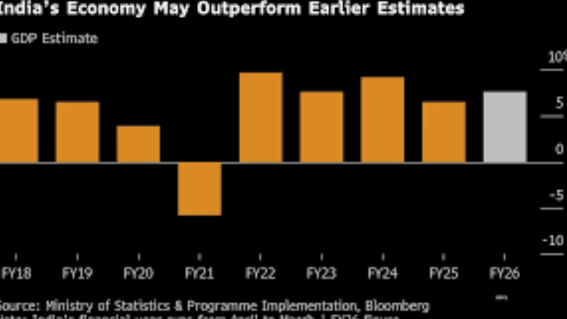
27 February 2026 Punjab Khabarnama Bureau : India’s economic growth could turn out to be stronger than previously estimated after a comprehensive overhaul of official data calculations, according to economists and policy observers. The revision process, which includes updated methodologies and expanded datasets, may significantly alter the country’s recent gross domestic product (GDP) trajectory.
The data overhaul is part of periodic statistical revisions conducted to reflect structural changes in the economy, incorporate new sources of information, and improve measurement techniques. Officials involved in the process say the updated framework aims to better capture activity in emerging sectors such as digital services, formalized small enterprises, and organized manufacturing.
Economists note that India’s economy has undergone rapid transformation in recent years, with increasing digitalization, improved tax compliance, and the formalization of previously informal sectors. These changes are often difficult to fully measure under older statistical models, potentially leading to underestimation of output and productivity.
One of the key components of the revision includes improved use of Goods and Services Tax (GST) data to track business activity more accurately. Since GST provides real-time transactional insights across sectors, analysts believe it can offer a more comprehensive picture of economic momentum.
Additionally, updated corporate filings and financial disclosures are being integrated more effectively into national income calculations. This step is expected to enhance measurement of private sector output, particularly in services and manufacturing.
If revised figures show higher growth rates for recent years, it could have broad implications for fiscal policy, investment sentiment, and global perceptions of India’s economic strength. Stronger historical growth may reinforce India’s position as one of the fastest-growing major economies.
Policy experts say upward revisions could also impact debt-to-GDP ratios and fiscal deficit calculations, potentially presenting a more favorable macroeconomic outlook. However, they caution that revisions are technical adjustments rather than immediate economic boosts.
India has consistently reported robust economic expansion compared with many developed economies, supported by domestic consumption, infrastructure spending, and rising exports in select sectors. Despite global headwinds such as supply chain disruptions, inflationary pressures, and geopolitical uncertainty, the economy has maintained steady momentum.
Analysts argue that the data overhaul reflects the government’s effort to align national statistics with evolving economic realities. The growing contribution of technology platforms, digital payments, and e-commerce requires refined measurement approaches.
The revision process may also include updates to the base year used for GDP calculation. Changing the base year helps better reflect current price structures and sectoral weights within the economy. When base years are updated, historical data are recalibrated to ensure consistency.
Some economists emphasize that while revisions may show stronger past growth, attention must remain on forward-looking indicators such as investment trends, employment generation, and productivity improvements. Sustainable growth depends on structural reforms and macroeconomic stability.
Market participants are watching closely, as higher reported growth could boost investor confidence and attract foreign capital. India has increasingly positioned itself as a manufacturing and supply-chain alternative amid global diversification efforts.
However, experts warn that revisions can sometimes generate debate over transparency and methodology. Ensuring clarity in communication and consistency in data presentation will be key to maintaining credibility.
International financial institutions and credit rating agencies are likely to evaluate the revised figures carefully. If growth estimates are upgraded meaningfully, it may strengthen India’s macroeconomic profile in global markets.
Economists stress that statistical revisions are standard practice worldwide and reflect improvements in data quality. The United States, European Union, and other major economies periodically revise GDP calculations to incorporate new economic realities.
For India, the data overhaul could underscore the strength of its expanding formal economy and digital transformation. With ongoing infrastructure investments and policy initiatives aimed at boosting manufacturing and innovation, the country’s long-term growth prospects remain closely watched by global investors.
As the revised figures are finalized and released, analysts will assess the scale of changes and their broader economic implications. Whether the upgrade significantly reshapes India’s growth narrative will depend on the magnitude of revisions and the consistency of future data trends.
Summary
India’s GDP growth may be revised higher after a major statistical overhaul incorporating updated methodologies and expanded datasets, potentially improving the country’s macroeconomic outlook and investor confidence.