

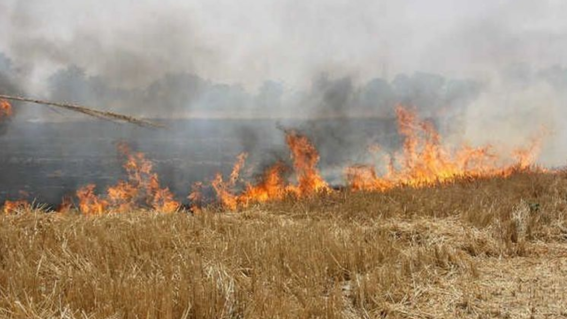
4 November 2026 Punjab Khabarnama Bureau : Punjab recorded its highest single-day number of stubble-burning incidents this season on November 3, with 584 farm fires detected in 24 hours. The sharp rise came as Delhi’s air quality deteriorated to the ‘Very Poor’ category, with the Air Quality Index (AQI) touching 350, its worst reading in 287 days.
According to satellite-based data cited in reports, Punjab’s seasonal farm-fire count rose to 2,196 between September 15 and November 3. Despite the latest spike, the total remains below the 2,518 incidents recorded during the corresponding period last year.
The developments have renewed concerns over crop-residue burning and its contribution to air pollution across northern India. They have also triggered a political exchange between the governments of Punjab and Delhi over responsibility for the worsening air quality.
Ferozepur, Bathinda and Sangrur among major hotspots
The latest incidents were reported across several districts of Punjab. Ferozepur recorded 112 farm fires on November 3, followed by Bathinda with 80 and Sangrur with 78. Tarn Taran reported 56 incidents.
The figures indicate that the problem is no longer confined to a few districts and has spread across parts of the Malwa belt as well.
Punjab’s seasonal count has increased sharply in recent days. The state recorded 292 farm fires on October 31, followed by 175 on November 1 and 98 on November 2, before the number jumped to 584 on November 3.
The comparison with previous years presents a mixed picture. While the cumulative number of fires remains lower than last year, the latest daily spike is significantly higher than the corresponding dates in 2024 and 2025.
Delhi AQI reaches 350, worst level in 287 days
Delhi’s air quality slipped further into the ‘Very Poor’ category on Tuesday, with the AQI reaching 350. According to the Central Pollution Control Board (CPCB), particulate matter PM2.5 was the dominant pollutant at several monitoring locations.
The deterioration has been linked to a combination of factors, including unfavourable weather conditions, local pollution sources and smoke from agricultural fires in neighbouring regions.
The Commission for Air Quality Management (CAQM) had already invoked Stage II of the Graded Response Action Plan (GRAP) across Delhi-NCR after the capital’s air quality entered the ‘Very Poor’ category on November 2.
Under GRAP Stage II, authorities are required to intensify measures such as mechanical road sweeping, water sprinkling to control dust, inspections at construction sites and steps to reduce traffic-related emissions.
The Air Quality Early Warning System under the Ministry of Earth Sciences has forecast that Delhi’s air quality is likely to remain in the ‘Very Poor’ category from November 4 to November 6.
Stubble burning’s contribution to Delhi pollution
Stubble burning is one of the seasonal contributors to air pollution in Delhi-NCR, although it is not the only source. According to the Decision Support System (DSS) for Delhi, crop-residue burning contributed around 8.6 per cent to the capital’s PM2.5 pollution on November 2. Its contribution was forecast to rise in the following days.
Vehicular emissions, road dust, construction activity, industrial emissions and residential pollution also add to the city’s overall pollution load.
Weather conditions play an important role in determining how quickly pollutants disperse. Low wind speeds, temperature conditions and atmospheric mixing can allow pollution to accumulate near the surface, worsening air quality even when emissions do not rise at the same rate.
CAQM issues notices to Punjab officials
The rising number of farm fires has also prompted action from the Commission for Air Quality Management. The commission issued show-cause notices to the Deputy Commissioners and Senior Superintendents of Police of Gurdaspur and Kapurthala, seeking explanations over the increase in stubble-burning incidents and the enforcement measures taken to prevent them.
The officials have been asked to submit their responses by November 6.
The CAQM also raised concerns over the situation in Tarn Taran, which recorded 797 farm-fire incidents between September 11 and October 29, compared with 296 during the corresponding period last year. The commission sought details of preventive measures, field-level monitoring and corrective action.
The notices have put the spotlight on the implementation of the state’s anti-stubble-burning action plan, including surveillance in hotspot villages and the deployment of crop-residue management machinery.
Political blame game between BJP and AAP
The worsening air quality has triggered a political exchange between the BJP and the Aam Aadmi Party.
Delhi Environment Minister Manjinder Singh Sirsa accused the Punjab Government of failing to control stubble burning. He also alleged that Punjab Police personnel were helping farmers set crop residue on fire, a charge that has not been independently established.
The AAP rejected the allegations, accusing the BJP of shifting responsibility for Delhi’s pollution onto Punjab’s farmers. Party leaders argued that Delhi’s air quality is influenced by several local and regional pollution sources and demanded evidence for the allegations.
The dispute comes as authorities in both states face pressure to control pollution during the peak post-harvest period.
Farm fires remain a concern despite lower seasonal count
The latest figures underline the challenge of managing paddy residue in Punjab. Although the seasonal count remains below last year’s level, the sudden increase in daily incidents has raised concerns about enforcement and the availability and use of alternatives to burning.
Farmers’ organisations have repeatedly sought greater financial support and incentives for managing crop residue, while authorities have promoted machinery and other methods to reduce dependence on burning.
With Delhi’s air quality expected to remain ‘Very Poor’ over the next few days, attention will remain on farm-fire trends, weather conditions and the effectiveness of pollution-control measures across the region.