

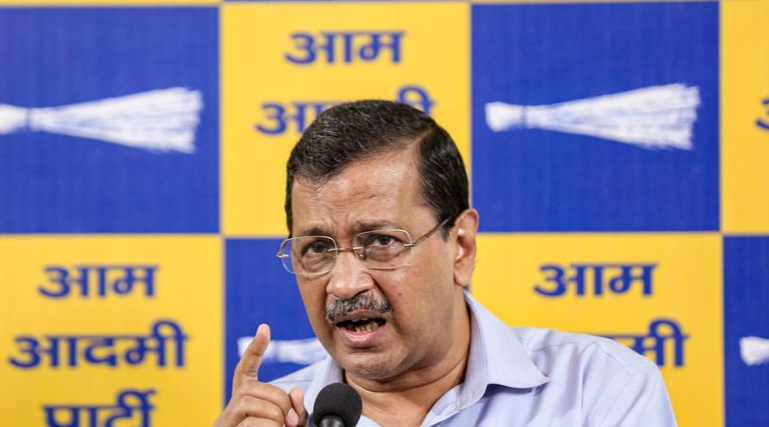
13 October 2026 Punjab Khabarnama Bureau : The Aam Aadmi Party (AAP) has approached the Akal Takht, seeking action against Union Home Minister Amit Shah over the controversy surrounding Delhi Police personnel’s entry into Gurdwara Bangla Sahib. The development comes after Delhi Police registered a First Information Report (FIR) against AAP convenor Arvind Kejriwal and other party leaders over an alleged political protest at the gurdwara.
The controversy has triggered a political confrontation between the AAP and the Bharatiya Janata Party (BJP), with both sides presenting competing accounts of the incident. At the centre of the dispute are allegations concerning the sanctity of the Sikh shrine, the conduct of protesters and the circumstances surrounding police action.
AAP Seeks Akal Takht’s Intervention
On October 12, a delegation of Punjab AAP legislators submitted a memorandum to the Akal Takht secretariat in Amritsar, urging the Sikh religious authority to take cognisance of the incident and summon Amit Shah for accountability.
The delegation was led by AAP MLA Dr Inderbir Singh Nijjar. The legislators alleged that Delhi Police personnel entered the premises of Gurdwara Bangla Sahib with their shoes on and their heads uncovered, which they described as a violation of Sikh religious traditions.
AAP leaders argued that the incident had hurt the religious sentiments of the Sikh community and called for action against those responsible. They also pointed to the Union Home Ministry’s administrative responsibility for Delhi Police while demanding that Shah be called to explain the circumstances surrounding the police action.
The party’s appeal to the Akal Takht has added a religious dimension to what was already a politically sensitive dispute. However, the allegations concerning the conduct of police personnel and the Home Minister’s responsibility remain matters of contention.
Why the Bangla Sahib Incident Became Controversial
The dispute relates to events at Delhi’s Gurdwara Bangla Sahib on October 10, when people participating in a protest over alleged electoral-roll irregularities reportedly took shelter at the shrine.
According to the Delhi Sikh Gurdwara Management Committee (DSGMC), protesters allegedly raised political slogans inside the gurdwara premises. The committee claimed that individuals associated with the AAP subsequently circulated videos and social media posts that presented a misleading account of what had happened.
AAP leaders, meanwhile, criticised the police action and alleged that officers entered the shrine without observing the religious protocols expected at a gurdwara.
The two sides have therefore offered different interpretations of the incident. The DSGMC has focused on the alleged political use of the religious premises, while the AAP delegation has emphasised the importance of respecting Sikh religious traditions during police operations.
The competing claims have made the examination of video footage and other evidence important to establishing the sequence of events.
FIR Registered Against Arvind Kejriwal and Other AAP Leaders
The Delhi Police registered an FIR following a complaint filed by the DSGMC against Kejriwal, AAP legislators, party workers and other individuals over the alleged disruption at Bangla Sahib.
The complaint alleged that protesters entered the gurdwara premises in a coordinated manner, raised political slogans and disturbed the sanctity of the religious site. It also raised concerns about videos and social media posts that allegedly misrepresented the incident.
The DSGMC asked the police to identify those involved, preserve relevant evidence and investigate who organised and directed the protest. Delhi Police has begun examining the video footage submitted with the complaint.
The registration of an FIR marks the beginning of a formal investigation into the allegations. It does not, by itself, establish the guilt of the individuals named in the complaint. The allegations will need to be examined through the applicable legal process.
DSGMC Disputes AAP’s Account
The DSGMC has rejected the suggestion that police personnel were responsible for violating the shrine’s sanctity in the manner alleged by AAP leaders.
Committee president Harmeet Singh Kalka maintained that the controversy should be viewed in the context of the alleged political protest inside the gurdwara. He argued that the religious premises should not be used for political demonstrations.
The committee also called for those responsible for the alleged disruption to be identified and investigated. Its position is that the sanctity of the gurdwara was compromised by political activity within the premises.
The competing accounts have made the incident a subject of wider debate, particularly over the responsibilities of political parties and law enforcement agencies when protests intersect with religious spaces.
An impartial examination of the available footage and the accounts of those present will be important in clarifying the circumstances.
BJP Hits Back at AAP
The BJP’s Punjab unit criticised AAP’s demand to summon Amit Shah before the Akal Takht, describing the move as misleading and accusing the ruling party in Punjab of politicising religious sentiments.
BJP spokesperson Sarchand Singh also argued that the AAP legislators were seeking political mileage from a sensitive religious issue. The party welcomed the registration of the FIR against Kejriwal and other AAP leaders following the DSGMC complaint.
The BJP’s response has further intensified the political exchange between the two parties. While AAP has demanded accountability over the alleged police conduct, the BJP has focused on the alleged political protest and the use of the gurdwara premises.
These positions remain competing political claims, and the allegations against the individuals involved have yet to be conclusively established through the investigation.
Sikh Religious Sentiments at the Centre of the Dispute
Gurdwara Bangla Sahib is one of Delhi’s most prominent Sikh religious sites and holds considerable religious and historical significance. Observance of established practices, including removing footwear and covering one’s head, is an important part of showing respect when entering a gurdwara.
The controversy has consequently prompted discussion about how law enforcement agencies should conduct operations around religious institutions and how political parties should handle protests in such sensitive locations.
The AAP delegation also referred to painful memories associated with the 1984 attacks on Sikh religious institutions, arguing that the latest incident had caused renewed concern within the community.
At the same time, the dispute has raised questions about the boundaries between religious authority, political accountability and the investigation of alleged unlawful activity. Any assessment of responsibility will require attention to the available evidence and the circumstances of the incident.
What Happens Next?
The immediate developments involve two parallel processes: the Delhi Police investigation into the allegations made by the DSGMC and the memorandum submitted by AAP leaders to the Akal Takht.
The police investigation will examine the complaint, video footage and other relevant evidence concerning the alleged protest. Separately, the Akal Takht will have to consider the memorandum and determine whether any further action is warranted within its authority.
For AAP, the demand for action against Amit Shah is part of its response to what it describes as a violation of Sikh religious traditions. For the BJP and the DSGMC, the focus remains on the allegations of political disruption inside the gurdwara.
The controversy has placed religious respect, political rivalry and legal accountability at the centre of Punjab’s political discourse. The outcome will depend on the evidence gathered by investigators and any subsequent response from the relevant religious and political authorities.