

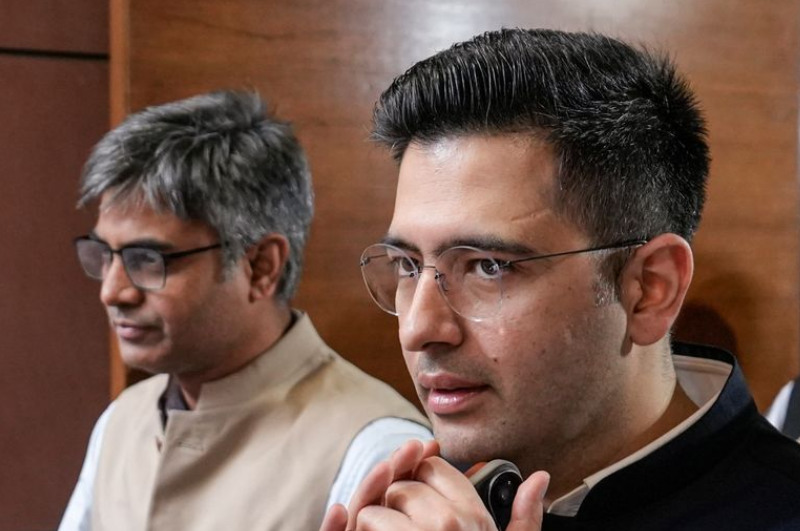
27 April 2026 Punjab Khabarnama Bureau : The Aam Aadmi Party (AAP) is grappling with growing internal challenges in Punjab, where loyalty lines drawn around senior leaders Raghav Chadha and Sandeep Pathak are beginning to test the unity of the party’s 94 MLAs. While AAP swept to power in Punjab with a massive mandate, recent developments suggest that maintaining cohesion within such a large legislative group is proving increasingly difficult.
Sources within the party indicate that informal factions have started taking shape, with some legislators aligning more closely with Raghav Chadha, who has played a significant role in strategizing and managing Punjab affairs, while others are seen as being closer to Sandeep Pathak, the party’s national general secretary (organisation), who has been instrumental in strengthening the party’s structure and grassroots network.
These emerging loyalty blocs are not yet formalized, but their influence is being felt in internal decision-making processes, ticket distribution debates, and even in governance-related discussions. The situation is particularly sensitive as Punjab remains one of AAP’s most significant political strongholds, and any sign of disunity could have broader implications for the party’s national ambitions.
The issue of ticket distribution has been a major flashpoint. With upcoming elections and organizational reshuffles on the horizon, MLAs and party workers are keenly watching how tickets will be allocated. Allegations of favoritism or bias toward certain groups have fueled discontent among some leaders, who feel sidelined despite their contributions to the party’s success in the state.
Several MLAs have reportedly raised concerns about lack of communication and transparency in decision-making. Some feel that centralized control from the party’s national leadership is limiting their ability to address local issues effectively. This has led to murmurs of dissatisfaction, particularly among those who believe that regional leaders should have greater autonomy.
At the same time, senior party leaders have downplayed the reports of divisions, emphasizing that differences of opinion are natural in a large political organization. They insist that the party remains united under its core ideology and leadership, and that any disagreements are being addressed internally through dialogue and consensus-building.
Observers note that managing a large legislative majority comes with its own set of challenges. With 94 MLAs, AAP has an overwhelming presence in the Punjab Assembly, but this also means balancing diverse interests, ambitions, and expectations. Ensuring that all legislators feel heard and valued is critical to maintaining unity.
The leadership is reportedly taking steps to address these concerns. Regular meetings, feedback mechanisms, and efforts to improve coordination between the state and central leadership are being strengthened. There is also a focus on reinforcing party discipline and aligning all members with the broader goals of governance and development.
Political analysts believe that how AAP navigates this phase will be crucial for its future in Punjab. The party came to power on the promise of clean governance, transparency, and a break from traditional politics. Any perception of internal discord could undermine public confidence and provide an opportunity for opposition parties to regain ground.
Moreover, Punjab’s political landscape is highly competitive, with established parties closely monitoring AAP’s internal dynamics. A divided house could weaken the government’s ability to implement policies effectively and respond to key issues such as law and order, economic challenges, and social welfare.
Despite these challenges, there are also signs of resilience within the party. Many MLAs remain committed to the party’s vision and are working actively to strengthen its grassroots presence. Efforts to engage with constituents, address local concerns, and deliver on election promises continue to be a priority for the government.
Ultimately, the coming months will be a test of AAP’s organizational strength and leadership. The ability to manage internal differences while maintaining a unified front will determine whether the party can sustain its dominance in Punjab and expand its footprint elsewhere in the country.
For now, the focus remains on bridging gaps, fostering unity, and ensuring that the party’s internal dynamics do not overshadow its governance agenda. As AAP navigates this complex phase, its approach to handling internal dissent and leadership rivalries will be closely watched by both supporters and critics alike.
Summary
AAP faces internal strain in Punjab as MLA loyalties to Raghav Chadha and Sandeep Pathak create divisions, challenging unity and raising concerns over governance and future political stability.