

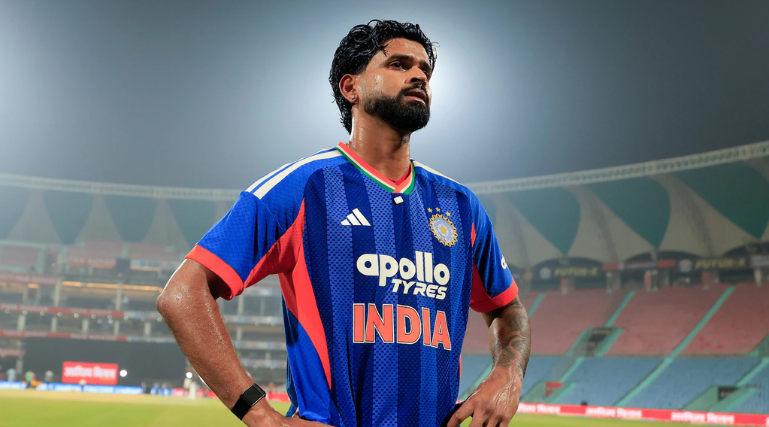
12 October 2026 Punjab Khabarnama Bureau : India registered a 14-run victory over the West Indies in the third T20 International at Holkar Stadium in Indore, but captain Shreyas Iyer made it clear that the team still has areas to improve. Despite taking a 2-1 lead in the five-match series, Iyer stressed the importance of maintaining concentration, avoiding complacency and executing plans consistently throughout the match.
The Indian team produced a strong batting performance before its bowlers stepped up to defend a challenging total. However, the West Indies’ aggressive chase demonstrated why India cannot afford to relax, even when defending a substantial score.
India Post 223 Runs After Strong Batting Performance
Batting first, India posted an imposing total of 223 runs, putting the visitors under pressure from the outset. The innings was powered by aggressive contributions from Abhishek Sharma and Ishan Kishan, who helped establish a strong platform for the middle order and finishers.
Abhishek Sharma delivered one of the standout performances of the match, scoring 69 runs off just 30 deliveries. His attacking approach during the powerplay gave India early momentum and allowed the team to build a competitive total.
Ishan Kishan added 37 runs from 18 balls, continuing the aggressive approach and ensuring that the scoring rate remained high. Their contributions proved particularly important on a ground where high-scoring matches are common.
Towards the end of the innings, Prince Yadav contributed an unbeaten 13-run cameo, adding valuable runs that strengthened India’s position.
The Indian batting unit demonstrated its ability to apply pressure through attacking cricket. Nevertheless, Iyer’s post-match assessment indicated that the team must continue following its plans rather than assuming that a large total automatically guarantees victory.
West Indies Fight Back in the Run Chase
Chasing 224 runs for victory, the West Indies needed an aggressive start and sustained partnerships to remain in contention. India made an early breakthrough by dismissing captain Shai Hope, with Arshdeep Singh leading the bowling effort.
However, the visitors refused to surrender easily. Nicholas Pooran and Shimron Hetmyer mounted a strong challenge, putting pressure on India’s bowlers and keeping the required run rate within reach for significant periods of the innings.
Pooran scored 42 runs, while Hetmyer contributed 43. Their attacking batting helped the West Indies recover after losing an early wicket and created a tense contest in the middle overs.
The visitors’ ability to score quickly highlighted the danger of taking their batting lineup lightly. Even when the required target appears difficult, West Indies batters have the power to change the direction of a T20 match within a few overs.
India’s bowlers therefore had to remain disciplined and focused, particularly when the opposition began finding boundaries regularly. The contest became a test of execution under pressure rather than simply a matter of defending a big total.
Arshdeep Singh Leads India’s Bowling Effort
Arshdeep Singh emerged as one of India’s most influential performers, finishing with figures of three wickets for 44 runs. His ability to take important wickets at crucial moments helped India regain control when the West Indies threatened to turn the contest around.
Naman Dhir also played a valuable role, claiming two wickets. Although the West Indies attacked him during the middle overs, he responded by dismissing Nicholas Pooran after the batter had struck three sixes in an over.
That breakthrough was important because it interrupted the opposition’s momentum and prevented the partnership from becoming even more dangerous.
India’s bowlers eventually restricted the West Indies to 209 for seven, securing a 14-run victory. The result demonstrated the value of taking wickets at critical stages instead of relying solely on defending the required run rate.
Shreyas Iyer Highlights the Need for Consistency
While Iyer expressed satisfaction with the result, his comments after the match underlined the importance of avoiding complacency. He praised the bowlers for their confidence, clear plans and determination to execute their responsibilities.
According to Iyer, the bowlers showed a positive mindset and were prepared to take on the challenge when given the ball. He also acknowledged the contributions of Abhishek Sharma, Ishan Kishan and Prince Yadav, whose runs helped India reach a formidable total.
However, the captain’s message was that India must maintain the same intensity throughout the game. The team cannot afford to assume that it has secured a victory simply because it has scored more than 200 runs.
The final stages of the West Indies innings reinforced that point. The visitors scored 22 runs in the last over, showing how quickly a seemingly comfortable position can become uncomfortable in T20 cricket.
Such passages of play can make a difference in close contests, particularly when opponents possess aggressive batters capable of striking multiple boundaries in succession.
For India, the lesson is not necessarily to abandon its attacking approach but to combine that aggression with greater consistency in execution. Bowlers must continue targeting their plans, while fielders and captains need to remain alert to changing match situations.
Iyer’s assessment also reflected the broader challenge of managing high-scoring matches. On batting-friendly surfaces, even totals above 220 may not provide complete security, meaning teams must stay focused until the final delivery.
India Take 2-1 Lead in Five-Match Series
The victory gives India a 2-1 lead in the five-match T20I series, placing the team in a strong position ahead of the remaining fixtures. The result also provides encouragement to the bowling unit after the West Indies demonstrated their ability to chase a demanding target.
India will look to build on the positives from the third match, particularly its aggressive batting, timely breakthroughs and ability to respond when the opposition threatened.
At the same time, the team will need to address the lapses that allowed the West Indies to remain competitive late in the innings.
For Iyer, the priority will be ensuring that the players maintain their discipline and avoid underestimating their opponents. The West Indies have already shown that they can put pressure on India, making concentration and adaptability essential.
India’s win was significant, but the captain’s message was equally important: a strong performance must be sustained from the first ball to the last. With the series still underway, maintaining that standard could prove decisive in determining the eventual winner.