

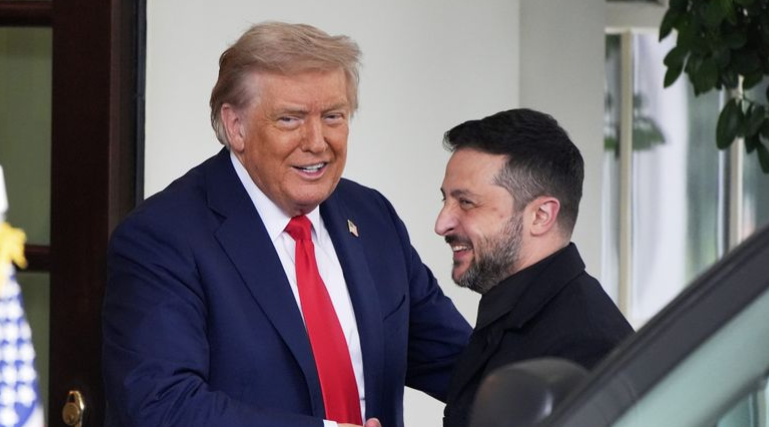
12 October 2026 Punjab Khabarnama Bureau : US President Donald Trump has announced that Russia and Ukraine have agreed to an “energy ceasefire” effective immediately, claiming that both sides would halt attacks on each other’s energy infrastructure. However, the announcement has been met with uncertainty, as Ukraine said it was awaiting further details and reported continued Russian strikes on energy facilities.
Trump made the announcement on October 11, 2026, through a post on his Truth Social platform. He offered no specific details about the proposed arrangement, including its duration, monitoring mechanism or the conditions under which it would be implemented. Neither Moscow nor Kyiv initially confirmed that a formal agreement had been reached. <Cite refs={[“turn564437news14″,”turn564437search11”]}/>
Trump announces immediate ceasefire
In his social media post, Trump stated that an energy ceasefire in the Russia-Ukraine war was taking effect immediately and claimed that both parties had agreed to it. He also warned the two sides not to violate the arrangement.
The announcement came amid continuing attacks on energy infrastructure, including facilities linked to electricity generation, fuel production and distribution. Such infrastructure has remained a significant target throughout the conflict, with damage affecting essential services and adding pressure on both countries.
An energy ceasefire would aim to reduce attacks on facilities critical to civilian life and economic activity. However, its practical impact would depend on the precise terms, the willingness of both sides to comply and whether a mechanism could be established to verify violations.
Trump’s statement did not clarify whether the proposed arrangement covered all energy infrastructure or only specific categories of facilities.
Zelenskyy says Ukraine supports the proposal
Ukrainian President Volodymyr Zelenskyy said Ukraine supported the ceasefire but was waiting for details from the US administration. His response indicated that Kyiv was prepared to consider the arrangement, while stressing that Russia would also need to observe it.
Zelenskyy has repeatedly argued that Ukraine would be willing to stop attacks on Russian energy facilities if Moscow halted its strikes against Ukraine’s energy system.
Following Trump’s announcement, Zelenskyy said that Ukraine supported steps towards de-escalation and the protection of civilian lives. He also stressed the importance of reciprocal commitments rather than a unilateral halt to Ukrainian operations.
The Ukrainian leadership’s response highlighted a key uncertainty surrounding the announcement: whether Russia had formally accepted the same conditions and whether the proposed ceasefire would be implemented in practice. <Cite refs={[“turn564437search11″,”turn564437news12”]}/>
Russian position remains unclear
At the time of the initial announcement, the Kremlin had not publicly confirmed that Russia had agreed to the proposed energy ceasefire. The absence of a detailed statement from Moscow left questions about the scope and enforcement of the arrangement.
A formal understanding would generally require clarity on which facilities are covered, when restrictions begin, how alleged violations are assessed and what steps would follow if attacks continue.
Without such details, it remained difficult to determine whether Trump’s announcement represented a mutually agreed arrangement or an initiative that still required further diplomatic negotiations.
The lack of immediate confirmation from Russia also complicated efforts to assess whether the announcement would lead to a sustained reduction in attacks.
Reports of continued strikes raise doubts
Developments on the ground added to the uncertainty surrounding the proposed ceasefire. Zelenskyy reported that Russian attacks on Ukrainian energy infrastructure continued after Trump’s announcement, including strikes affecting facilities in Kyiv and Kharkiv.
The reported attacks raised questions about whether the proposed arrangement had been communicated to both sides, whether it had formally entered into force and whether any commitments were being observed.
Continued strikes do not, by themselves, establish the full status of the proposed agreement, particularly when its terms and implementation arrangements have not been made public. However, they underscore the difficulty of translating a political announcement into an effective halt to military operations.
The situation also highlights the vulnerability of energy facilities during the conflict, especially as Ukraine approaches the colder months, when reliable electricity and heating become increasingly important for civilians.
Energy infrastructure at the centre of the conflict
Russia and Ukraine have repeatedly targeted energy-related infrastructure during the war. Attacks on power plants, electricity networks, refineries and fuel facilities can affect military logistics as well as civilian services and wider economic activity.
For Ukraine, damage to electricity generation and distribution can disrupt homes, hospitals, businesses and public services. For Russia, attacks on refineries and other energy facilities can affect fuel production and distribution.
An effective energy ceasefire could therefore reduce some immediate risks to civilian infrastructure. Nevertheless, it would represent a limited measure unless accompanied by broader progress towards ending the war.
A halt to energy-related strikes would not automatically mean that fighting along the front lines or attacks on other military targets had stopped. The distinction is important because no comprehensive ceasefire was established by Trump’s announcement alone.
Diplomatic efforts face further challenges
The announcement came during a period of strained relations between Trump and Zelenskyy, including disagreements over Ukrainian attacks on Russian refineries and Washington’s approach to ending the conflict.
Zelenskyy has maintained that Ukraine is willing to take steps towards de-escalation if Russia makes reciprocal commitments. He has also emphasised the need for credible guarantees that any agreement will be respected.
For the United States, efforts to secure a reduction in attacks on energy infrastructure could offer a limited diplomatic opening. However, the initiative’s success will depend on direct engagement with Moscow and Kyiv, clearly defined conditions and evidence of compliance.
International observers will be watching for official confirmation, details about the arrangement and any sustained reduction in attacks.
What happens next?
The immediate priority is to establish whether Russia and Ukraine have formally accepted the same terms and whether those terms are being implemented. Further statements from Moscow, Kyiv and Washington could clarify the proposal’s duration, scope and monitoring arrangements.
If both sides observe an energy ceasefire, it could offer some protection to critical infrastructure and reduce the risk of further disruptions to civilian services. If attacks continue, questions about enforcement and the credibility of the arrangement are likely to intensify.
For now, Trump’s announcement has raised the possibility of a limited pause in attacks on energy infrastructure, but the lack of clearly established terms and reports of continued strikes mean that its effectiveness remains uncertain. A lasting reduction in hostilities will require verifiable commitments from both sides and progress beyond the announcement itself.