

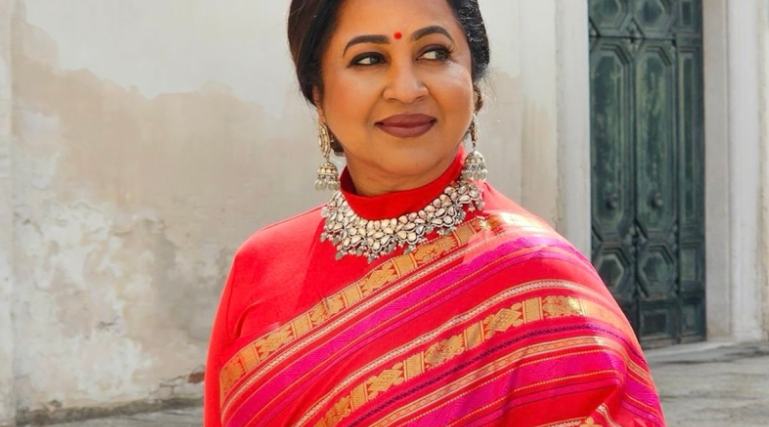
21 Aug 2026 Punjab Khabarnama Bureau : Few actors in Indian cinema have managed to remain relevant across five decades, multiple languages and three generations of audiences quite like Radikaa Sarathkumar. From sharing the screen with Rajinikanth and Kamal Haasan in the 1980s to working with stars such as Vijay and Suriya, her career reflects the remarkable evolution of South Indian cinema.
A Career That Has Spanned Five Decades
Radikaa began her acting journey in the late 1970s and went on to establish herself as one of the most dependable performers in South Indian cinema.
Over the years, she has worked across Tamil, Telugu, Malayalam, Kannada and Hindi, demonstrating an ability to adapt to different industries, filmmaking styles and audiences.
Her longevity is particularly notable in an industry where leading roles and opportunities can change rapidly with age and changing audience tastes.
From Rajinikanth and Kamal Haasan to a New Generation
Radikaa’s filmography connects several generations of Indian cinema.
In the 1980s, she appeared alongside major stars including Rajinikanth and Kamal Haasan. Decades later, she continued to share screen space with younger stars, including Vijay and Suriya.
This ability to remain part of mainstream cinema across generations has become one of the defining features of her career.
More Than Just a Supporting Actor
Radikaa’s contribution goes beyond simply appearing in films as a supporting performer.
Throughout her career, she has taken on roles that require emotional depth, authority and a strong screen presence. Her characters have often been central to the emotional or family dynamics of a story.
That versatility has allowed her to move comfortably between commercial cinema, family dramas and television.
A Strong Presence Across Five Languages
Working across five major Indian languages has further strengthened Radikaa’s position as a pan-South Indian performer.
Rather than being identified exclusively with one film industry, she has built recognition among audiences across linguistic boundaries.
Her career demonstrates how an actor can remain relevant by continually adapting to different cinematic cultures.
Three Generations Have Watched Her Work
One of the strongest indicators of Radikaa’s impact is the number of generations that have grown up watching her performances.
Audiences who first encountered her films in the 1980s have seen her continue working through the 1990s and 2000s, while younger viewers have discovered her through more recent films and television projects.
This continuity has made her a familiar face across generations.
The Changing Role of Women in Indian Cinema
Radikaa’s career also reflects the changing opportunities available to women in Indian cinema.
She has transitioned from playing younger leading characters to portraying mothers, authority figures and complex older women without losing her distinctive screen presence.
That transition is significant because actresses have historically faced fewer opportunities to remain prominent as they age.
Television Added Another Dimension
Radikaa also became a major presence on Indian television, particularly through Tamil serials.
Her television work helped her connect with audiences beyond theatrical cinema and strengthened her status as a household name.
The move between cinema and television demonstrated another aspect of her adaptability.
Why She Remains Difficult to Replace
Radikaa’s uniqueness comes from a combination of experience, versatility, language skills and screen presence.
There are many talented actors working today, but few possess a career that combines five decades of experience with familiarity across multiple generations and film industries.
Her ability to make even supporting roles memorable has further strengthened her reputation.
An Enduring Legacy
Radikaa Sarathkumar’s career is ultimately a story of reinvention.
She has remained relevant despite enormous changes in Indian cinema, from the superstar-driven films of the 1980s to today’s multi-language productions and streaming-focused entertainment landscape.
Her continued presence is a reminder that longevity in cinema is not simply about surviving the industry—it is about continuously finding new ways to belong in it.