

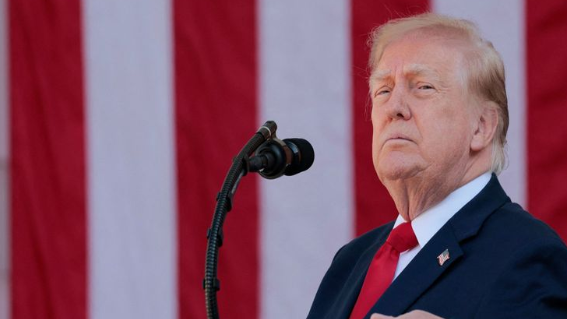
26 November 2026 Punjab Khabarnama Bureau : US President Donald Trump has criticised former President Barack Obama over the storage of nearly five tonnes of unstable explosives at a military facility in Iowa, claiming that no carcinogens were released into the atmosphere following the US Army’s controlled detonation of the hazardous material.
Trump praised the military operation in a post on his Truth Social platform on Thursday, November 26, describing it as a successful detonation. He credited the US Army and other government agencies for carrying out the operation and claimed that the blast did not release harmful carcinogenic substances into Iowa’s air.
His remarks came after federal authorities reported that environmental monitoring systems had detected no airborne lead following the controlled explosion at the Iowa Army Ammunition Plant in Middletown.
The operation had attracted considerable public attention because of concerns about potential environmental contamination and the possible impact of toxic lead particles on nearby communities.
Trump Criticises Obama Over Explosives Stored in Iowa
In his Truth Social post, Trump took a direct swipe at the previous administration while celebrating the outcome of the military operation.
He wrote that 0.000 per cent of what he described as Obama-caused carcinogens had been released into Iowa’s air following the detonation. He also praised the Army and other personnel, saying that everyone had worked hard to ensure the operation’s success.
The Trump administration has blamed the previous administration for the storage of the hazardous explosives at the Iowa facility in 2009.
The White House also credited Trump’s leadership and coordination among federal agencies for the successful execution of the operation.
US Army Destroys Nearly Five Tonnes of Explosives
The US Army conducted two controlled detonations on Wednesday, November 25, at the Iowa Army Ammunition Plant in Middletown.
The operation involved 68 barrels containing nearly five tonnes of degraded lead azide, a highly unstable chemical commonly used in explosives.
The material had reportedly been stored at the facility since around 2009. Over time, its condition deteriorated, making its handling and transportation increasingly dangerous.
Military officials warned that moving the material or attempting to open the containers for chemical treatment could potentially trigger an uncontrolled explosion.
Authorities therefore decided that a carefully planned and controlled detonation was the safest available option to eliminate the threat.
The two detonations were conducted at approximately 9 am local time under extensive safety arrangements. Officials had also deployed specialised equipment and personnel to minimise the potential spread of hazardous particles.
According to the US Army, the operation successfully destroyed the targeted material without secondary explosions or damage to infrastructure at the facility.
EPA Reports Zero Airborne Lead Detection
Following the explosion, the US Environmental Protection Agency (EPA) reported that its real-time air monitoring systems had detected zero airborne lead in the surrounding region.
EPA Administrator Lee Zeldin said monitoring continued throughout the operation and that the agency’s equipment did not register detectable airborne lead after the detonation.
According to the agency, approximately 1,200 samples of land, air, dust and water had been collected before the explosion to establish baseline environmental conditions.
Around 300 EPA personnel and contractors were also deployed to support environmental monitoring before, during and after the operation.
The agency confirmed that additional teams had returned to the field to collect further samples and assess possible environmental changes.
Officials said monitoring would continue over the coming days to provide more information about the operation’s environmental impact.
However, the initial zero airborne-lead readings do not mean that all environmental testing has been completed. Soil, water and other samples still require assessment.
Why Did the Iowa Explosives Detonation Become Controversial?
The Army’s decision to destroy the explosives through controlled detonations faced opposition from environmental organisations and local residents.
Concerns were raised about the possibility of toxic lead dust spreading through the air and settling on nearby homes, agricultural land, livestock and water sources.
The proposed operation also triggered legal challenges, protests and public discussions about the environmental risks associated with destroying such a large quantity of hazardous material.
A federal court initially intervened in the process, temporarily blocking the planned operation over environmental and public health concerns. However, an appeals court subsequently cleared the way for the Army to proceed.
The operation was postponed several times before finally taking place on November 25.
Authorities also arranged temporary relocation assistance for residents living in the designated evacuation zone around the facility.
The Army and federal agencies maintained that the deteriorated explosives presented a serious safety risk and that controlled destruction was preferable to leaving the unstable material in storage.