

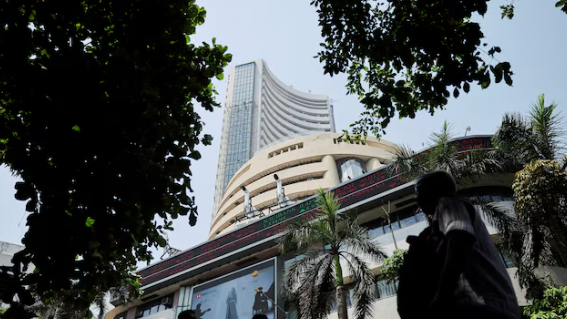
23 November 2026 Punjab Khabarnama Bureau : Indian stock markets declined on Monday, November 23, as investors started booking profits after a strong four-week rally. Heavy selling in banking, financial and metal stocks dragged the benchmark indices lower, reversing their early morning gains. The decline came despite continued foreign investor interest in Indian equities and relatively easing crude oil prices.
The benchmark Nifty 50 and BSE Sensex opened the trading session on a positive note but soon came under selling pressure. According to Reuters, by 10:16 AM IST, the Nifty 50 had fallen 0.65% to 25,636, while the Sensex declined 0.61% to 83,417.69.
Both indices had gained around 0.8% during early trading before reversing their direction. The selling pressure was visible across several sectors, indicating that investors were using the recent market gains as an opportunity to book profits.
Banking and Financial Stocks Lead Market Decline
Banking and financial stocks were among the biggest contributors to Monday’s market weakness. These sectors had recorded substantial gains during the previous four weeks, making them vulnerable to profit-booking.
The Nifty Bank and Nifty Private Bank indices declined 1.9% each. Both sectors had gained approximately 19% during the previous four weeks.
The financial services sector also witnessed selling, declining 1.3% during the session. Public sector banks faced additional pressure, with the corresponding index falling 2.4%.
The banking sector has been an important driver of the recent rally in Indian equities. However, investors appeared willing to reduce their exposure after the strong gains recorded in November.
Four-Week Rally Faces Temporary Pause
Indian equity markets had experienced a strong recovery over the previous four weeks, supported by renewed foreign investment, improving corporate earnings and relatively stable economic growth.
The Nifty 50 and Sensex had continued their upward movement despite weakness in several international markets.
According to Reuters, the two benchmark indices remained higher by 11.4% and 12.2%, respectively, during November despite Monday’s decline.
The recent rally had also attracted considerable foreign institutional investment. Foreign investors purchased Indian shares worth a record $13 billion during November, providing significant support to domestic markets.
However, after such a strong upward movement, investors appeared cautious about maintaining their positions at elevated market levels.
Metal Stocks Also Under Pressure
Metal stocks were another major source of weakness during Monday’s trading session. The Nifty Metal index declined 2.4%, reflecting pressure from falling international metal prices and a stronger US dollar.
Global market uncertainty also affected investor sentiment. Concerns about the outlook for artificial intelligence-related investments and the possibility of higher US interest rates contributed to selling pressure across several Asian markets.
Tata Steel was among the notable losers, declining 5.5% during the session. APL Apollo Tubes also witnessed a sharp fall of 14.9%.
The weakness in metal shares added to the overall pressure on the Indian stock market.
Foreign Investor Buying Supports Indian Equities
Despite Monday’s decline, foreign institutional investors have remained important supporters of the Indian stock market.
Foreign investors purchased Indian shares worth approximately ₹10,308 crore ($1.11 billion) on Friday, according to provisional exchange data. Their total investment in Indian equities reached a record $13 billion during November.
The renewed foreign buying has helped reduce year-to-date foreign investment outflows to approximately $18.4 billion.
Indian equities have attracted international investors partly because of their relatively limited exposure to the global artificial intelligence stock selloff. Investors looking to diversify their portfolios have increasingly considered Indian markets as an alternative destination.
Improving corporate earnings and steady economic growth have also supported investor confidence.
Broader Market Also Witnesses Selling
The weakness was not limited to banking and metal stocks. Selling pressure extended across the broader market, with 14 of the 16 major sectoral indices recording losses.
Small-cap and mid-cap indices also declined approximately 0.6% each.
This indicates that investors were reducing exposure to several categories of stocks following the recent rally.
Market participants are closely monitoring international developments, foreign investment activity and upcoming economic data to assess the next direction of domestic equities.
Tata Steel and APL Apollo Shares Decline
Among individual stocks, Tata Steel and APL Apollo Tubes attracted attention after witnessing significant declines.
Tata Steel shares fell 5.5%, while APL Apollo Tubes dropped 14.9%.
The movement followed Tata Steel’s announcement that it would acquire an initial 26.38% stake in APL Apollo for approximately $1.67 billion. The development is linked to Tata Steel’s plan to expand its downstream steel business following an agreement to sell its tubes and colour-coated steel business to APL Apollo.
The announcement added to stock-specific activity during an already volatile trading session.
Analysts Warn of Further Market Consolidation
Market experts believe that the recent rally has increased the possibility of short-term corrections and consolidation.
Both the Sensex and Nifty had spent considerable time in overbought territory during November. Such conditions can encourage investors to book profits after sustained gains.
Hitesh Tailor, a research analyst at Choice Broking, noted that strengthening bullish momentum could still be accompanied by intermittent profit-booking or consolidation because of elevated relative strength index levels.
Investors are therefore expected to remain attentive to market valuations, global economic developments and institutional investment trends.
What Lies Ahead for the Indian Stock Market?
The coming trading sessions will be important in determining whether Monday’s decline represents a temporary correction or the beginning of a longer period of consolidation.
Investors will closely monitor foreign institutional investment, corporate earnings, crude oil prices and developments in international financial markets.
The global selloff in artificial intelligence-related stocks and uncertainty surrounding US interest rates could also influence market sentiment.
Despite Monday’s losses, the strong monthly performance of the Sensex and Nifty indicates that the broader market trend has remained positive during November.
For now, banking and financial stocks remain key sectors to watch as investors assess whether the recent gains can be sustained.
Indian markets could experience further volatility as investors balance the positive impact of foreign inflows and improving economic conditions against elevated valuations and international uncertainties.