

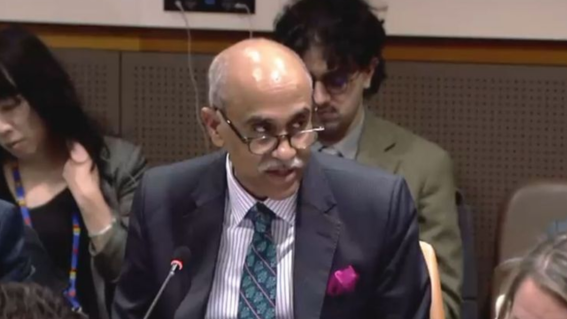
19 November 2026 Punjab Khabarnama Bureau : India has strongly criticised Pakistan at the United Nations over the alleged exploitation of its natural resources, questioning the role of the Pakistani military in the country’s resource management. During a discussion on natural resource governance, India’s representative referred to an incident in which Pakistan’s Army Chief, Field Marshal Asim Munir, displayed a wooden box containing mineral stones to foreign leaders.
The remarks highlighted India’s concerns about the influence of Pakistan’s military over the country’s natural wealth and whether these resources are being utilised for the benefit of ordinary citizens. India argued that natural resources should contribute to public welfare, economic development and prosperity rather than serving the interests of powerful institutions.
The exchange took place during a United Nations discussion on natural resource governance, where Pakistan raised concerns about India’s position on the Indus Waters Treaty. India responded by questioning Pakistan’s approach to managing its own resources and the involvement of its military leadership in the process.
India Questions the Pakistani Military’s Role in Resource Management
India’s Permanent Representative to the United Nations, Ambassador Harish Parvathaneni, made the remarks while responding to Pakistan’s comments during an Arria-formula meeting titled Natural Resources and Conflict: Strengthening Cooperation for Prevention and Peace on November 18, 2026.
According to India’s official statement, the Pakistani delegation had raised issues concerning the Indus Waters Treaty. India said its position on the treaty remained clear and consistent, but criticised Pakistan for using an international platform to advance what it described as propaganda.
In a pointed response, Ambassador Harish referred to the September 2025 incident in which Asim Munir presented a wooden box containing mineral stones to foreign leaders. The presentation took place during a visit involving Pakistan’s Prime Minister Shehbaz Sharif and US President Donald Trump at the White House.
The mineral display was widely viewed as part of Pakistan’s effort to attract American investment in its critical mineral and rare earth resources. The presentation came at a time when countries were looking to diversify mineral supply chains and reduce dependence on China.
India used the incident to question why Pakistan’s military leadership was directly involved in promoting the country’s natural resources and whether the benefits were reaching the wider population.
India Says Natural Resources Must Benefit Ordinary Citizens
During the discussion, India also presented its broader position on natural resource governance, arguing that minerals, energy resources and other natural assets should be used to support economic development and improve people’s living conditions.
Ambassador Harish stressed that natural resources are primarily an engine of development and prosperity for sovereign countries. However, he acknowledged that illegal exploitation and trafficking of these resources can sometimes finance armed groups and prolong conflicts.
India emphasised that resource management should be based on transparency, accountability, national ownership and respect for international law.
The Indian representative also highlighted the importance of ensuring that local communities receive a fair share of the economic benefits generated from natural resources.
He argued that regions rich in minerals and other resources can face instability when their populations do not receive adequate benefits from the wealth generated in their areas.
India Highlights Concerns Over Resource-Rich Regions
India further pointed out that resource-rich but economically underdeveloped regions can become centres of insecurity if local communities feel excluded from development.
According to the Indian statement, heavy-handed and security-focused approaches to managing resource-rich areas can deepen existing grievances rather than resolve them.
The remarks carried particular significance in the context of Pakistan, where questions about the distribution of natural resource wealth and the relationship between provincial governments and the federal establishment have remained politically sensitive.
India argued that governments must ensure that resource-bearing provinces and communities receive an equitable and just share of the benefits generated from their natural wealth.
The Indian representative’s remarks also highlighted the importance of involving local communities, including women and young people, in decisions related to resource management.
India Presents Its Own Resource Governance Model
During the UN discussion, India also referred to its domestic initiatives to demonstrate how natural resource wealth can be connected to community development.
Ambassador Harish highlighted the role of District Mineral Foundations (DMFs), which were established under India’s mining framework.
These foundations collect contributions from mining operators and use the funds for the welfare of people and areas affected by mining activities.
The initiative aims to ensure that communities living in mining regions receive tangible benefits from the extraction of natural resources.
India said such arrangements could help strengthen public participation, improve local development and ensure that the economic advantages of mining reach people who are directly affected by these activities.
The country also called for responsible supply chains, transparency and cooperation between producing, transit and consuming nations to prevent illegal resource trading.
India Calls for International Cooperation
India also used the meeting to call for stronger international cooperation to prevent the illegal exploitation and trafficking of natural resources.
The Indian representative referred to the Kimberley Process as an example of international cooperation that has helped curb the trade in conflict diamonds while allowing legitimate trade to continue.
India, which is chairing the Kimberley Process in 2026, said it was committed to making the initiative more effective and inclusive.
The country further stressed that international standards should not create unnecessary barriers for developing economies. Instead, cooperation should support technology partnerships, local value addition, better market access and capacity-building.
India maintained that countries possessing valuable natural resources should have the opportunity to develop their own industries and benefit from processing and manufacturing activities within their borders.
Diplomatic Tensions Between India and Pakistan Continue
The latest exchange at the United Nations reflects the continuing diplomatic tensions between India and Pakistan, with both countries frequently raising bilateral disputes at international forums.
The Indus Waters Treaty, signed in 1960, has remained a major point of disagreement between the two neighbours. India has maintained that cooperation under the treaty cannot be expected without mutual trust and an end to cross-border terrorism.
Pakistan has repeatedly raised concerns about India’s position on the agreement, particularly its implications for water availability and the country’s agricultural sector.
India, meanwhile, has argued that Pakistan should focus on its domestic governance challenges instead of making allegations against New Delhi.
The latest remarks by Ambassador Harish added another dimension to the diplomatic exchange by bringing Pakistan’s natural resource management and the influence of its military leadership into the discussion.
India concluded by reiterating its willingness to work with international partners on practical and consensus-based approaches to ensure that natural resources contribute to sustainable development, shared prosperity and lasting peace.
The Indian statement made clear that resource wealth should ultimately improve the lives of ordinary people rather than become a source of political influence, inequality or conflict.