

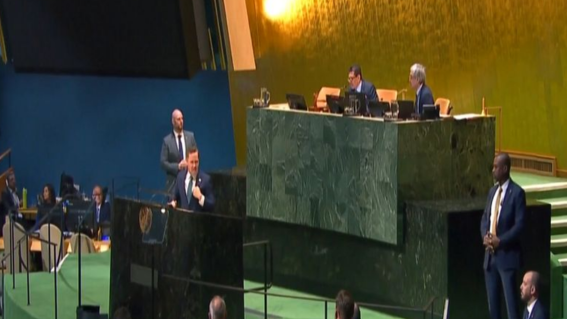
28 October 2026 Punjab Khabarnama Bureau : A heated confrontation erupted at the United Nations General Assembly on October 27, 2026, when US Ambassador to the UN Mike Waltz and Cuban Foreign Minister Bruno Rodríguez Parrilla exchanged angry words during a debate over Washington’s decades-long economic embargo against Cuba.
The dispute unfolded as Waltz urged UN member states to oppose an annual resolution condemning the US embargo. As the American envoy criticised Cuba’s government over alleged corruption, members of the Cuban delegation shouted objections and struck their table in protest.
Rodríguez subsequently approached the front of the assembly and accused Waltz of lying. The US envoy responded by demanding that the Cuban foreign minister step back from the podium, declaring, “This is America. Back up.”
The exchange briefly disrupted the diplomatic proceedings and highlighted the growing tensions between Washington and Havana under US President Donald Trump’s administration.
How the Confrontation Began
Waltz took the floor during the UN General Assembly’s annual debate on the US economic and trade embargo against Cuba. His remarks focused on allegations of corruption within Cuba’s socialist government and criticism of its political leadership.
During the speech, the Cuban delegation repeatedly interrupted, calling for a point of order and challenging the American envoy’s statements. The assembly president attempted to restore order as the argument intensified.
Waltz continued his criticism, arguing that Cuba’s leadership enjoyed privileges while ordinary citizens faced economic hardship. He also displayed photographs of former Cuban leader Fidel Castro and current President Miguel Díaz-Canel, referring to luxury watches as part of his argument about inequality and alleged corruption.
Rodríguez objected to Waltz’s remarks and moved towards the front of the chamber. At one point, he shouted, “You are a liar!”
Waltz demanded that Rodríguez move away from the podium, telling him that he would not be intimidated. The confrontation prompted the presiding officer to suspend the meeting temporarily.
US Envoy Defends Washington’s Position
Waltz’s remarks formed part of a broader US diplomatic effort to persuade countries to vote against the annual resolution condemning the embargo.
The Trump administration has intensified pressure on Cuba, arguing that the country’s government should face greater accountability over its political system and record on human rights.
During the debate, Waltz defended Washington’s approach and criticised Cuba’s leadership. He also argued that the Cuban delegation’s response illustrated the government’s intolerance of criticism.
The US administration has sought support from other UN member states for its position, using diplomatic meetings and public statements to challenge the resolution.
The dispute also reflects the increasingly confrontational tone of US-Cuba relations, particularly as Washington pursues policies intended to pressure Havana into political and economic changes.
Cuba Condemns US Economic Pressure
Rodríguez and other Cuban officials have repeatedly argued that the US embargo is a major contributor to the island’s economic difficulties.
Cuba has faced shortages of fuel, food and other essential goods, alongside widespread power outages and problems affecting public services. The Cuban government maintains that American sanctions and restrictions on international trade have intensified these challenges.
Trump announced in January 2026 that his administration would impose tariffs on countries supplying oil to Cuba. The measure has further complicated the island’s access to fuel and contributed to concerns about electricity generation, transportation and basic services.
Cuban officials argue that Washington is attempting to use economic pressure to force political change. The US government, meanwhile, maintains that its approach is aimed at challenging Cuba’s leadership and promoting political accountability.
The competing positions have made diplomatic engagement between the two countries increasingly difficult.
UN Resolution Puts Embargo Back in Focus
The confrontation took place a day before the General Assembly was scheduled to vote on a resolution calling for an end to the US embargo against Cuba.
The measure has been presented annually for more than three decades and has traditionally received broad international support. In the previous vote, 165 countries supported the resolution, seven voted against it and 12 abstained.
Although General Assembly resolutions of this kind are not legally binding, they provide an indication of international opinion on major diplomatic issues.
The United States has opposed the resolution, maintaining that its policy towards Cuba should not be dictated by a non-binding UN vote. Cuba, on the other hand, uses the annual debate to call attention to the economic consequences of American restrictions.
The 2026 vote has attracted additional attention because of the Trump administration’s intensified economic measures and efforts to persuade other countries to oppose the resolution.
A Wider Diplomatic Dispute
The clash was not the first public confrontation between Waltz and Cuban representatives in recent days. A similar dispute occurred the previous week during a US-hosted event at UN headquarters involving Cuban dissidents and former prisoners.
The latest exchange underscores how the long-running disagreement over the embargo has become part of a broader diplomatic struggle involving human rights, economic sanctions and Cuba’s political future.
The argument also drew attention to the conduct of diplomatic representatives at the United Nations, where proceedings depend on established rules and efforts to maintain order even when member states disagree sharply.
Following the interruption, the General Assembly proceedings resumed and Waltz completed his remarks, urging delegates to reject the resolution.
What Happens Next?
The immediate focus is the General Assembly vote on the resolution condemning the US embargo. Its outcome will provide another indication of how the international community views Washington’s policy towards Cuba.
The heated exchange itself does not change the legal status of the embargo, which remains governed by US law and policy. However, it has brought renewed attention to the worsening relationship between the two countries.
For Cuba, the central issue remains the economic impact of US restrictions. For Washington, the administration’s stated objective is to increase pressure on the Cuban government.
As both sides continue to defend their positions, the UN debate has once again demonstrated the depth of the disagreement and the difficulty of finding common ground over one of the longest-running disputes in international relations.