

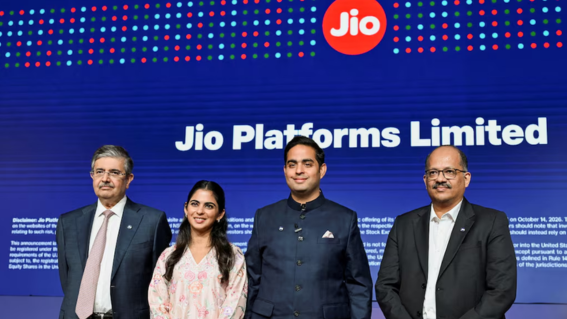
28 October 2026 Punjab Khabarnama Bureau : Mukesh Ambani’s telecom and digital services business, Jio Platforms, is set to make its stock market debut in Mumbai on Wednesday, October 28, 2026, following a record-breaking initial public offering (IPO) worth approximately $3.2 billion. The offering attracted bids worth around $77 billion, making it the most heavily subscribed IPO in Indian history and placing the company among the country’s most closely watched market listings.
Jio Platforms, a subsidiary of Reliance Industries, has been valued at approximately $108.3 billion at the upper end of its IPO pricing. The listing marks a major milestone for Ambani’s strategy to expand Reliance beyond its traditional oil and petrochemicals businesses into telecommunications, digital services, artificial intelligence and consumer technology.
The market debut is expected to attract significant attention from domestic and international investors as they assess the company’s growth prospects, valuation and ability to generate revenue beyond its core mobile connectivity business.
Jio IPO Sets a New Record in India
Jio Platforms raised approximately ₹30,213 crore through its public offering, making it India’s largest IPO to date. The issue was priced in a band of ₹1,065 to ₹1,119 per share, with the final offer price set at the upper end of the range.
The IPO received bids worth approximately ₹7.3 lakh crore, equivalent to around $77 billion, reflecting substantial investor interest in the company.
The offering was subscribed more than 22 times, according to reports. Institutional investors demonstrated particularly strong demand, while retail investors also participated in the landmark issue.
The scale of the offering highlights the growing depth of India’s capital markets and investor appetite for large technology and telecommunications businesses. It also represents Reliance Industries’ first major public offering in around two decades.
Jio’s listing follows a period of strong activity in India’s primary market, with companies using public offerings to raise capital, provide liquidity to investors and expand their shareholder base.
Valuation Places Jio Among India’s Largest Companies
At an implied valuation of approximately $108.3 billion, Jio Platforms could rank among India’s largest listed companies by market capitalisation once trading begins.
The company’s valuation reflects its extensive telecommunications network, large customer base and ambitions in digital services. Jio has more than 530 million customers, making it one of the largest telecommunications operators in the world by subscriber numbers in a single country.
The company has transformed India’s mobile data market since launching in 2016, when it introduced highly competitive voice and data plans. Its expansion accelerated smartphone adoption and increased access to internet services across urban and rural India.
The upcoming listing will give public-market investors a more direct opportunity to invest in Jio Platforms’ business and assess its financial performance independently of its parent company, Reliance Industries.
However, the valuation also raises questions about how quickly Jio can expand its earnings and turn its large customer base into higher revenue from digital products and enterprise services.
Meta and Google Back the Digital Business
Jio Platforms has attracted investments from major international technology companies, including Meta and Google, the parent company of Alphabet.
Their investments have helped establish Jio as a significant player in India’s digital economy. The company’s ecosystem includes mobile connectivity, home broadband, enterprise technology and a growing range of digital services.
Jio is also pursuing opportunities in cloud computing, artificial intelligence, connected devices and other technology-led businesses. These areas could provide additional growth opportunities as demand for digital infrastructure increases.
Managing Director Akash Ambani has emphasised the company’s ambition to develop technology and digital services alongside its telecommunications operations.
Nevertheless, telecommunications remains the core of Jio’s business. Investors will be watching closely to see whether newer services can become a larger contributor to revenue and profits over time.
How Jio Plans to Use IPO Proceeds
According to the company’s IPO prospectus, a substantial portion of the proceeds is intended to repay or prepay borrowings at its telecommunications subsidiary, Reliance Jio Infocomm.
Up to approximately ₹27,500 crore, or around $2.9 billion, is earmarked for debt repayment, while the remaining funds will be used for general corporate purposes, including capital expenditure.
Reducing borrowings could strengthen the telecommunications business’s balance sheet and provide greater financial flexibility for future investment.
The company will continue to require capital for network expansion, infrastructure upgrades and the development of digital services. These investments are particularly important as data consumption rises and competition intensifies across India’s telecommunications sector.
Investors will therefore assess not only the initial market valuation but also how effectively Jio allocates capital and manages its spending.
Grey Market Premium Signals Strong Expectations
Ahead of the listing, activity in the unofficial grey market indicated a premium of approximately 22% over the IPO price, according to media reports.
Grey market premiums reflect informal trading expectations before shares begin trading on recognised exchanges. They can provide an indication of market sentiment, but they are unregulated and do not guarantee the actual listing price or subsequent returns.
Investors should therefore distinguish between expectations before the debut and the price established through trading on the stock exchanges.
The first trading sessions will offer an early indication of how public-market investors value Jio’s growth prospects, profitability and risks.
Competition and Regulation Remain Key Risks
Despite strong demand for its IPO, Jio Platforms faces several challenges.
India’s telecommunications market remains highly competitive, with Bharti Airtel and Vodafone Idea among its principal rivals. Companies must continue investing in network quality, spectrum and technology while balancing competitive pricing with profitability.
Regulatory changes involving spectrum allocation, licensing and telecommunications fees could also affect operating costs.
Another potential challenge is the development of satellite-based internet services in India, which could introduce additional competition in certain connectivity markets if regulatory approvals and commercial expansion progress.
Jio’s ambitions in artificial intelligence and digital services also require sustained investment. Investors will need to evaluate whether these businesses can deliver sufficient growth to support the company’s valuation.
What Investors Will Watch After Listing
The market debut will be an important test of investor confidence in one of India’s largest technology businesses.
Attention will focus on the opening share price, trading volumes, market capitalisation and the response from institutional and retail investors. Over the longer term, quarterly earnings, subscriber growth, average revenue per user, debt levels and digital-services revenue will be important indicators of performance.
For Mukesh Ambani, the listing is a significant step in Reliance Industries’ transformation into a broader consumer and technology group. For India’s capital markets, it represents a landmark public offering that could influence expectations for future large-scale listings.
While the record demand signals strong interest in Jio Platforms, its long-term performance will depend on its ability to sustain growth, manage costs and translate its extensive customer base into durable earnings.