

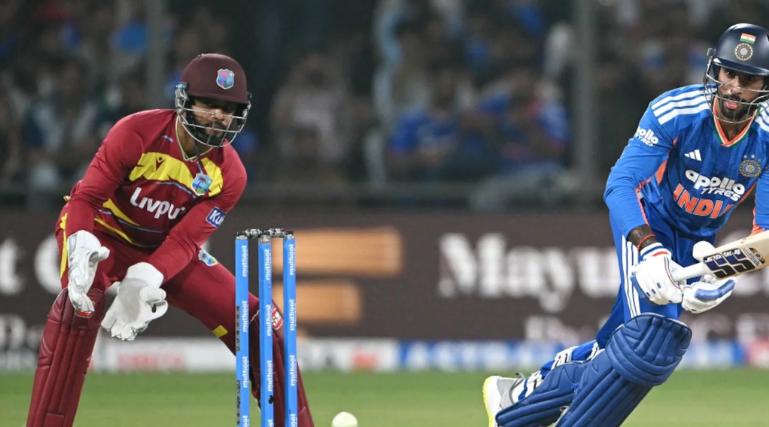
13 October 2026 Punjab Khabarnama Bureau : India batter Tilak Varma has reportedly faced criticism for his approach during the third T20 International against West Indies, with the phrase “taking a walk on the beach” drawing attention to questions about his batting intent and performance in the match.
The remark has added to the discussion surrounding India’s batting approach in the T20I series. In the shortest international format, players are often expected to balance their innings carefully while maintaining a scoring rate that keeps the team competitive. Any period of slow scoring can attract scrutiny, particularly when the team needs momentum or is trying to build a challenging total.
Tilak Varma Under the Spotlight
Tilak Varma has established himself as a promising left-handed batter in India’s limited-overs setup. His ability to play different types of bowling and adapt to varied match situations has made him an important option in the middle order.
However, expectations are particularly high in T20 cricket, where teams frequently look for batters who can rotate the strike, find gaps and accelerate when required. The criticism reflected in the headline appears to centre on whether Tilak’s approach during the third T20I matched the demands of the situation.
The expression “taking a walk on the beach” suggests a perception of a relaxed or insufficiently urgent approach. Without the original commentary or the full match context, however, it would be inappropriate to conclude that Tilak was deliberately playing slowly or failing to meet his responsibilities.
Why Batting Intent Matters in T20 Cricket
T20 cricket places considerable importance on scoring momentum. Batters must assess the match situation, the quality of the bowling attack, the condition of the pitch and the wickets remaining before deciding how aggressively to play.
A measured start can sometimes help a team recover after losing early wickets. At other times, a slow scoring rate can increase the pressure on the batters who follow, forcing them to take greater risks later in the innings.
This is why a player’s strike rate alone does not always provide a complete picture of an innings. The number of balls faced, partnerships, wickets lost and the required scoring rate are also important factors in evaluating a performance.
For a middle-order batter such as Tilak, the challenge is to maintain stability while ensuring that the innings does not lose momentum. His role can change depending on whether India needs to rebuild, consolidate or accelerate.
India’s Batting Strategy in the West Indies Series
India’s T20I campaign against West Indies has provided another opportunity to assess the team’s batting combinations and approach. The management must consider how to distribute responsibilities among top-order batters, middle-order players and finishers.
Young batters are often expected to demonstrate flexibility, particularly when conditions change or the opposition deploys different bowling strategies. Their ability to respond to pressure situations can influence both individual selection decisions and the team’s broader plans.
Tilak’s performances are therefore likely to be assessed in the context of his assigned role rather than through a single moment or isolated passage of play. The team’s requirements may differ depending on the match situation and the composition of the batting lineup.
Criticism and Performance Analysis
Public criticism is a familiar part of professional cricket, especially when expectations are high. However, strong assessments should be supported by the match scorecard, the player’s scoring rate and the circumstances in which the innings unfolded.
A batter who scores cautiously while wickets are falling may be performing a different role from one expected to attack from the beginning. Similarly, a player who starts slowly but accelerates later may still contribute effectively to the team’s total.
The “taking a walk on the beach” remark has attracted attention because it questions the urgency of Tilak’s approach. Yet a fair evaluation requires more than a headline or a colourful description.
What It Means for Tilak Varma
For Tilak, the wider challenge is to continue developing his ability to adapt to different T20 match situations. Maintaining composure while increasing scoring intent when required is an important skill for middle-order batters.
His future opportunities will depend on consistent performances, team balance and the requirements of India’s selection plans. One criticised innings does not necessarily determine a player’s standing, just as a strong performance does not guarantee a permanent place.
The debate surrounding the third T20I ultimately highlights the fine balance between patience and aggression in modern T20 cricket. For India, finding the right balance across the batting order will remain essential as the team continues to refine its combinations and prepare for future international assignments.
Note: The precise incident, match statistics and source of the quoted criticism should be checked against the original report and official scorecard before publication.