

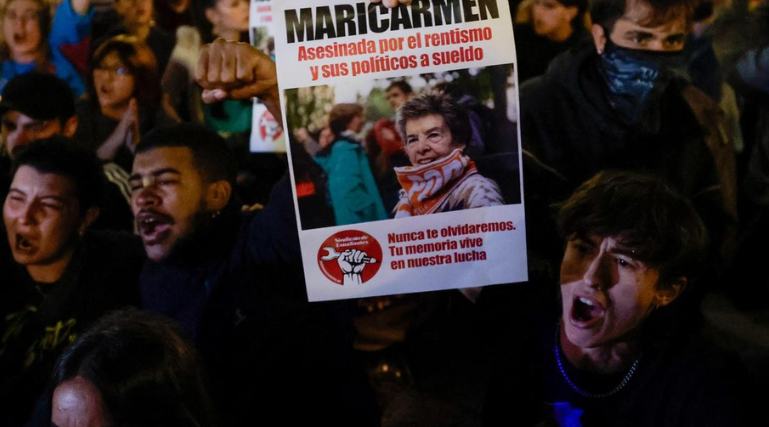
8 October 2026 Punjab Khabarnama Bureau : Maricarmen Abascal, the 87-year-old Spanish woman whose eviction from her Madrid home became a powerful symbol of the country’s housing crisis, has died, triggering renewed protests and calls for stronger protections for tenants.
Abascal died on Wednesday while receiving treatment in a Madrid hospital, according to the Madrid Tenants’ Union and her lawyer. Her cause of death was not immediately disclosed. She had been hospitalised following her eviction from the apartment where she had lived for more than seven decades.
Her case attracted national attention on September 23, when police and social workers removed her from her home in Madrid’s Retiro district. Because of her fragile condition and use of a wheelchair, she was carried out on a stretcher and taken to an ambulance. Images of the eviction quickly spread across Spain and became a rallying point for housing activists.
Abascal had lived in the apartment for around 70 years. The property was acquired by an investment company, after which the rent was set to rise sharply. Housing activists and her legal representatives had attempted to find an agreement that would allow the elderly tenant to remain in her home.
The eviction intensified an already growing debate over Spain’s housing affordability crisis. Rents and property prices have increased significantly in many parts of the country, while campaigners have argued that the supply of affordable housing has failed to keep pace with demand.
Following Abascal’s eviction, thousands of people took to the streets in Madrid and other Spanish cities. Activists established a protest camp in the capital’s Puerta del Sol, one of Madrid’s most prominent public squares. Demonstrations also took place in Barcelona and other parts of the country.
While Abascal was in hospital recovering from the ordeal, she continued to express support for the protesters. Her words from her hospital bed encouraged demonstrators to continue demanding affordable housing and protection for tenants.
The pressure eventually led to an agreement that would have allowed Abascal to return to her apartment under a new arrangement with the property owner. Her lawyer said she had planned to complete the agreement after recovering from her hospitalisation. However, she died before she could return home.
The Madrid Tenants’ Union said the agreement came too late and described her ordeal as preventable. The organisation said Abascal’s case had become a turning point in Spain’s housing movement, linking her eviction to wider demonstrations, protest camps and political pressure.
News of her death prompted an immediate response from protesters gathered in Madrid. People at the Puerta del Sol camp observed a minute of silence before demonstrators marched towards Parliament. Protesters carried messages honouring Abascal and called for continued action over housing affordability.
Spanish Prime Minister Pedro Sánchez expressed condolences following her death, while Housing Minister Isabel Rodríguez also paid tribute to Abascal. Opposition leader Alberto Núñez Feijóo said her death should be treated with respect and should not become a political campaign issue.
The political consequences of the housing protests have already been significant. The demonstrations came as Sánchez’s government struggled to secure parliamentary support for emergency housing measures. Parliament’s rejection of proposed measures dealing with evictions and rental pressures contributed to the government’s decision to call an early general election for November 29.
The government has also announced a package of urgent housing measures aimed at addressing the crisis. The proposals include stronger protections for vulnerable tenants, measures concerning rental properties, incentives related to housing construction and financial support for people seeking to rent or buy homes.
Trade unions have separately announced plans for a nationwide general strike over housing issues on November 11, adding further pressure on political parties ahead of the election.
Abascal’s death has therefore come at a moment when housing has moved to the centre of Spain’s political and social debate. Her personal experience resonated with renters who fear being priced out of homes they have occupied for years or decades.
For many protesters, however, Abascal represented more than a dispute between one tenant and a property owner. Her eviction highlighted broader questions about ageing renters, rising housing costs, investment ownership and the availability of secure and affordable accommodation.
Her story also drew attention to the human consequences of housing insecurity, particularly for elderly people who may have spent most of their lives in the same homes.
As Spain prepares for an early election, housing is expected to remain a major issue. Abascal’s name has become closely associated with the movement demanding greater housing security, and protesters have pledged to continue campaigning in her memory.
The Madrid Tenants’ Union said Abascal’s legacy would be remembered through the movement that emerged after her eviction. Her case, which began with one elderly woman’s struggle to remain in her longtime home, has become part of a much broader national debate about who can afford to live in Spain’s cities and what protections should exist for vulnerable tenants.