

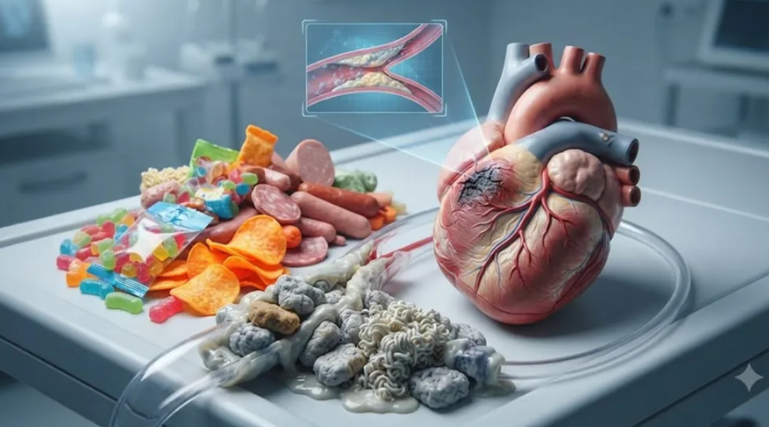
25 September 2026 Punjab Khabarnama Bureau : Eating more ultra-processed food (UPF) every day has been linked to a higher risk of cardiovascular disease, with a recent large-scale analysis finding that every additional 100 grams of UPF consumed per day was associated with about a 14% higher risk of heart attack and stroke.
The findings add to growing evidence connecting diets high in ultra-processed foods with poorer long-term health outcomes. However, the research is based on observational data, meaning the association does not by itself prove that ultra-processed food directly causes heart disease.
What Counts as Ultra-Processed Food?
Ultra-processed foods are industrially formulated products that often contain multiple ingredients, additives and substances not commonly used in home cooking.
Common examples include:
- Packaged snacks
- Sugary drinks
- Instant noodles
- Processed meats
- Ready-to-eat meals
- Packaged biscuits and cookies
- Some commercially produced breads
- Confectionery and other highly formulated foods
The category is broader than simply calling a food “junk food”. Some products that appear relatively ordinary can also fall under ultra-processing classifications depending on their ingredients and manufacturing methods.
What Did the Study Find?
The latest analysis examined evidence from a very large population base and found a consistent association between higher ultra-processed food consumption and cardiovascular outcomes.
The reported finding that an additional 100 grams per day was associated with approximately 14% greater cardiovascular risk means the comparison is based on differences in consumption levels across populations.
It does not mean that eating exactly 100 grams of a particular packaged food automatically increases an individual’s personal heart-attack risk by 14%.
Earlier Research Also Found a Cardiovascular Link
Previous research has reported similar associations.
A large NutriNet-Santé cohort study involving more than 105,000 adults found that higher ultra-processed food consumption was associated with increased risks of overall cardiovascular disease, coronary heart disease and cerebrovascular disease.
That study found that a 10-percentage-point increase in the proportion of ultra-processed foods in the diet was associated with a 12% higher risk of overall cardiovascular disease.
Why Could UPFs Be Linked to Heart Risk?
Researchers have proposed several possible explanations.
Many ultra-processed products can be high in salt, added sugars and unhealthy fats, while also being relatively low in fibre and other nutrients.
Frequent consumption may therefore contribute to obesity, high blood pressure, abnormal cholesterol levels and metabolic problems—all established cardiovascular risk factors.
Some researchers are also investigating whether food additives, changes in food structure and effects on the gut microbiome could play a role. However, these mechanisms are still being studied and should not be presented as proven explanations for the observed association.
The Amount Matters, But Food Quality Matters Too
The 100-gram figure should not be interpreted in isolation.
Two foods can have similar weights but very different nutritional profiles. For example, 100 grams of one packaged product may contain considerably more salt, sugar or saturated fat than another.
What matters for health is therefore the overall dietary pattern, not simply the weight of one particular food.
Not All Processed Food Is the Same
Processing itself does not automatically make food unhealthy.
Freezing vegetables, pasteurising milk, fermenting foods or minimally processing grains can improve safety, storage and convenience without making them ultra-processed.
The concern is primarily around diets in which highly formulated packaged products make up a large share of total food intake.
Evidence Does Not Prove Cause and Effect
This distinction is important.
Most research linking ultra-processed food with chronic disease is observational. People who consume more UPFs may also differ in other ways, including physical activity, smoking, sleep, income, overall diet and healthcare access.
Researchers can adjust for many of these factors, but observational studies cannot completely eliminate the possibility of confounding factors.
Therefore, the findings show an association rather than proving that UPFs alone caused the additional cardiovascular risk.
What Can People Do?
Health experts generally recommend reducing reliance on highly processed packaged foods and replacing them where practical with minimally processed options.
A heart-friendly eating pattern can include more:
- Vegetables and fruits
- Whole grains
- Pulses and legumes
- Nuts and seeds
- Fish and other nutritious protein sources
- Foods prepared with limited added salt, sugar and unhealthy fats
The goal is not necessarily to eliminate every packaged food but to make minimally processed foods the foundation of the diet.
A Growing Area of Research
The latest findings add to a rapidly expanding body of research examining the relationship between ultra-processed foods and chronic disease.
Researchers are increasingly looking beyond individual nutrients and asking whether the degree of processing, food structure and industrial formulation may independently influence health.
More research, particularly long-term intervention studies, will be needed to establish how much of the observed risk is directly attributable to ultra-processed foods.