

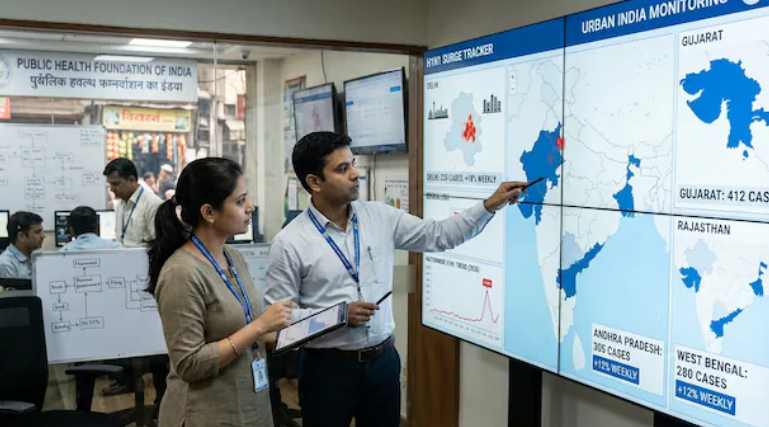
1 September 2026 Punjab Khabarnama Bureau : India is seeing a noticeable rise in H1N1 influenza cases this monsoon season, but the increase has not been uniform across cities. Delhi, for instance, has reported a particularly sharp rise, while other cities have seen smaller increases.
Experts say the differences are likely linked to a combination of weather, humidity, population density, indoor crowding, immunity levels, healthcare-seeking behaviour and local surveillance rather than the emergence of a completely new or unusually dangerous H1N1 strain.
Delhi Has Seen a Sharp Increase
Delhi has emerged as one of the major hotspots this season.
Health data reported in August showed more than 1,700 confirmed H1N1 cases in the capital, substantially higher than the 229 cases recorded during the corresponding period last year. The rise prompted authorities to strengthen hospital preparedness and surveillance.
More recent reports indicate that the number has continued to rise, underlining how quickly influenza activity can change during the season.
Monsoon Weather Can Help Flu Spread
One important factor is the monsoon environment.
Influenza transmission in India can increase during rainy periods, when humidity is high and people spend more time indoors because of rain. Poor ventilation and close contact can make it easier for respiratory viruses to spread.
Doctors have noted that influenza transmission in India typically shows seasonal peaks, including during the monsoon and again in winter.
Humidity Is Only Part of the Story
Weather alone cannot explain why one city experiences more cases than another.
Cities differ in population density, housing conditions, commuting patterns, workplace crowding and school attendance. A densely populated urban area with extensive daily movement can provide more opportunities for respiratory viruses to circulate.
Local rainfall patterns and the timing of the monsoon can also affect when a city’s influenza wave begins and how quickly it grows.
Population Movement Can Amplify Outbreaks
Large cities such as Delhi, Mumbai and Bengaluru attract millions of commuters, students and workers from surrounding areas.
This constant movement can create a large network of contacts through public transport, offices, schools, markets and other crowded settings.
Once influenza begins circulating within such networks, transmission can accelerate rapidly, particularly when people continue normal activities while experiencing mild symptoms.
Immunity Levels Differ Between Communities
Another factor is population immunity.
Influenza viruses evolve through gradual genetic changes, and immunity from previous infections or vaccination may not provide identical protection against every circulating strain.
The Indian Council of Medical Research has said the predominant H1N1 virus currently circulating is similar to A/Missouri/11/2025 (H1N1)pdm09-like viruses. Experts have not found evidence of a new, unusually dangerous H1N1 strain driving the current increase.
Vaccination Coverage Can Also Matter
Influenza vaccination is another factor that can influence how much the virus spreads and how severe illness becomes.
Vaccination rates are not uniform across India, and uptake can vary according to awareness, access, cost and whether people are considered part of a higher-risk group.
Lower vaccination coverage can leave larger susceptible populations when influenza activity increases.