

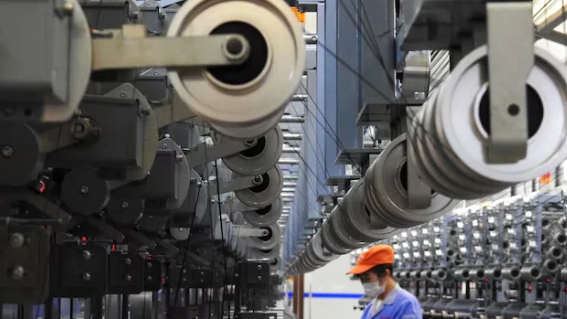
27 November 2026 Punjab Khabarnama Bureau : China’s industrial companies recorded their fastest profit growth in five months in October, signalling improvement in parts of the country’s manufacturing sector. However, the latest figures also highlight an uneven economic recovery, as weak domestic consumption, property-sector challenges and uncertainty over international trade continue to weigh on businesses.
According to data released by China’s National Bureau of Statistics (NBS) on Friday, November 27, profits at industrial firms increased 20.1% year-on-year in October. This was significantly higher than the 14.4% growth recorded in September and marked the fastest expansion since May.
For the first 10 months of 2026, industrial profits increased 16% compared with the same period last year. The growth rate was slightly higher than the 15.5% increase recorded during January-September, indicating some improvement in overall corporate earnings.
Despite the stronger figures, economists have cautioned that the recovery remains concentrated in selected industries rather than being spread evenly across China’s economy.
Technology sector drives industrial profit growth
The technology and electronics industries remained among the strongest performers during the first 10 months of the year. Profits in computer, telecommunications and other electronic equipment manufacturing doubled compared with the same period last year.
Strong international demand for technology products, artificial intelligence-related equipment and electronic components has supported manufacturers. Businesses connected to advanced technology and industrial supply chains have benefited from growing overseas orders.
However, the performance of traditional manufacturing industries has been considerably weaker. Furniture manufacturers recorded a 52.4% decline in profits during January-October, highlighting the significant gap between high-performing technology businesses and sectors facing weaker demand.
The contrast suggests that China’s industrial recovery is increasingly dependent on a relatively small number of industries, particularly those benefiting from global technology demand.
Weak domestic demand remains a major concern
One of the biggest challenges for China’s economy continues to be subdued domestic consumption. Despite government efforts to encourage spending and support businesses, household demand has yet to recover strongly enough to provide broad-based support to industrial companies.
Weak consumer spending has affected manufacturers producing goods for the domestic market. Businesses in several consumer-facing industries continue to face pressure from limited demand and intense competition.
The prolonged weakness in China’s property sector has added to these difficulties. The real estate downturn has affected construction-related businesses, household confidence and demand for various industrial products.
Economists believe that a stronger recovery in household spending will be important if China wants to maintain industrial profit growth over the coming months.
Government support measures provide some relief
Chinese authorities have introduced several measures to support economic activity and improve business conditions. These include steps to reduce borrowing costs, increase liquidity in the financial system and provide targeted financing to industries considered important for long-term economic development.
Technology, manufacturing and infrastructure have remained key areas of policy support.
These measures are intended to encourage investment, improve access to financing and strengthen industrial production. However, analysts say their impact has been mixed, with improvements concentrated in specific sectors.
The latest profit figures indicate that policy support and stronger external demand have helped some businesses improve their financial performance. Nevertheless, the wider economy continues to face structural challenges that cannot be addressed through industrial investment alone.
Export dependence creates fresh uncertainty
Overseas demand has become an important source of support for Chinese manufacturers. Companies producing electronics, machinery and other industrial goods have benefited from international orders, helping offset relatively weak domestic consumption.
However, increasing trade tensions have created uncertainty around the outlook for exports.
Concerns about potential tariff increases and additional trade restrictions by the United States and European Union could affect Chinese manufacturers that depend heavily on overseas markets.
Any significant deterioration in trade relations could increase costs, disrupt supply chains and reduce the competitiveness of Chinese products in international markets.
Analysts have also pointed to the possibility of slower investment in artificial intelligence infrastructure and questions surrounding profitability in parts of the AI industry. Such developments could affect some of the sectors currently driving industrial earnings.
What the latest figures mean for China’s economy
Industrial profit data are closely monitored because they provide an indication of corporate financial health, investment conditions and the effectiveness of government economic policies.
The October increase offers a positive signal for China’s manufacturing sector. However, the sharp differences between technology-related businesses and traditional industries suggest that the improvement has not yet translated into a broad economic recovery.
The latest figures also come ahead of the release of China’s November manufacturing activity data, which could provide further clues about the strength of economic momentum during the final quarter of 2026.
For policymakers, the challenge will be to extend the benefits of industrial growth beyond technology and export-oriented businesses. Strengthening household consumption, stabilising the property market and improving confidence among private companies are likely to remain important priorities.
While China’s industrial profits are growing at their fastest pace in five months, sustaining that momentum will depend on whether domestic demand improves and manufacturers can navigate growing international trade uncertainties.