

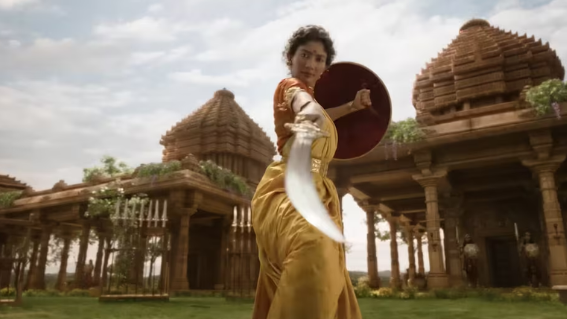
27 November 2026 Punjab Khabarnama Bureau : Author Amish Tripathi has come out in support of actress Sai Pallavi’s portrayal of Sita as a warrior in filmmaker Nitesh Tiwari’s film Ramayana. The depiction has sparked considerable discussion among viewers, with some questioning why Sita has been shown handling weapons and fighting demons. However, Amish believes that the portrayal is not a modern invention but is inspired by an ancient version of the Ramayana traditionally attributed to Maharishi Valmiki.
Sai Pallavi plays the character of Sita in the film, which also features Ranbir Kapoor as Lord Rama and Yash as Ravana. In several scenes, her character is shown practising swordplay, handling weapons and fighting against asura soldiers.
While some viewers have appreciated this interpretation, others have raised objections, arguing that Sita has traditionally been portrayed as a symbol of patience, devotion and strength rather than a warrior participating in battles.
Amish Tripathi, who is known for his mythology-based books, has now shared his perspective on the controversy and explained why he believes the portrayal has a historical and literary connection.
Amish Tripathi Explains the Adbhuta Ramayana Connection
In an interview with SCREEN, Amish Tripathi referred to the Adbhuta Ramayana, an ancient text traditionally attributed to Valmiki.
According to the author, people are often familiar with only one version of the Ramayana and may not know about the different interpretations and retellings that exist.
He explained that the Adbhuta Ramayana presents a powerful version of Sita, in which she takes on a warrior form and defeats a much more powerful version of Ravana.
Amish said that the more powerful, thousand-headed Ravana is ultimately killed by Sita in this version.
He emphasised that portraying Sita as a warrior is not necessarily a new creative idea introduced by filmmakers. Instead, he argued that the concept has roots in an ancient retelling of the epic.
The author also pointed out that the Ramayana and Mahabharata have multiple versions, but these are not widely discussed or taught in the education system.
Why Sai Pallavi’s Sita Has Become a Talking Point
The portrayal of Sita in Nitesh Tiwari’s Ramayana has generated debate among audiences.
In the film, Sai Pallavi’s character is presented as someone who understands both weapons and scriptures. One sequence reportedly shows her teaching young girls swordplay, while another depicts her defending herself against asura soldiers.
These scenes have attracted attention because many previous screen adaptations have largely presented Sita through her role in Rama’s journey, focusing on her devotion, sacrifice and experiences during exile.
Actor Mukesh Khanna was among those who questioned the decision to show Sita as a fighter. He expressed disagreement with the interpretation, arguing that the character was not traditionally depicted as a warrior.
Amish Tripathi’s comments have brought another perspective into the discussion by highlighting the different literary traditions associated with the epic.
Amish Tripathi’s Own Book Also Presents Sita as a Warrior
Amish Tripathi is not new to presenting Sita through a different perspective. His bestselling book Sita: Warrior of Mithila, published in 2017, explores the character as a powerful and independent woman.
The book is part of his Ram Chandra Series and presents Sita as a capable leader with considerable knowledge, intelligence and strength.
Through his writing, Amish has attempted to explore aspects of Indian mythology that may receive less attention in popular retellings.
His support for Sai Pallavi’s portrayal is also consistent with the broader interpretation of Sita that he has explored in his literary work.
The author believes that understanding different versions of ancient epics can help audiences develop a wider perspective on their characters and stories.
What Does Adbhuta Ramayana Say About Sita?
The Adbhuta Ramayana contains an account involving Sahasra Ravana, a powerful thousand-headed form of Ravana.
In this narrative, Rama is unable to defeat the powerful demon, and Sita reveals a fierce and divine form associated with Shakti.
She ultimately defeats Sahasra Ravana, presenting her as a powerful force capable of protecting the universe.
This episode is different from the more widely known narrative in which Rama defeats Ravana in the battle of Lanka.
It is important to understand that the Adbhuta Ramayana is a distinct traditional retelling, and its attribution to Valmiki is a literary and religious tradition rather than a universally established historical authorship claim.
Amish Tripathi Shares His Views on History and Mythology
During the same conversation, Amish Tripathi also discussed the relationship between history and mythology.
He argued that the central events described in Indian epics may have historical foundations, even though certain supernatural or extraordinary elements could have been added through generations of storytelling.
To explain his perspective, he referred to Homer’s Odyssey and the discovery of the ancient city of Troy in the 19th century.
He said that archaeological discoveries helped establish a historical connection to aspects of the Trojan War, although the literary narratives also contain elements of mythology.
Amish believes that ancient Indian texts should be studied through a broader perspective, with greater awareness of different literary traditions and historical interpretations.
Ramayana Film Features Ranbir Kapoor, Sai Pallavi and Yash
Directed by Nitesh Tiwari, Ramayana features a major ensemble cast, with Ranbir Kapoor playing Lord Rama, Sai Pallavi portraying Sita and Yash appearing as Ravana.
Ravie Dubey plays Lakshman, while Sunny Deol appears as Hanuman.
The film has attracted considerable attention because of its scale, visual presentation and interpretation of the ancient Indian epic.
The project is planned as a two-part cinematic series, with the second instalment scheduled for 2028.
With the debate surrounding Sai Pallavi’s portrayal of Sita continuing, Amish Tripathi’s comments have added an important literary perspective to the discussion.
His explanation highlights that Sita’s character has been interpreted differently across traditional versions of the Ramayana. The discussion also demonstrates how filmmakers and writers continue to explore lesser-known narratives while bringing ancient stories to modern audiences.