

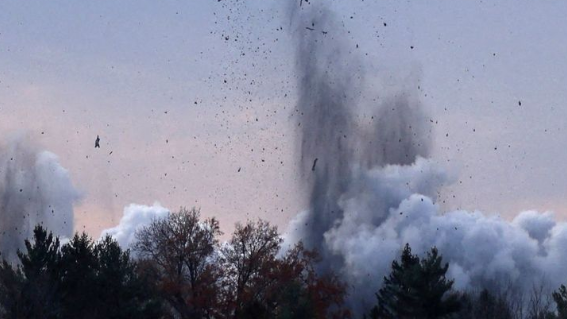
26 November 2026 Punjab Khabarnama Bureau : The US Environmental Protection Agency (EPA) has reported zero detection of airborne lead more than five hours after the US Army carried out a controlled detonation of nearly five tonnes of unstable explosive material at the Iowa Army Ammunition Plant in Middletown, Iowa. The initial monitoring results indicate that the operation did not produce detectable airborne lead in the surrounding region, although environmental testing is continuing.
The controlled detonation took place on Wednesday, November 25, 2026, at the Iowa Army Ammunition Plant. The operation was conducted to safely destroy a stockpile of degraded and crystallised lead azide, an explosive chemical that officials considered increasingly dangerous because of its unstable condition.
EPA Administrator Lee Zeldin confirmed that all agency air monitoring systems continued to report zero detection of airborne lead more than five hours after the explosion. He said EPA teams would continue collecting samples from the air, land and water over the coming days to assess any possible environmental impact.
EPA Reports Zero Airborne Lead Detection
In an update following the operation, Zeldin said that EPA monitoring systems had continuously collected data before, during and after the controlled detonation.
According to the agency, the initial readings showed no detectable airborne lead across the monitored region. The monitoring equipment is providing data at regular intervals, allowing officials to track potential changes in air quality.
Zeldin also said that approximately 300 EPA employees and contractors had been positioned in Iowa and surrounding areas to support environmental monitoring and any necessary cleanup activities.
The agency had collected more than 1,200 samples of air, soil, dust and water before the detonation to establish baseline environmental conditions. These samples will help officials compare conditions before and after the operation.
The EPA has said that monitoring and testing will continue, and further updates will be provided as additional information becomes available.
US Army Destroys Nearly Five Tonnes of Explosive Material
The US Army carried out the controlled detonation to eliminate approximately 9,700 pounds of degraded lead azide stored in 68 drums at the Iowa Army Ammunition Plant.
Lead azide is a highly sensitive primary explosive commonly used in detonators and other military ammunition. Officials discovered that the stored material had deteriorated and developed crystallisation, making it extremely sensitive to friction, vibration, heat and physical shock.
The condition of the explosive material created serious safety concerns for military personnel and nearby communities. Authorities warned that attempting to move, open or chemically neutralise the material could potentially trigger an accidental explosion.
Following technical assessments involving several federal agencies, the Army determined that a controlled detonation at the storage location was the safest available option to eliminate the hazard.
The operation was carried out by military explosive ordnance disposal specialists, with support from federal and state authorities.
Extensive Safety Measures Used Before Detonation
Authorities implemented several safety measures to minimise the potential spread of lead-containing dust and other particles during the explosion.
The Army reinforced the bunkers containing the degraded explosive material with sand-filled barriers and constructed earthen protective structures around the detonation area.
Water application systems, airborne misting equipment, foam and other mitigation measures were also deployed to reduce the possibility of particulate matter spreading into nearby communities.
Officials carefully monitored weather conditions and wind direction before proceeding with the operation. The detonation was scheduled during conditions considered suitable for reducing potential environmental exposure.
The EPA, Federal Emergency Management Agency (FEMA), Department of Health and Human Services and other agencies coordinated their efforts to support the operation and protect public health.
Residents Were Advised to Take Precautions
Before the detonation, authorities issued precautionary advisories to residents living near the Iowa Army Ammunition Plant.
Some residents were advised to evacuate temporarily, while others were instructed to remain indoors with windows and doors closed to minimise potential exposure to dust and airborne particles.
Particular attention was given to protecting children, pregnant women and people with existing health conditions because of the potential health risks associated with lead exposure.
Local authorities also advised residents to clean outdoor surfaces that children might touch, including windowsills, railings and play equipment, using wet cleaning methods.
The precautionary measures were introduced because lead exposure can pose serious health risks, particularly for young children and developing babies.
EPA to Continue Air, Soil and Water Testing
Despite the initial zero-detection readings, the EPA has emphasised that environmental monitoring will continue following the operation.
Agency teams are conducting additional sampling of air, soil, dust and water to identify any possible contamination that may not be reflected in the initial air-monitoring results.
The pre-detonation samples will also help scientists determine whether the operation caused any measurable changes in environmental conditions.
The agency has deployed hundreds of personnel and contractors to support the monitoring process and is prepared to undertake remediation activities if testing identifies a need.
Officials have encouraged residents in the affected region to follow local public safety advisories and use the EPA’s dedicated Iowa information portal for updates.
Environmental Concerns Remain Under Monitoring
The controlled detonation had raised concerns among environmental organisations and local communities before the operation took place. Environmental groups had questioned the potential spread of lead-containing dust and sought legal intervention to stop the planned explosion.
The legal challenges were ultimately unsuccessful, allowing the Army to proceed with the operation after reviewing the safety measures and potential risks associated with leaving the unstable explosive material in storage.
The operation has now been completed, with initial EPA monitoring showing no detectable airborne lead more than five hours after the detonation.
However, officials have not concluded the environmental assessment. Continued sampling and analysis will be important in determining whether the explosion had any longer-term effects on surrounding land, water and communities.
For now, the EPA’s initial findings provide an early indication that the mitigation measures limited detectable airborne lead following the controlled destruction of the hazardous explosive stockpile.