

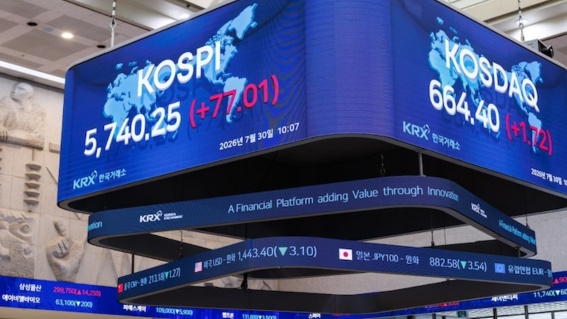
20 November 2026 Punjab Khabarnama Bureau : Asian stock markets witnessed a sharp decline on Friday as concerns over artificial intelligence (AI) valuations and technology-sector investments triggered heavy selling across the region. South Korea’s benchmark KOSPI plunged nearly 5 per cent, Japan’s Nikkei 225 dropped more than 4 per cent, while Hong Kong’s Hang Seng index moved closer to bear-market territory.
The widespread selloff reflected growing nervousness among global investors about the sustainability of the AI-driven stock market rally. Semiconductor and technology companies faced significant selling pressure, extending losses that had already affected Wall Street during the previous trading session.
According to market reports, South Korea’s KOSPI declined approximately 4.7 per cent, while Japan’s Nikkei fell around 4.1 per cent. The sharp losses also affected other Asian markets, with Taiwan’s stock market witnessing particularly heavy selling.
The downturn came despite a major development in the artificial intelligence industry, as Anthropic made a record-breaking public market debut. However, the company’s strong market debut failed to restore investor confidence across the broader technology sector.
Asian Technology Stocks Lead the Decline
The technology sector was among the worst-performing segments across Asian markets. In Japan, semiconductor and technology-related companies faced particularly strong selling pressure.
Shares of SoftBank Group, Kioxia Holdings and Ibiden fell more than 10 per cent during morning trading. These companies have attracted investor interest because of their connections to artificial intelligence, semiconductor manufacturing and data-centre infrastructure.
South Korea also witnessed significant pressure on its major technology companies. Samsung Electronics and SK Hynix, two of the country’s largest semiconductor manufacturers, recorded substantial losses as investors reduced their exposure to chip-related stocks.
The KOSPI’s decline was particularly important because South Korea has been one of the major beneficiaries of the global AI investment boom. The country’s semiconductor industry plays a crucial role in supplying memory chips used in AI processors and data centres.
However, concerns about the sustainability of technology-sector valuations and future AI infrastructure spending have increased selling pressure.
Hang Seng Moves Towards Bear Market Territory
Hong Kong’s Hang Seng Index also experienced a significant decline, falling as much as 2.1 per cent during the trading session.
The index’s decline from its January 29 peak reached approximately 20 per cent, bringing it close to the commonly recognised threshold for a bear market.
A bear market is generally defined as a decline of 20 per cent or more from a recent market peak. The weakness in Hong Kong equities has been influenced by concerns about China’s economic outlook, technology-sector valuations and restrictions imposed by the United States on advanced semiconductor exports.
Chinese technology companies have also faced pressure as investors reassess their growth prospects amid changing international trade and technology policies.
Anthropic’s Record IPO Fails to Lift Market Sentiment
One of the major developments in the global technology sector was the stock market debut of Anthropic, the company behind the Claude artificial intelligence chatbot.
The company completed a record-breaking public offering worth approximately $81 billion, attracting considerable attention from investors and the technology industry.
Anthropic shares opened at $111.50 against their initial public offering price of $83 and climbed as high as $115 during the first trading session. However, the stock eventually reduced its gains and closed 17.1 per cent above its offering price.
Despite the strong debut, the development failed to improve sentiment across the broader AI investment market.
Investors remain concerned about whether the enormous investments being made in artificial intelligence infrastructure will generate sufficient returns over the coming years.
Wall Street Losses Add to Global Market Pressure
The decline across Asian markets followed another difficult session on Wall Street, where all three major US stock indices closed more than 2 per cent lower on Thursday.
The Dow Jones Industrial Average dropped 1,101.11 points, or 2.19 per cent, to close at 49,097.06.
The S&P 500 declined 2.02 per cent to 7,175.83, while the technology-heavy Nasdaq Composite fell 2.25 per cent to 23,879.20.
The S&P 500 also extended its losing streak to six consecutive trading sessions, reflecting growing concerns about technology valuations and the broader economic outlook.
The weakness in US equities created additional pressure on Asian markets, where investors were already concerned about semiconductor stocks and AI-related investments.
Asian Markets Head Towards Worst Week Since 2020
The broader market decline has placed Asian equities on track for their weakest weekly performance since March 2020.
The MSCI Asia-Pacific Index fell approximately 3 per cent during Friday’s trading session, reaching its lowest level since April and extending its losing streak to six sessions.
Japan’s Nikkei was heading towards a weekly decline of approximately 6.8 per cent, while South Korea’s KOSPI was on track for a weekly loss of around 7.5 per cent.
The widespread selling indicates that concerns about artificial intelligence investments are no longer limited to individual technology companies but are increasingly affecting global equity markets.
Investors are now closely monitoring developments in the semiconductor industry, US technology policies and the financial performance of major AI companies.
The latest market correction highlights the uncertainty surrounding the future of the global AI investment boom. While artificial intelligence continues to attract substantial corporate investment, questions about valuations, infrastructure costs and future profitability are influencing investor decisions.
For now, Asian markets remain under pressure as investors reassess their exposure to technology and semiconductor stocks amid growing global financial uncertainty.