

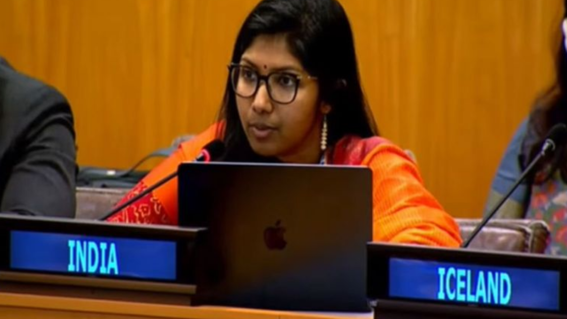
20 November 2026 Punjab Khabarnama Bureau : India has criticised Pakistan at the United Nations for what it described as the selective misuse of the principle of self-determination for narrow domestic political purposes. India stressed that the concept should not be used to justify secession or undermine the territorial integrity of independent countries.
Delivering India’s statement at the United Nations General Assembly’s Third Committee, Bhavika Mangalanandan, First Secretary at India’s UN Mission, said that attempts to reinterpret fundamental principles of the UN Charter for political objectives were unacceptable.
She emphasised that international principles must be applied consistently rather than selectively to advance the interests of individual countries.
“It is unacceptable that attempts are continuously made at the United Nations and elsewhere to reinvent some of the basic principles of the Charter, such as self-determination, and to apply them selectively for narrow or domestic political ends,” Mangalanandan said.
Her remarks came during the committee’s consideration of a resolution titled Universal Realisation of the Right of Peoples to Self-Determination, proposed by Pakistan.
India argued that the principle of self-determination has a specific historical and international context, particularly in relation to decolonisation. Mangalanandan pointed out that the United Nations has recognised self-determination as a vehicle for decolonisation and not as a justification for secession or the violation of the territorial integrity of member states.
India’s representative further explained that in countries that have already achieved independence, the principle of self-determination is best exercised through democratic participation and the regular electoral process.
“We would like to reiterate that in states that have now become independent, self-determination is best maintained through the regular exercise of democratic choice,” she stated.
Although Mangalanandan did not directly name Pakistan during her remarks, her comments were widely understood as a response to Islamabad’s repeated references to Jammu and Kashmir at international forums. Pakistan has frequently raised the Kashmir issue at the United Nations, presenting it as a matter concerning the right to self-determination.
India has consistently rejected Pakistan’s position on Jammu and Kashmir, maintaining that the region is an integral part of the country. New Delhi has also argued that democratic elections and political participation provide people with an opportunity to exercise their democratic rights.
The discussion took place in the General Assembly’s Third Committee, which deals with social, humanitarian and human rights-related matters. The committee considers a range of international issues, including fundamental freedoms, human rights protection and the rights of different communities.
The resolution under consideration was proposed by Pakistan under the title Universal Realisation of the Right of Peoples to Self-Determination. It received support from 62 co-sponsoring countries and was adopted unanimously.
The resolution did not specifically mention any country or territory. This approach helped secure broader support among UN member states. Interestingly, Pakistan’s Permanent Representative to the United Nations, Syed Haider Shah, did not raise the Kashmir issue in his remarks while presenting the resolution.
The development highlighted the diplomatic sensitivity surrounding the principle of self-determination and its interpretation in different international contexts.
The right to self-determination is an important principle of international law and is recognised under the United Nations Charter and other international instruments. It gives peoples the right to determine their political status and pursue their economic, social and cultural development. However, its application and relationship with territorial integrity have remained subjects of international legal and political debate.
India’s statement sought to underline the distinction between the historical process of decolonisation and attempts to use the principle in disputes involving already independent states.
The latest exchange also reflects the continuing diplomatic differences between India and Pakistan over Jammu and Kashmir. Both countries have repeatedly presented their positions before international institutions, particularly the United Nations.
India has maintained that Pakistan should refrain from using international platforms to raise what New Delhi considers its domestic matters. Pakistan, on the other hand, continues to refer to international resolutions and the right to self-determination in its position on Kashmir.
The issue remains an important part of diplomatic discussions between the two neighbouring countries. India’s latest remarks at the Third Committee once again brought attention to its position on the interpretation of international principles, democratic participation and the territorial integrity of sovereign nations.
The statement by Bhavika Mangalanandan is part of India’s broader diplomatic efforts to present its position on Jammu and Kashmir and respond to references made by Pakistan at international forums.
As discussions on self-determination continue within the United Nations, India’s intervention has reinforced its argument that international principles should not be selectively interpreted or used to advance narrow political interests.