

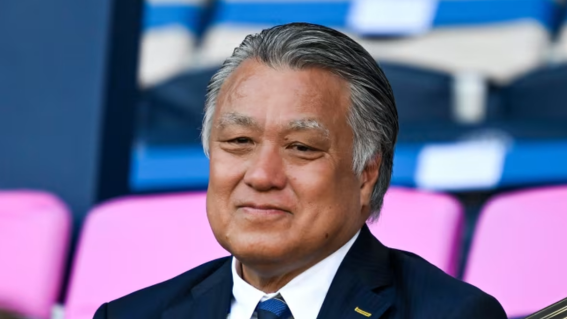
6 November 2026 Punjab Khabarnama Bureau : Japan’s former football federation chief Kozo Tashima has announced his intention to contest the FIFA presidential election against incumbent president Gianni Infantino, setting the stage for a competitive leadership race in world football. Tashima’s announcement comes with the backing of the Japan Football Association (JFA) and introduces a significant challenger ahead of the election scheduled for March 2027.
The 68-year-old Tashima, who currently serves as honorary president of the Japan Football Association, confirmed his decision on November 5 following a meeting of the JFA board in Tokyo. He said he was grateful to receive the full support of the Japanese football governing body and wanted to promote the values of honesty, integrity and responsible administration in international football.
Speaking to Japanese media, Tashima said his decision was not simply about winning or losing the election. Instead, he wanted to communicate the principles that Japanese football had developed over the years and contribute to the future development of the global game.
Tashima’s announcement makes him the second publicly declared challenger to Infantino. Former Tottenham Hotspur defender Ramon Vega had also announced his intention to contest the FIFA presidency in October.
Infantino, who has led FIFA since 2016, is seeking another term in office. The election is scheduled to take place in March 2027 at the 77th FIFA Congress in Rabat, Morocco.
Kozo Tashima’s Football Background
Tashima is an experienced figure in Japanese and international football. Before entering football administration, he represented Japan as a player and earned seven international caps. He also played for Furukawa Electric during his professional career in the 1980s.
After retiring as a player, he moved into coaching and administration. He worked with several Japanese youth teams and was also involved in developing young footballers. One of his notable coaching assignments came in 2001, when he managed Japan’s Under-17 national team at the FIFA U-17 World Cup.
Tashima later became an important figure in Japanese football administration. He served as president of the Japan Football Association from 2016 to 2024 before Tsuneyasu Miyamoto succeeded him. He has also been a member of the FIFA Council since 2015, giving him considerable experience in international football governance.
His long association with FIFA and the Japanese football system is expected to play an important role in his campaign. His stated focus is on promoting transparency, ethical standards and responsible leadership within the organisation.
FIFA Election and Candidate Requirements
The FIFA presidential election is scheduled for March 18, 2027, in Rabat, Morocco. FIFA has 211 member associations, which will participate in the election process.
However, announcing an intention to contest the election does not automatically guarantee a place on the ballot. Candidates must receive formal nominations from at least five FIFA member associations. They must also pass an eligibility review conducted by a three-member panel appointed by FIFA.
The deadline for candidates to submit their nominations is November 18, 2026. Tashima will therefore need to secure the required support from national football associations before the deadline.
Japan’s backing provides an important starting point for his campaign. Reports suggest that he could also receive support from some Southeast Asian countries and European football associations that have expressed concerns about FIFA’s recent decisions.
Meanwhile, Ramon Vega has also entered the presidential race. The former Switzerland international has spoken about football reforms, restoring confidence in FIFA and modernising the organisation.
Infantino Faces Criticism Over FIFA Decisions
Infantino’s leadership has faced criticism in recent months following a controversial proposal involving FIFA’s commercial structure and future World Cup revenues.
In July 2026, FIFA introduced a plan known as FIFA Forward Enterprise, which involved bringing private investors into a commercial entity connected to the organisation’s future tournament revenues. The proposal attracted criticism from several football authorities, including UEFA and CONCACAF.
Opponents raised concerns about transparency, governance and the possible involvement of private investors in FIFA’s commercial activities. Following the backlash, the proposal was withdrawn within days of its announcement.
The controversy added pressure on Infantino’s administration and created further discussion about the organisation’s decision-making processes.
Another important development came from the Asian Football Confederation (AFC). Although the confederation had previously criticised FIFA’s proposed commercial arrangement, its president, Sheikh Salman bin Ibrahim Al Khalifa, announced support for Infantino’s re-election in October 2026.
This development has created an interesting situation for Tashima because Japan is part of the Asian football structure, while the AFC leadership has publicly backed the current FIFA president.
Japan has also witnessed internal disagreement over football administration. Takeshi Okada, vice president of the Japan Football Association and former national team coach, recently resigned from his position. Reports linked his departure to disagreements surrounding developments in international football and sporting integrity.
These developments have brought greater attention to Japan’s position ahead of the FIFA presidential election.
Japan Wants to Promote Integrity in International Football
Tashima has emphasised that his campaign will focus on values that he believes should guide international football. These include honesty, integrity, transparency and high ethical standards.
His announcement also reflects Japan’s intention to play a more active role in discussions about the future leadership of world football.
Japan has developed a strong reputation in international football through its national teams, domestic competitions and youth development programmes. The country’s football administration has also maintained a presence in FIFA’s decision-making structure for several years.
Tashima believes that the experience he has gained through his involvement with Japanese football and the FIFA Council can help him contribute to the development of the sport globally.
His candidacy could also bring additional discussion about the relationship between FIFA’s leadership and its regional confederations. Different football associations have expressed different positions regarding Infantino’s administration, particularly following the abandoned investment proposal.
What Lies Ahead for the FIFA Presidential Race?
The coming weeks will be important for all candidates hoping to challenge Infantino. With the November 18 nomination deadline approaching, securing support from at least five national associations will be the immediate requirement.
The election will determine who leads FIFA during another important period for international football. The organisation will continue overseeing major competitions, including the FIFA World Cup, continental tournaments and international development programmes.
Infantino has already received public backing from the Asian Football Confederation leadership, while Tashima has the support of the Japan Football Association. Ramon Vega has also expressed his intention to contest the election.
With multiple names entering the race, FIFA’s presidential election is attracting attention from football associations and supporters around the world.
Tashima’s decision represents an important development for Japanese football, as he becomes the first Japanese candidate to seek FIFA’s top position. Whether he can secure the necessary nominations and build wider international support will become clearer before the deadline.