

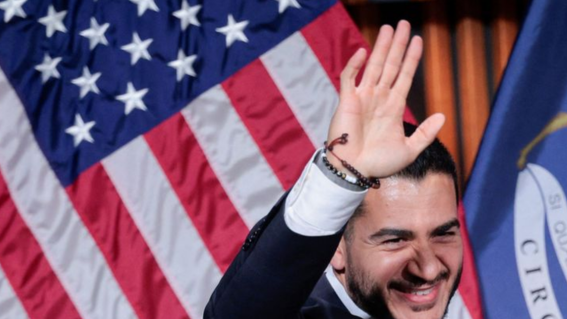
5 November 2026 Punjab Khabarnama Bureau : In a historic political development in the United States, Democrat Abdul El-Sayed has won Michigan’s Senate election, becoming the first Muslim ever elected to the US Senate. His victory marks a significant milestone in American political history, particularly for Muslim and Arab American communities. The election result has also attracted international attention because of the controversial remarks made by US President Donald Trump during the election campaign.
According to media projections reported by Reuters on November 4, 2026, El-Sayed defeated Republican candidate Mike Rogers in Michigan’s closely watched Senate race. The victory allows Democrats to retain the Senate seat being vacated by outgoing Senator Gary Peters.
The 42-year-old politician entered the election campaign facing strong criticism from Trump and several Republican supporters. During a campaign rally in Michigan, Trump repeatedly described El-Sayed as a potential national security threat, called him a jihadist and compared the effort to stop his election with the actions of passengers who fought against hijackers during the September 11, 2001, terrorist attacks.
Despite the controversy, El-Sayed secured the victory, creating a historic moment for American politics.
Trump’s Controversial Remarks During Election Campaign
Donald Trump’s comments about Abdul El-Sayed became one of the most discussed aspects of the Michigan Senate election campaign.
At a rally in Port Huron, Michigan, on October 25, Trump accused El-Sayed of having extremist associations and questioned his loyalty to the United States. He repeatedly used the term jihadist and alleged that El-Sayed had links to the Muslim Brotherhood.
Trump also invoked the September 11 attacks, referring to Todd Beamer, one of the passengers aboard United Airlines Flight 93 who helped resist the hijackers.
Addressing supporters, Trump urged Michigan voters to stand up and prevent what he described as a jihadist from entering the US Senate.
He also made a controversial remark suggesting that El-Sayed would have to pass through a metal detector before entering the Senate.
These comments generated widespread criticism, with Democratic leaders and Arab American organisations describing the rhetoric as discriminatory and Islamophobic.
Abdul El-Sayed Rejects Allegations
Abdul El-Sayed strongly rejected the allegations made against him during the campaign. He denied having any connection with extremist organisations and described questions about his loyalty to America as shameful.
El-Sayed was born in Michigan to Egyptian immigrant parents. He is a physician, epidemiologist and former public health official who previously served as Detroit’s health director.
Responding to Trump’s remarks during a campaign event in Grand Rapids, El-Sayed suggested that the president was using his name and religious identity to distract voters from important economic concerns.
He also criticised the focus on his faith, arguing that voters were more concerned about the rising cost of groceries, fuel and healthcare.
The Democratic candidate maintained that his campaign was focused on improving the lives of ordinary Americans rather than engaging in personal attacks.
Who Is Abdul El-Sayed?
Abdul El-Sayed is a 42-year-old American politician, physician and public health expert. He was born in Michigan to Egyptian immigrant parents and built his career in medicine and public service.
Before entering national politics, he served as Detroit’s health director, where he worked on public health programmes and healthcare-related issues.
He also gained political recognition during his 2018 campaign for governor of Michigan. Although he did not win that election, he continued to build his political profile and became associated with the progressive wing of the Democratic Party.
His political agenda includes affordable healthcare, economic equality, stronger consumer protections and reducing the influence of large corporations in American politics.
What Did Trump Say About Muslim Brotherhood Links?
Another major controversy during the election campaign involved allegations linking El-Sayed to the Muslim Brotherhood, an Islamist political movement.
Trump and Republican supporters raised questions about his alleged connections to the organisation. However, El-Sayed denied any affiliation with the Muslim Brotherhood.
The Associated Press reported that there was no evidence establishing El-Sayed’s membership or affiliation with the organisation. Democratic leaders criticised the allegations and said his religious identity was being used against him for political purposes.
Republican candidate Mike Rogers also raised concerns about El-Sayed’s political associations and positions on foreign policy. However, Rogers publicly stated that he had never personally called El-Sayed a terrorist.
What Are Abdul El-Sayed’s Political Priorities?
During his Senate campaign, El-Sayed focused heavily on economic issues affecting American households.
His major campaign promises included expanding access to affordable healthcare, introducing Medicare for All, reducing the financial burden on working families and limiting corporate influence over government policies.
He also expressed strong opposition to US military assistance to Israel and described Israel’s actions in Gaza as genocide. These positions became another important point of disagreement during the election campaign.
His campaign attracted support from progressive voters who wanted stronger action on healthcare costs, economic inequality and corporate influence.
Historic Victory for Muslim Americans
El-Sayed’s victory is being viewed as a historic development for Muslim representation in American national politics.
Although Muslim Americans have previously served in the US House of Representatives and other elected positions, no Muslim had previously been elected to the US Senate.
His election is therefore expected to have significance beyond Michigan, particularly among Muslim and Arab American communities across the country.
The result also demonstrates how issues such as religious identity, immigration, healthcare, foreign policy and economic affordability became central themes in the 2026 midterm elections.
With his victory, Abdul El-Sayed is set to enter the US Senate as a historic first, following an election campaign marked by intense political attacks and debates over his religious identity and policy positions.
The focus will now shift towards his role in the Senate and how he plans to pursue his campaign promises on healthcare, economic reforms and other national issues.