

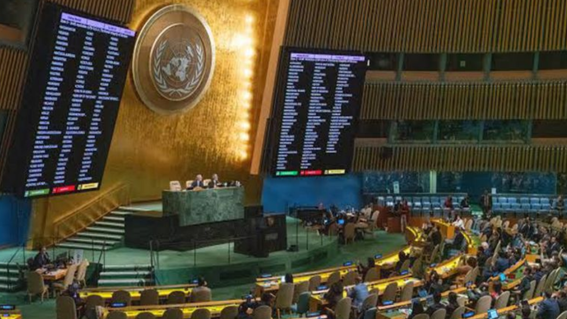
29 October 2026 Punjab Khabarnama Bureau : India has reiterated its opposition to laws that adversely affect the sovereignty of other nations while voting in favour of a United Nations General Assembly resolution calling for an end to the longstanding United States economic embargo against Cuba. The resolution was adopted on October 28, 2026, with 130 countries voting in favour, 17 against and 25 abstaining.
Addressing the General Assembly ahead of the vote, Soumya Nair, counsellor at India’s Permanent Mission to the United Nations, stressed that countries should refrain from introducing or applying laws with extraterritorial effects that undermine the sovereignty and development of other states.
India’s position reflects its continued emphasis on international law, multilateral cooperation and diplomatic engagement in addressing global disputes.
India Raises Concerns Over Laws Affecting Sovereignty
Speaking before the vote, Nair said India supported the UN General Assembly’s repeated calls for countries to reject laws and regulations that have effects beyond their national borders and adversely affect other nations.
She reiterated the Assembly’s appeal for states to refrain from introducing such measures and to repeal or invalidate existing laws that conflict with their obligations under the UN Charter and international law.
India argued that unilateral economic and financial restrictions can affect the progress and prosperity of populations in countries targeted by such measures. The Indian delegation emphasised that international challenges should be addressed through dialogue and diplomacy in accordance with the principles of the United Nations.
Nair said India’s commitment to multilateralism was rooted in the belief that global challenges were best addressed collectively and through respect for established international rules.
UN General Assembly Votes Against the US Embargo
The United Nations General Assembly adopted a resolution titled Necessity of Ending the Economic, Commercial and Financial Embargo Imposed by the United States of America Against Cuba.
The resolution received 130 votes in favour, 17 against and 25 abstentions. India was among the countries supporting the measure, which calls for the removal of the US restrictions that have remained a major source of tension between Washington and Havana for more than six decades.
The annual resolution carries diplomatic and political significance but is non-binding. It does not compel the United States to lift the embargo, and changes to the restrictions remain subject to US domestic law and congressional authority.
Support for the resolution was lower than in 2025, when 165 countries voted in favour, seven opposed it and 12 abstained. Several countries that had previously supported the measure, including Germany and Italy, abstained in the latest vote.
India Highlights the Humanitarian Impact on Cuba
During her statement, Nair referred to the humanitarian and economic difficulties facing Cuba and cited information from the UN Secretary-General’s report.
She said Cuba’s health system faced shortages of more than 60 per cent of essential medicines, while food production had declined by over 50 per cent during the previous five years.
India also expressed concern that restrictions on fuel supplies had aggravated Cuba’s energy crisis. Shortages have disrupted essential services, including healthcare, education, water supplies, food distribution and transportation.
Nair said India hoped the embargo would be lifted at the earliest to create conditions that would allow the Cuban people to participate more fully in international cooperation and pursue their development aspirations.
India’s statement focused on the impact of economic restrictions on ordinary people and the need to address international disagreements through diplomacy.
Diplomatic Tensions Between Washington and Havana
The vote took place amid heightened tensions between American and Cuban representatives at the United Nations.
The diplomatic dispute intensified on Tuesday, October 27, during a General Assembly session when Cuban Foreign Minister Bruno Rodríguez Parrilla approached the dais while US Ambassador Mike Waltz was speaking. The confrontation led to a temporary suspension of proceedings as officials sought to restore order.
On Wednesday, Waltz said a Cuban diplomat would be expelled from the United States following allegations of physical contact with an American diplomat during the incident. The episode added to the tensions surrounding the annual vote on the embargo.
UN Secretary-General António Guterres’ spokesperson Stéphane Dujarric subsequently stressed the importance of respecting the rules and procedures of the General Assembly.
The exchanges highlighted the increasingly strained relations between the two countries as Washington continued to defend its restrictions and Havana called for their removal.
US Defends Its Position on Cuba
The United States voted against the resolution and has maintained that its sanctions are intended to challenge Cuba’s communist government. Washington has also increased pressure on Havana amid the island’s worsening economic crisis.
Following the vote, US Ambassador Mike Waltz welcomed the change in voting patterns, pointing to the increased number of countries that had either opposed the resolution or abstained.
The United States has voted against resolutions calling for an end to the embargo for most years since 1992, with an exception in 2016, when Washington abstained during a period of improved relations with Cuba.
Cuba, meanwhile, has blamed the restrictions for contributing to shortages of essential goods, electricity disruptions and broader economic difficulties. The United States and Cuba continue to disagree over the causes of the crisis and the effectiveness of the sanctions.
India’s Stand on Multilateral Diplomacy
India’s vote reaffirmed its longstanding position that international disputes should be addressed in accordance with the UN Charter and international law.
By supporting the resolution, New Delhi joined the majority of General Assembly members calling for an end to the US embargo, while reiterating its concerns about the extraterritorial impact of unilateral economic measures.
However, the vote does not itself remove the restrictions. The embargo remains in place, and its future will depend on decisions by the US authorities.
The outcome nevertheless carries diplomatic significance, reflecting continuing international debate over economic sanctions, national sovereignty and the humanitarian consequences of prolonged trade restrictions.