

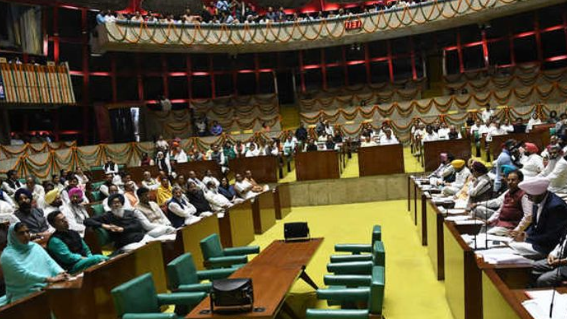
27 October 2026 Punjab Khabarnama Bureau : The Punjab Legislative Assembly is scheduled to take up five resolutions concerning the state’s river water rights on Tuesday, the final day of the ongoing Assembly session. The proposed resolutions cover Punjab’s claim to Yamuna waters, control of key irrigation headworks, the Dam Safety Act, royalty for water supplied to Rajasthan and the flow of Ravi river water into Pakistan.
The resolutions bring the long-running dispute over river water allocation and control of irrigation infrastructure back into focus. The issue has remained a major political and agricultural concern in Punjab, where irrigation needs and declining groundwater levels have increased the importance of reliable water resources.
According to a report by The Tribune, the state government is set to move the five resolutions in the Assembly. The proposals also follow assurances given earlier this year to farmer organisations, including Samyukt Kisan Morcha and Bharatiya Kisan Union (Ekta-Ugrahan), regarding demands related to interstate water agreements and Punjab’s water rights.
Punjab’s claim to Yamuna waters
One of the proposed resolutions asserts Punjab’s historical and legal claim to a share of the Yamuna’s waters. It argues that the river flowed through undivided Punjab before the state’s reorganisation in 1966, but Punjab was not included in formal allocations of Yamuna water.
The resolution highlights the state’s dependence on groundwater for agricultural activities and the pressure this places on its water resources. It notes that groundwater levels have depleted across a significant proportion of Punjab’s blocks.
Punjab had filed a formal complaint on April 25, 2025, seeking the constitution of a water disputes tribunal to determine its claim to an equitable share of Yamuna water. The proposed resolution seeks to reinforce that demand, arguing that access to additional river water could support agriculture and reduce dependence on groundwater.
The question of water allocation is particularly important for Punjab’s farming sector, where irrigation requirements are substantial. Any change in water-sharing arrangements, however, would involve legal, technical and inter-state considerations.
Dispute over irrigation headworks
Another resolution challenges Section 79(1)(c) of the Punjab Reorganisation Act, 1966, under which control of the Ropar, Harike and Ferozepur irrigation headworks was assigned to the Bhakra Beas Management Board (BBMB).
The proposed resolution argues that the provision is unconstitutional and beyond Parliament’s legislative competence, maintaining that water regulation falls within the State List of the Constitution. These are the arguments advanced in the resolution and should not be understood as a final judicial determination of the dispute.
The three headworks are important components of Punjab’s irrigation infrastructure. Their management and the distribution of water have remained contentious issues between Punjab and other stakeholders. The proposed resolution seeks to place the state government’s objections before the Assembly and renew the debate over administrative control.
Demand to reject the Dam Safety Act
The third resolution seeks to reaffirm the Punjab Assembly’s unanimous resolution of May 5, 2025, rejecting the Dam Safety Act, 2021.
The legislation establishes a framework for the surveillance, inspection, operation and maintenance of specified dams in India. Punjab’s proposed resolution would reiterate the state’s position on the law and its concerns regarding the legislation.
The issue forms part of the broader disagreement over the authority of state and central institutions in managing water infrastructure and related responsibilities.
Punjab seeks royalty from Rajasthan
The fourth resolution seeks royalty from Rajasthan for water supplied from the Sutlej, Ravi and Beas rivers. It argues that Punjab should not be required to supply water to another state without payment and calls on the Rajasthan government and the Union Ministry of Jal Shakti to acknowledge the financial liability, ensure annual payments and settle the cost of water already supplied.
The resolution describes Rajasthan as a non-riparian state and argues that it should share the financial burden associated with the water it receives. A non-riparian state is one that does not have the same direct relationship with a river through its territory as states through which the river flows.
The demand is not new. A similar resolution seeking royalty for water supplied to non-riparian states was passed by the previous Akali-BJP government in the Punjab Assembly on November 16, 2016.
The latest proposal could renew debate over the principles governing interstate water distribution, the financial responsibilities of recipient states and the legal framework under which existing arrangements operate.
Ravi water flowing into Pakistan
The fifth resolution addresses the flow of Ravi river water into Pakistan from the Madhopur Headworks, the last headworks on the river in India.
The proposal places attention on how river water is managed at the point where it leaves the Indian side and on Punjab’s concerns regarding the use of available water resources. The issue is linked to the broader debate over the utilisation, management and distribution of river water in the region.
The outcome of the proposed resolutions and any subsequent action by the state or central governments will be important in determining how these demands progress beyond the Assembly.
River water rights remain a major issue
Punjab’s river water disputes have remained a subject of debate across successive governments, particularly because of their implications for farming, irrigation and groundwater conservation. Farmer organisations have also raised demands for reconsideration of older interstate water-sharing agreements and changes to provisions governing water management.
The ongoing Assembly session provides the state government an opportunity to formally place its position on these matters before the House. However, passing resolutions would not by itself settle every interstate dispute; further legal, administrative or intergovernmental steps may be required, depending on the issue.
The five proposed resolutions are expected to bring questions of water allocation, infrastructure control, financial compensation and river management into focus as Punjab continues to press its claims over the state’s water resources.