

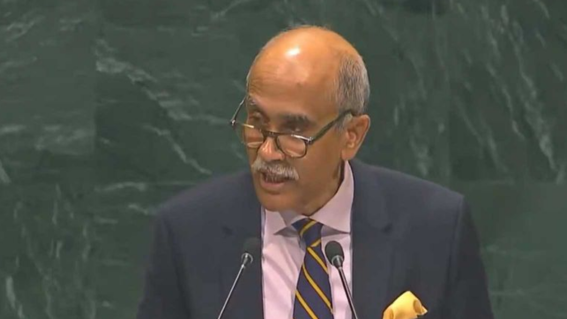
23 October 2026 Punjab Khabarnama Bureau : India has called for meaningful reforms of the United Nations Security Council (UNSC), arguing that the international order established in 1945 no longer reflects present-day geopolitical realities. New Delhi has urged member states to move beyond prolonged discussions and begin concrete, text-based negotiations to make the powerful UN body more representative, effective and accountable.
Speaking during discussions on Security Council reform at the United Nations General Assembly, India’s representative said that the existing structure continued to reflect an earlier era despite major changes in global politics, population and economic power. India stressed that reform must produce tangible outcomes rather than remain limited to repeated statements and procedural discussions.
The intervention comes as the United Nations marks 80 years since its establishment in 1945, renewing calls from several countries for changes to the organisation’s decision-making structures.
India Calls for Expansion of Permanent and Non-Permanent Seats
India emphasised that any meaningful reform of the Security Council must include an expansion of both permanent and non-permanent membership categories.
According to India’s position, increasing only the number of non-permanent seats while postponing changes to permanent membership would leave existing inequalities largely unchanged.
The country argued that the Council’s composition should better reflect the contemporary international community, including the growing importance of developing nations and regions that remain underrepresented in global decision-making.
India has long advocated a larger role for emerging economies and developing countries in the Security Council. It is also part of the Group of Four, alongside Brazil, Germany and Japan, which supports comprehensive reform and expansion of the Council.
Push for Time-Bound, Text-Based Negotiations
India expressed concern over the slow pace of negotiations, noting that discussions on Security Council reform have continued for years without a substantial agreement on changes to its structure.
The Indian representative called for the early commencement of text-based negotiations, supported by clear milestones and timelines. Such negotiations would provide member states with a concrete proposal to examine, amend and discuss rather than repeatedly presenting general positions.
India argued that the existing intergovernmental negotiations process must become more productive and focused on delivering measurable progress.
The country also called on member states to demonstrate political commitment and adopt a constructive approach to resolving differences. It maintained that meaningful reform would require countries to move beyond narrow national considerations and work towards a more effective multilateral system.
India Highlights Africa’s Underrepresentation
Another important element of India’s statement concerned the representation of Africa in the Security Council.
India said historical inequalities must be addressed by including African countries in the permanent membership category of a reformed Council. It urged countries that support correcting Africa’s underrepresentation to clarify their positions on permanent seats.
India also expressed support for representation for small island developing states in a reformed Council, while maintaining that membership arrangements should be based on appropriate criteria rather than religious identity.
The statement reflected India’s broader argument that regional representation is essential to the Council’s legitimacy and its ability to address international peace and security challenges.
Why the Security Council Needs Reform
The United Nations was established in 1945 following the Second World War, with the Security Council given primary responsibility for maintaining international peace and security.
The Council currently has 15 members: five permanent members and 10 non-permanent members elected for two-year terms. The permanent members are China, France, Russia, the United Kingdom and the United States. These five countries also hold veto power over substantive resolutions.
The number of UN member states has increased significantly since the organisation’s founding. However, the Security Council’s membership was last expanded in 1965, when the number of non-permanent seats increased from six to 10.
Supporters of reform argue that the present structure does not adequately represent the wider membership of the United Nations, particularly countries in Africa, Asia and Latin America. They also point to disagreements among permanent members that can prevent the Council from taking action on major international crises.
Reform proposals involve difficult questions, including the number of additional seats, the selection of new members, the distribution of regional representation and the future of veto powers.
Other Countries Also Demand Change
India’s call formed part of a broader international debate over the future of the Security Council. Several countries and regional groups have supported expanding membership in both the permanent and non-permanent categories.
The Group of Four has backed a comprehensive reform model, while the L69 group of developing countries has called for stronger representation of underrepresented regions. African countries have also continued to demand a permanent role that addresses what they describe as a historical injustice.
At the same time, member states hold differing views on the size and composition of an expanded Council, the distribution of seats and the question of veto rights. Reaching agreement therefore remains a major diplomatic challenge.
India Urges Member States to Deliver Results
Concluding its intervention, India called on member states to use the current negotiations to achieve meaningful progress. It said the objective should be a Security Council that reflects present-day global realities and strengthens international cooperation.
India maintained that reform should not be pursued merely for symbolic reasons but should improve the Council’s ability to respond to international challenges and maintain peace and security.
The central message was clear: after eight decades of major global change, the structure of the Security Council needs to evolve. Whether countries can translate their repeated commitments into an agreed reform plan will depend on their willingness to negotiate concrete proposals and bridge their differences.