

19 October 2026 Punjab Khabarnama Bureau : China’s economy gathered momentum in the third quarter of 2026, supported by strong exports of technology-related products and rising global demand for artificial intelligence infrastructure. However, the recovery remains uneven, as weak household spending, declining property investment and sluggish private-sector activity continue to weigh on the domestic economy.
According to data released by China’s National Bureau of Statistics on October 19, gross domestic product (GDP) increased by 4.5% year-on-year in the July–September quarter, up from 4.3% in the previous quarter. The result exceeded economists’ expectations and brought the country closer to its annual growth target of 4.5% to 5%.
The latest figures highlight a growing divide within the world’s second-largest economy. While manufacturers are benefiting from international demand for artificial intelligence hardware, semiconductors and other advanced products, domestic consumers and businesses remain cautious about spending and investment.
AI Boom Strengthens China’s Export Sector
The global expansion of artificial intelligence has become an important source of support for Chinese manufacturing. Demand for semiconductors, data-processing equipment and other technology-related products has helped Chinese companies increase overseas shipments, even as other parts of the economy struggle to regain momentum.
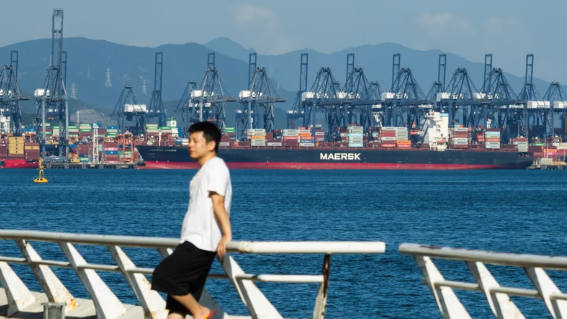
China’s exports rose by 36.3% year-on-year in September, according to recently reported trade figures. Strong shipments of high-tech products, including semiconductor-related goods and data-processing equipment, contributed significantly to the increase. The country recorded a monthly trade surplus of approximately $133.5 billion, while its cumulative surplus for the first nine months of 2026 reached about $938 billion.
The export performance reflects China’s established manufacturing base and its growing role in supplying equipment needed for the global technology industry. As businesses worldwide invest in AI computing capacity, demand has increased for the hardware and industrial components that support data centres and advanced digital infrastructure.
For Chinese manufacturers, overseas demand has helped maintain production levels and support economic growth despite limited momentum at home. Industrial production rose by 5.5% in September, providing further evidence of the strength of the manufacturing sector.
However, export-led growth also creates risks. China’s performance increasingly depends on international demand, leaving the economy exposed to shifts in global technology investment, trade restrictions and geopolitical tensions.
Weak Consumer Spending Remains a Major Concern
Despite stronger exports, domestic demand has not recovered sufficiently to provide a broad foundation for economic growth. Consumers remain cautious, while the prolonged property-sector downturn continues to affect household confidence and spending decisions.
Retail sales increased by 1.1% year-on-year in September, marking their strongest growth since March, but the modest rise suggests that the recovery in consumer demand remains fragile. The contrast between strong industrial activity and limited growth in household spending highlights the uneven nature of China’s economic performance.
Weak consumption is particularly important because domestic spending is essential for sustaining growth over the longer term. If households remain reluctant to spend, manufacturers and retailers may struggle to generate stronger sales within China, even when export orders remain healthy.
The property market is another major obstacle. Falling investment in real estate has weighed on construction activity, related industries and household confidence. Property investment plunged by 20.6% year-on-year, while overall fixed-asset investment declined by 7.2%, according to the latest reported figures.
These figures underline the challenge facing policymakers: gains in technology exports have not yet translated into a broad-based recovery in domestic investment.
Government Faces Pressure to Support Growth
Chinese authorities have introduced measures intended to stabilise economic activity, including support for homebuyers, more affordable credit for selected sectors and additional funding capacity for infrastructure projects.
The government has also sought to direct financial resources towards technology and other strategic industries. These steps are intended to strengthen growth while helping offset weakness in property and private investment.
However, policymakers have so far avoided relying entirely on a large-scale stimulus programme. Strong export performance has eased some immediate pressure to introduce more aggressive measures, but the continuing weakness in domestic demand means additional support could still be required.
The central challenge is to encourage households to spend and businesses to invest without creating new financial risks. A lasting recovery would require more than higher factory output: it would also depend on improving consumer confidence, stabilising the property market and creating conditions for stronger private-sector activity.
Trade Tensions Add to the Uncertainty
China’s growing trade surplus is also attracting greater scrutiny from its trading partners. The sharp increase in exports has raised concerns that overseas markets could face additional competitive pressure from Chinese manufacturers, particularly in technology and other industrial sectors.
The European Union and other major trading partners have been examining ways to respond to trade imbalances and the growing presence of Chinese products in their markets. Any escalation in tariffs, restrictions or other trade barriers could affect the outlook for Chinese exporters.
There is also uncertainty surrounding the sustainability of the global AI investment boom. Chinese manufacturers have benefited from demand for AI-related equipment, but a slowdown in investment by technology companies could reduce orders and weaken one of the economy’s strongest growth drivers.
Outlook: Growth Continues, but Recovery Remains Uneven
China’s 4.5% growth in the third quarter represents an improvement over the previous quarter and keeps the country broadly on track to meet its annual target. Nevertheless, the underlying figures show that export strength and domestic economic weakness are developing simultaneously.
For Beijing, the priority will be to turn the momentum generated by technology manufacturing into stronger domestic demand. Encouraging consumer spending, supporting private investment and addressing the property downturn will be crucial to making growth more balanced.
The AI export boom has provided China with an important economic cushion in 2026. Whether that momentum can be sustained will depend not only on global demand for advanced technology, but also on the government’s ability to restore confidence among households and businesses at home