

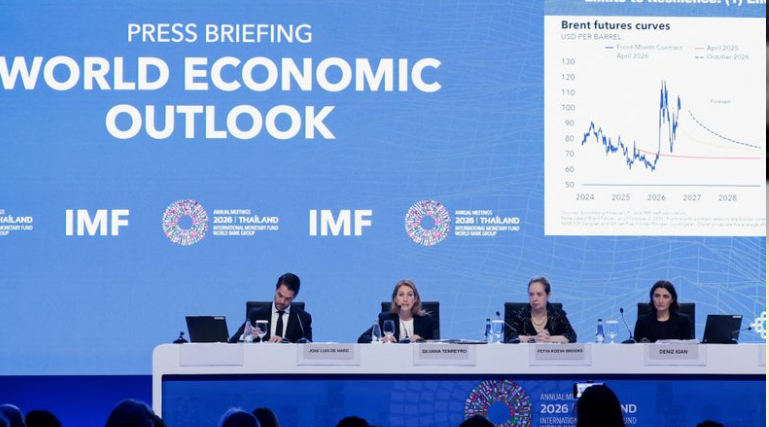
13 October 2026 Punjab Khabarnama Bureau : The International Monetary Fund (IMF) has slightly raised its global economic growth forecast for 2026 to 3.1%, up from its earlier projection of 3% in July. However, the international financial institution has warned that the global economy continues to face significant risks from geopolitical tensions, elevated energy prices, rising public debt and uncertainty surrounding artificial intelligence investment. The IMF’s latest World Economic Outlook update was released on October 13, 2026, as global economic and financial leaders gathered in Bangkok for the IMF and World Bank meetings.
Global Growth Outlook Remains Uneven
According to the IMF, the world economy expanded by 3.5% in 2025. Although the upward revision for 2026 indicates some resilience, the projected growth rate remains below last year’s level.
The IMF expects global economic growth to reach 3.4% in 2027, unchanged from its July forecast. The outlook reflects an uneven recovery, with some economies benefiting from investment in artificial intelligence and technology, while others face increasing pressure from higher energy costs and weaker domestic demand.
The Fund has cautioned that the global economy remains vulnerable to further disruptions, particularly if geopolitical conflicts intensify or financial markets reassess the profitability of major investments in artificial intelligence.
Artificial Intelligence Supports Economic Activity
Investment in artificial intelligence has emerged as an important factor supporting global growth. Spending on data centres, semiconductor manufacturing, computing infrastructure and related technologies has helped offset some of the economic damage caused by higher oil and gas prices.
However, the benefits are concentrated in a relatively small number of countries. The United States and China account for more than three-quarters of net global demand for imported computer chips and other AI-related equipment, according to the IMF’s assessment.
Countries integrated into global technology supply chains may benefit from additional investment and export opportunities. In contrast, economies that depend heavily on imported energy but have limited exposure to the AI investment boom could experience weaker growth.
The IMF has also highlighted uncertainty about whether current technology investments will generate sufficient productivity gains and profits over the longer term. A sudden reassessment of AI-related valuations could affect financial markets and investment activity
Rising Oil Prices Add to Inflation Concerns
Higher energy prices remain a major concern for policymakers and businesses. The IMF expects oil prices to average approximately $96 per barrel in 2026, representing an increase of nearly 41% compared with the previous year.
The rise has been linked to the ongoing conflict in the Middle East and concerns about disruptions to global energy supplies. Higher crude oil prices can increase transportation and manufacturing costs, weaken household purchasing power and complicate central banks’ efforts to control inflation.
Global headline inflation is projected to rise to 4.7% in 2026, compared with 4.1% in 2025. The IMF expects inflation to ease to 4.1% in 2027, although the outlook remains sensitive to developments in energy markets and geopolitical conditions.
United States and Europe Show Different Growth Trends
The IMF expects the United States economy to grow by 2.3% in both 2026 and 2027. Private consumption, fiscal measures and investment in artificial intelligence are expected to support activity.
The eurozone’s 2026 growth forecast has been raised to 1.1%, from 0.9% previously. Increased investment in technology-related industries and higher defence spending have contributed to the improvement.
China’s economy is projected to expand by 4.5% in 2026 and 4% in 2027. Higher energy prices and persistent weaknesses in domestic demand are expected to weigh on growth despite continued export activity.
These projections illustrate the differences between major economies and underline how energy dependence, technology investment and domestic demand are shaping their economic prospects.
India Remains a Major Growth Driver
India continues to stand out among major economies. The IMF has raised its growth forecast for India to 7% for both 2026 and 2027 on a fiscal-year basis, citing resilient domestic demand, strong services activity and investment momentum.
The upward revision contrasts with the more challenging outlook facing several energy-importing economies. Nevertheless, India remains exposed to higher crude oil prices, which can increase import costs, add to inflationary pressures and affect the country’s external balance.
Strong domestic consumption and services activity are expected to provide support, although global uncertainty could influence exports, investment flows and business confidence.
Rising Debt and Geopolitical Risks Threaten Stability
The IMF has warned that governments have limited room to respond to another major economic shock because public debt and borrowing costs remain elevated. Meanwhile, dwindling energy inventories and prolonged geopolitical tensions could leave economies more vulnerable to additional supply disruptions.
The uneven distribution of growth also presents a challenge. Countries benefiting from AI-related investment may continue to expand, while conflict-affected economies and energy importers could face deeper economic difficulties.
The Fund’s latest assessment highlights the need for policymakers to strengthen public finances, manage inflation and improve economic resilience.
Overall, the IMF’s revised outlook suggests that the global economy remains resilient but faces considerable uncertainty. The modest upgrade for 2026 offers some reassurance, yet geopolitical risks, energy prices, debt pressures and the sustainability of AI investment will remain crucial factors shaping the outlook for 2027.