

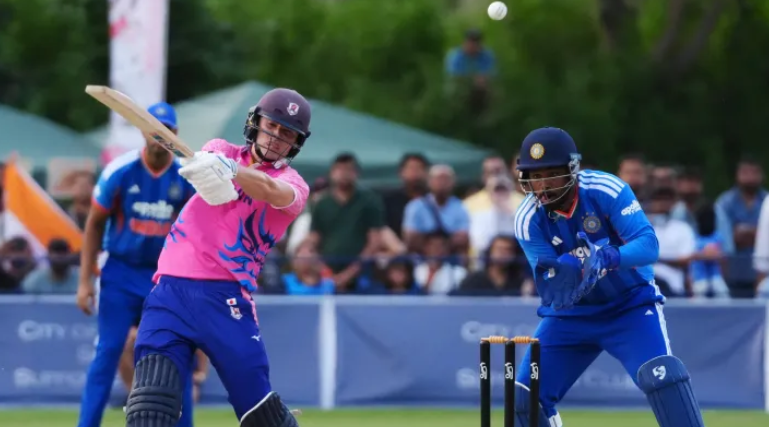
23 September 2026 Punjab Khabarnama Bureau : India escaped with a two-run victory over Japan in a rain-shortened T20 international in Sano, Japan, but the result was overshadowed by a controversial umpiring decision in the final over.
The match was reduced to five overs per side because of rain, with India posting 32/4 before restricting Japan to 30/3. The decisive moment came when a wide call against India was initially given and then overturned after protests from Indian players. The reversal triggered criticism from cricket journalists and fans, with some accusing India of putting undue pressure on the umpires.
What Happened in the Final Over?
Japan entered the final over needing eight runs to win, setting up the possibility of a major upset against India.
Axar Patel was bowling the over for India. After a dot ball and a single, another delivery was initially called a wide by Japanese umpire Chris Thurgate. The decision gave Japan an additional run and another delivery, which would have made the chase considerably easier.
Indian captain Shreyas Iyer and Patel immediately questioned the call. Iyer spoke to square-leg umpire Chris Brown while the two officials subsequently discussed the decision.
The original wide call was then overturned and the delivery was declared legal. Japan therefore lost the extra run and the additional ball that would have followed the wide. The visitors went on to concede only three singles from the remaining deliveries and finished at 30/3.
Why Did the Decision Cause Controversy?
The main issue was not simply that the wide call was changed. The controversy centred on how and when the decision was reversed.
There was no DRS or television umpire available for the match. Instead, the two on-field officials consulted and changed the original decision after the Indian players had protested.
That sequence led to criticism from several observers, particularly because the match was at a decisive stage and Japan was within reach of a historic victory. Wisden writer Ben Gardner described the incident as “disgraceful” and accused India of “bullying” the umpires. Those are his characterisations, rather than an established finding that India improperly influenced the officials.
Was the Wide Call Legally Reversible?
The laws of cricket allow an umpire to revoke a wide decision in specific circumstances.
According to Law 22.3 of the MCC Laws of Cricket, a wide can be revoked if the ball subsequently makes contact with the striker’s bat or person before touching a fielder, or if the delivery is subsequently called a no-ball.
Reports on the incident noted that neither of those circumstances appeared to apply to the disputed delivery. This has fuelled questions about the basis on which the decision was changed.
However, other cricket analysis has pointed out that an umpire can consult another official and correct a decision before the next delivery has come into play. Cricbuzz cited former umpire Simon Taufel’s explanation that an umpire can revoke a call before the next ball begins, meaning the legality of the reversal and whether the players improperly pressured the officials are separate questions.
India Still Had to Defend the Total
Regardless of the controversy, Japan still needed to score the remaining runs after the decision was changed.
The Japanese batters managed three singles from the final three deliveries, leaving them two runs short of India’s 32-run total.
The result completed a remarkable performance from Japan, who had been expected to struggle against the reigning T20 world champions but remained in contention until the final ball.
Japan Came Close to a Historic Upset
India’s batting had already struggled on the slow surface.
Japan’s Charlie Hara-Hinze dismissed Abhishek Sharma early and then removed Ishan Kishan, putting India under immediate pressure. Iyer eventually led a recovery with a quick 16 from 12 balls, allowing India to reach 32/4.
Japan then showed considerable composure during the chase and kept the contest alive despite losing wickets. Captain Kendel Kadowaki-Fleming scored 12 and helped keep Japan within striking distance before being dismissed.
India-Japan Match Carries Wider Significance
The game was significant beyond its controversial finish.
It was the first men’s T20 international between India and Japan, and Japan’s first men’s T20 match against a full ICC member. The match was also connected to celebrations marking 75 years of diplomatic relations between India and Japan.
Japan’s cricket authorities have been working to expand the sport in a country where baseball and football remain far more established. Facing India provided the Japanese side with an important opportunity to gain international exposure.
Shreyas Iyer Praises Japan
After the match, Iyer praised Japan’s performance rather than focusing publicly on the umpiring controversy.
He acknowledged that a five-over match can produce unpredictable results and praised the Japanese team’s attitude and approach.
Japan captain Kadowaki-Fleming also expressed pride in his team’s performance, saying that taking India to the final ball was a significant moment for Japanese cricket.
What the Controversy Really Shows
The incident has opened a broader discussion about player conduct and umpiring procedures.
Players are entitled to question decisions within the laws and spirit of cricket, but officials ultimately control decisions on the field. The absence of DRS in the match meant there was no formal technological review mechanism to settle the dispute.
At the same time, the available reporting does not establish that Indian players deliberately manipulated the officials. The claim that they “bullied” the umpires originated from criticism by commentators and fans following the incident.
A Narrow Win Overshadowed by a Wider Debate
India officially won the match by two runs, but the final-over decision became the dominant talking point.
The episode has raised questions about how officials should handle disputed calls in matches without DRS and how players should respond when they strongly disagree with an umpire.
For Japan, the result was disappointing, but the team demonstrated that it could compete deep into a match against a major cricketing nation. For India, the narrow victory came with an unusual controversy that is likely to remain part of the discussion surrounding the historic encounter.