

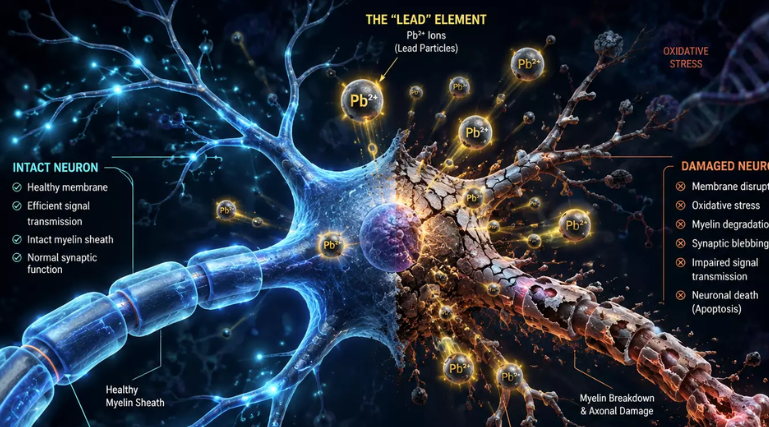
24 Aug 2026 Punjab Khabarnama Bureau : Exposure to lead may worsen damage to nerve cells, particularly when it occurs alongside amyloid-beta, a protein associated with changes seen in neurodegenerative disorders, according to a study by researchers at the ICMR-National Institute of Nutrition (ICMR-NIN).
The research, published in the Journal of Applied Toxicology, examined how lead and amyloid-beta affect human neuronal cells under laboratory conditions.
Lead and Amyloid-Beta Combination Causes Greater Damage
Researchers studied the effects of lead exposure and two forms of amyloid-beta on human nerve cells.
While lead and amyloid-beta individually caused cellular disruption, the combination produced a significantly stronger effect, suggesting that environmental lead exposure could add to cellular stress linked to amyloid-beta.
Lysosomes at the Centre of the Damage
The researchers found that the damage was particularly evident in lysosomes, tiny structures that act as the cell’s waste-disposal and recycling system.
Combined exposure affected the cells’ survival, disrupted the acidic conditions lysosomes need to function properly and altered their structure.
Lysosomal Membranes Became Unstable
The study also found signs that lysosomal membranes became unstable and leaky.
Such leakage could allow enzymes normally contained inside lysosomes to escape into the cell, potentially contributing to further cellular damage.
Changes in Key Proteins and Genes
Researchers observed changes involving proteins and genes associated with lysosomal function, including TFEB, TRPML1, LAMP1, LAMP2 and Cathepsin B.
These changes provide clues about how lead exposure may interfere with the cellular mechanisms that help nerve cells maintain and clear damaged material.
Researchers Highlight Environmental Exposure
Dr Suresh Challa, who led the research team at ICMR-NIN, said the findings show that lead exposure can significantly worsen lysosomal dysfunction when amyloid-beta is present.
The researchers said understanding these cellular changes could help clarify how environmental pollutants may influence neuronal health.
Study Does Not Prove Lead Causes Neurodegenerative Disease
The researchers stressed that the findings should be interpreted carefully.
The experiments were conducted on human neuronal cells in laboratory conditions. The study therefore does not establish that exposure to lead directly causes neurodegenerative disease in people.
Why the Findings Matter
Lead is an environmental pollutant known to affect multiple organs, including the nervous system. The new research adds to scientific understanding by examining how lead may interact with biological factors associated with neuronal stress.
The findings also highlight the importance of studying environmental exposures alongside other factors that may influence brain health.
Need for Further Research
More research, including studies involving human populations, will be needed to determine whether the cellular effects observed in the laboratory translate into measurable neurological risks in people.
Researchers say understanding such interactions could eventually help identify pathways through which environmental pollutants influence neurodegenerative disease processes.