

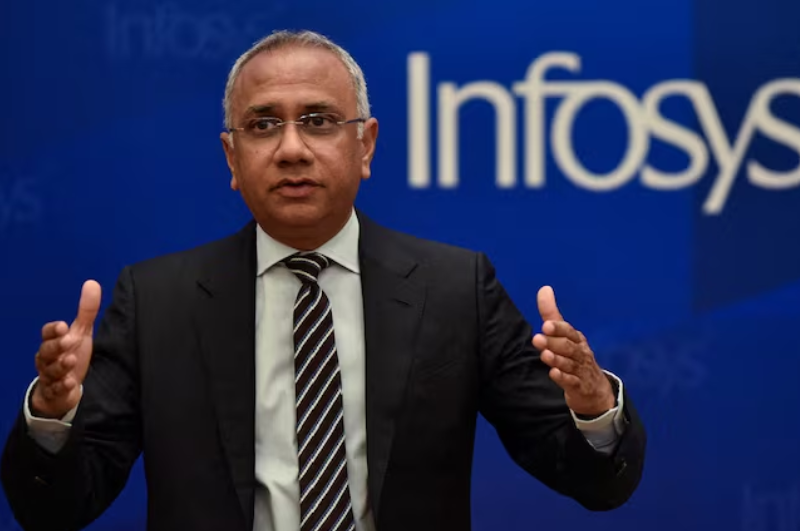
24 April 2026 Punjab Khabarnama Bureau Infosys has granted employee stock ownership plans (ESOPs) worth approximately ₹52 crore to its Chief Executive Officer Salil Parekh, even as a decision on wage hikes for employees remains pending. The development has drawn attention within the IT sector, particularly amid ongoing discussions around compensation and workforce expectations.
According to company disclosures, the ESOP grant is part of the long-term incentive structure designed to reward senior leadership and align their interests with the company’s performance. Such stock-based compensation is commonly used in the corporate world to retain top executives and incentivise sustained growth.
The timing of the grant, however, has sparked debate, as employees continue to await clarity on annual salary revisions. Infosys, like many IT firms, has been navigating a challenging business environment marked by cautious client spending and global economic uncertainty. These factors have influenced decisions related to compensation and hiring.
Industry observers note that ESOPs differ from direct cash payouts, as their value depends on the company’s stock performance over time. For executives, this creates a long-term incentive to drive shareholder value. However, employees often view such announcements in the context of broader compensation policies, including salary hikes and bonuses.
Infosys has not yet announced its decision on wage hikes for the current cycle. In recent quarters, IT companies have adopted a cautious approach to salary increases due to slower demand growth and pressure on margins. Delayed hikes have become a trend across the sector, reflecting the uncertain outlook.
Employees, particularly at junior and mid-levels, have been expecting updates on pay revisions. With rising living costs and inflation concerns, compensation adjustments remain a key issue for the workforce. The delay has led to discussions within the industry about balancing cost management with employee satisfaction.
From the company’s perspective, maintaining financial discipline is crucial in a volatile environment. Infosys has been focusing on operational efficiency, cost optimisation, and strategic investments to sustain growth. Decisions on wage hikes are likely being evaluated in this broader context.
Analysts suggest that the ESOP grant to the CEO is part of a pre-determined compensation framework and should not be directly linked to the timing of employee salary decisions. However, perceptions within the workforce can differ, especially when announcements coincide.
The IT sector has been undergoing a phase of adjustment following a period of rapid growth during the pandemic. Demand for digital services has moderated, leading to a more cautious approach by companies. This has impacted hiring, salary increments, and overall workforce planning.
Infosys remains one of India’s leading IT services companies, with a strong global presence and a diverse client base. Its performance and policies are closely watched by industry stakeholders, given its influence on broader trends.
The company has emphasised its commitment to employee well-being and long-term growth. Initiatives related to training, upskilling, and career development continue to be part of its strategy to retain talent.
As the situation evolves, employees are likely to look for clear communication from the company regarding compensation decisions. Transparency and timely updates can help manage expectations and maintain morale.
The broader conversation also reflects the changing dynamics of the workplace, where compensation structures are increasingly complex and include a mix of fixed pay, variable incentives, and stock-based rewards.
In conclusion, Infosys’ decision to grant ₹52 crore worth of ESOPs to CEO Salil Parekh highlights its approach to executive compensation, while the pending decision on employee wage hikes underscores the challenges faced by the IT sector in balancing growth and cost management.
Summary
Infosys granted ₹52 crore ESOPs to CEO Salil Parekh, while employee wage hikes remain undecided, highlighting ongoing IT sector challenges in balancing executive incentives with workforce compensation amid economic uncertainty.