

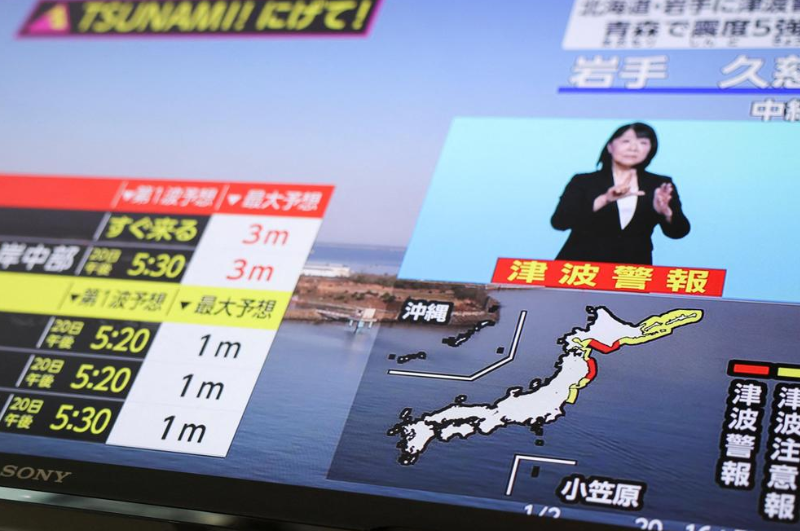
20 April 2026 Punjab Khabarnama Bureau : A powerful earthquake measuring around 7.4–7.5 magnitude struck off the northeastern coast of Japan, triggering tsunami warnings and prompting emergency evacuations across several coastal regions. Authorities confirmed that tsunami waves of up to 80 centimetres were recorded shortly after the quake, raising concerns about further coastal impact.
The earthquake occurred in the Pacific Ocean near Japan’s northern Honshu region, with its epicentre located at a relatively shallow depth of about 10 kilometres. Such shallow undersea quakes are more likely to generate tsunami activity due to the displacement of the ocean floor.
According to the Japan Meteorological Agency, tsunami warnings were issued for multiple prefectures, including Iwate, Aomori, and parts of Hokkaido. Officials initially warned that waves could reach heights of up to 3 metres, although the first waves recorded were significantly smaller at around 80 cm.
Authorities urged residents in low-lying coastal areas to evacuate immediately and move to higher ground. Emergency alerts were broadcast across affected regions, and evacuation orders were issued in several towns with a history of tsunami vulnerability.
The earthquake’s tremors were strong enough to be felt across a wide area, including major cities such as Tokyo. Transport services were disrupted as a precautionary measure, with bullet train operations temporarily suspended in some regions.
Japan’s Prime Minister, Sanae Takaichi, announced the formation of an emergency task force to assess potential damage and coordinate response efforts. Officials stated that they were closely monitoring the situation for aftershocks and additional tsunami waves, which can arrive in multiple surges following a major quake.
Emergency services and disaster response teams were deployed quickly, reflecting Japan’s high level of preparedness for seismic events. The country lies along the Pacific “Ring of Fire,” one of the most seismically active zones in the world, making earthquakes and tsunamis relatively frequent occurrences.
Initial reports did not indicate any major abnormalities at nuclear facilities in the affected regions, although inspections were ongoing as a precaution. This is particularly significant given Japan’s history with nuclear incidents triggered by seismic events, most notably the 2011 Fukushima disaster.
The observed 80 cm wave, while not catastrophic, is still considered dangerous, especially for coastal infrastructure, fishing vessels, and low-lying communities. Experts warn that even relatively small tsunami waves can cause strong currents and flooding, posing risks to life and property.
Authorities also cautioned that tsunami waves often come in multiple phases and that the first wave is not always the largest. Residents were advised to remain in safe areas until official warnings are lifted, even if initial waves appear minor.
The incident has revived memories of past disasters in Japan, particularly the devastating 2011 earthquake and tsunami that caused widespread destruction and loss of life. While the current event appears less severe, officials are taking no chances in ensuring public safety.
Experts note that earthquakes of this magnitude are capable of causing structural damage and generating aftershocks, which may continue for days. Monitoring agencies are keeping a close watch on seismic activity in the region to provide timely updates.
The global community has also been observing developments, with international agencies ready to assist if needed. Japan’s robust disaster management systems, however, are expected to handle the situation effectively.
In conclusion, the 7.4–7.5 magnitude earthquake off Japan’s coast and the resulting 80 cm tsunami wave highlight the country’s ongoing vulnerability to natural disasters. While the initial impact appears limited, authorities remain vigilant as they assess damage and ensure the safety of residents in affected areas.
Summary
A 7.4–7.5 magnitude earthquake hit Japan, triggering tsunami warnings and an 80 cm wave, prompting evacuations as authorities monitor aftershocks and potential further risks.