

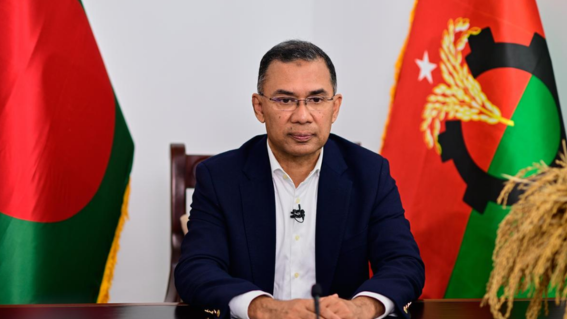
13 February 2026 Punjab Khabarnama Bureau : The political landscape of Bangladesh has witnessed many dramatic moments since independence, but few have generated as much attention and debate as the political rise and renewed prominence of Tarique Rahman. Often described as one of the most polarising figures in Bangladeshi politics, Rahman’s emergence as a central opposition leader marks what many observers call a striking political debut in the country’s contemporary history.
As the acting chairman of the Bangladesh Nationalist Party (BNP), Tarique Rahman has stepped firmly into the national spotlight, shaping opposition strategy and redefining the party’s political messaging at a time of intense democratic debate. His rise carries both the weight of legacy and the promise of generational change, making his political journey closely watched by supporters and critics alike.
Born into one of Bangladesh’s most influential political families, Tarique Rahman is the elder son of former Prime Minister Khaleda Zia and the late President Ziaur Rahman. For years, his political identity was inseparable from his lineage. However, in recent times, Rahman has sought to carve out an independent political profile, positioning himself as a reform-oriented leader capable of revitalising the BNP.
His political debut, though gradual, has been striking due to its timing and impact. At a moment when opposition politics in Bangladesh faced organisational fatigue and declining morale, Rahman’s assertive leadership injected new energy into the BNP’s ranks. Party insiders credit him with restructuring grassroots networks, re-engaging young supporters, and sharpening the party’s criticism of governance and democratic practices.
Rahman’s leadership style reflects a blend of traditional opposition rhetoric and modern political communication. Addressing supporters through virtual platforms and coordinated party messages, he has managed to remain politically relevant despite being away from the country. Analysts say this approach has allowed him to overcome physical distance while maintaining influence over party strategy.
Supporters portray Rahman as a symbol of resistance and continuity. To them, his leadership represents the revival of the BNP as a credible alternative force in national politics. They argue that his ability to mobilise supporters, articulate demands for electoral reform, and challenge entrenched power structures demonstrates political maturity beyond mere inheritance.
Critics, however, remain sceptical. They point to controversies from earlier phases of his political career and question whether his leadership can broaden the BNP’s appeal beyond its traditional support base. Some political analysts caution that while Rahman’s debut as a dominant opposition figure is impressive, sustaining momentum will require inclusive politics and tangible organisational reforms.
The significance of Rahman’s political emergence is closely tied to Bangladesh’s broader democratic trajectory. His speeches frequently emphasise issues such as free and fair elections, judicial independence, and political accountability—topics that resonate strongly with sections of the electorate. By consistently framing the BNP’s agenda around democratic reform, Rahman has attempted to align his leadership with popular aspirations.
Observers note that Rahman’s rise also reflects a generational shift within Bangladeshi politics. Younger voters, many of whom did not experience the political era of his parents, are encountering him as a contemporary political figure rather than a legacy name. His messaging increasingly targets youth concerns, including employment opportunities, governance transparency, and political participation.
Internationally, Rahman’s growing prominence has attracted attention among diplomatic and policy circles monitoring Bangladesh’s political developments. His role in shaping opposition narratives is viewed as a key factor in determining how competitive and inclusive future political processes may become.
Despite challenges, Tarique Rahman’s political debut stands out for its resilience and adaptability. Few opposition leaders in Bangladesh’s recent history have managed to maintain influence under prolonged political pressure while reorganising a major party. Whether his leadership ultimately transforms the BNP into a decisive electoral force remains uncertain, but his impact on the political discourse is undeniable.
As Bangladesh continues to navigate questions of democracy, governance, and political pluralism, Tarique Rahman’s role is likely to remain central. His striking political debut is not merely about personal ascent—it reflects the evolving dynamics of opposition politics in a country at a critical crossroads.
Summary
Tarique Rahman’s emergence as BNP’s key leader marks a striking political debut, reshaping opposition politics in Bangladesh and signaling a generational shift amid ongoing debates over democracy and governance.