

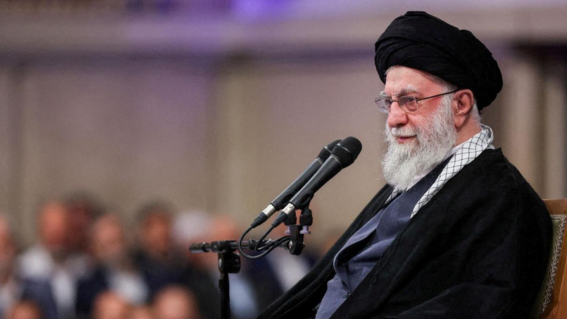
9 January 2026 Punjab Khabarnama Bureau : Protests across Iran continued to simmer as Supreme Leader Ayatollah Ali Khamenei delivered a sharp rebuke to former US President Donald Trump, telling him to “focus on the problems in his own country” instead of commenting on Iran’s internal situation. The remarks came amid renewed demonstrations in several Iranian cities, driven by a mix of economic hardship, political discontent, and longstanding grievances against the establishment.
In a public address, Khamenei accused the United States of hypocrisy, asserting that Washington has no moral authority to lecture Iran on governance, human rights, or public dissent. Without naming Trump directly in all instances, the Iranian leader made it clear that recent comments by the former US president regarding unrest in Iran were “interference” and part of a broader pattern of external pressure.
Trump had earlier commented on social media and in public statements about protests in Iran, expressing support for demonstrators and criticising the Iranian leadership. His remarks echoed similar positions taken during his presidency, when his administration pursued a “maximum pressure” campaign against Tehran, including harsh economic sanctions and diplomatic isolation.
Responding to these comments, Khamenei said the US itself is grappling with deep social, racial, and economic divisions. He pointed to issues such as inflation, crime, homelessness, gun violence, and political polarisation as evidence that American leaders should prioritise domestic challenges rather than “meddling” abroad.
“Those who cannot manage their own society should not pretend to be advisers to others,” Khamenei said, according to state media. He also alleged that foreign powers routinely attempt to exploit internal problems in Iran to weaken the country from within.
The protests in Iran have reportedly taken place in parts of Tehran and several provincial cities. While demonstrations have varied in size and intensity, they reflect persistent public frustration over high unemployment, rising prices, currency depreciation, and restrictions on political and social freedoms. In some areas, protesters have reportedly chanted slogans critical of the government and called for reforms.
Iranian authorities, however, have played down the scale of the unrest. State officials have described the protests as “limited” and accused hostile foreign actors of amplifying them through social media and international news coverage. Security forces have been deployed in sensitive areas, and internet access has reportedly been restricted in some regions to curb the spread of protest-related content.
The Iranian government maintains that economic challenges are largely the result of US-led sanctions, which have significantly constrained Iran’s ability to trade freely and access global financial systems. Officials argue that despite these pressures, the country continues to function and that recent economic difficulties are being addressed through domestic policy measures.
Khamenei reiterated this narrative, blaming Western sanctions for much of the economic pain faced by ordinary Iranians. He accused the US of deliberately targeting civilians through economic warfare while simultaneously claiming to support the Iranian people.
Analysts say the exchange between Khamenei and Trump highlights how Iran’s internal unrest is closely intertwined with its fraught relationship with the United States. Any major protest movement in Iran tends to draw international attention, particularly from Washington, which Tehran views with deep suspicion due to decades of hostility.
The comments also come at a time of heightened geopolitical tensions in the Middle East. Iran remains involved in complex regional dynamics, including conflicts in Gaza, Syria, and Yemen, and its relationship with Western powers continues to be strained over its nuclear programme. Against this backdrop, Iranian leaders are particularly sensitive to foreign statements that could be perceived as encouraging domestic dissent.
Political observers note that Khamenei’s strong response serves multiple purposes. Domestically, it reinforces a narrative of resistance against foreign interference, which has long been a cornerstone of the Islamic Republic’s legitimacy. Internationally, it signals that Tehran remains defiant in the face of external criticism and unwilling to soften its stance under pressure.
Meanwhile, reactions among Iranians appear mixed. Some citizens reportedly welcomed Khamenei’s criticism of the US, viewing it as a defence of national sovereignty. Others, however, argue that external criticism does not negate the reality of internal problems, particularly economic hardship and restrictions on freedoms.
Human rights groups outside Iran have continued to call on the Iranian government to respect the right to peaceful protest and freedom of expression. They have urged authorities to avoid excessive use of force and to address protesters’ concerns through dialogue and reform.
As protests continue intermittently, the situation remains fluid. Whether demonstrations will escalate or subside may depend on a range of factors, including economic conditions, government responses, and broader regional developments. For now, Khamenei’s message is clear: Iran’s leadership rejects foreign commentary on its internal affairs and insists that criticism from figures like Trump carries little credibility.
The latest exchange underscores the enduring animosity between Tehran and Washington, suggesting that even as leadership changes in the US, sharp rhetoric and mutual distrust remain deeply entrenched.
Summary
Amid ongoing protests in Iran, Supreme Leader Ayatollah Khamenei slammed Donald Trump for commenting on unrest, urging him to address America’s own problems and accusing the US of interference.