

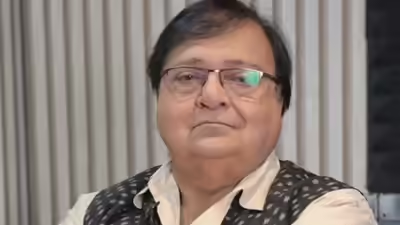
16 December 2025 Punjab Khabarnama Bureau : Veteran actor Rakesh Bedi is best known for his comic roles. So, he couldn’t help but pepper some laughs even in an extremely violent and gory film like Aditya Dhar’s Dhurandhar. The actor plays a politician in Pakistan’s Lyari, Jameel Jamali who knows how to stay in power even as the balance of power shifts and overturns. He is fine to even marry his daughter to a man he knows is a violent gangster, essayed by Ranveer Singh, as long as he can keep a sight on his ‘kursi’. Bedi accepted that his character is based on a real-life Pakistan politician. While Bedi didn’t reveal the name, Reddit threads have zeroed in on Pakistani politicians such as Nabeel Gabol. However, Aditya Dhar and filmmakers have been clear that it’s a work of fiction that is inpired by real life incidents.
On the latest edition of SCREEN Spotlight, Bedi discusses the approach to his role, working with Dhar and Ranveer Singh in the blockbuster spy thriller, and his memories of Sai Paranjpye’s seminal 1981 comedy Chashme Buddoor.
It was a pleasant surprise to see you in Dhurandhar since it’s such a violent film. How did that happen?
There’s violence of course, but it’s sporadic. But yes, it’s a very intense film. My role is also violent in a way. I’m not killing someone or getting beaten up. But I’m pulling the shots. There’s a politician in Pakistan, whom you can spot in the political arenas and the Senate there even today. It’s their Parliament, but they call it ‘Senate’ (laughs). There’s violence ingrained in his thinking and actions.
Have you impersonated that real-life Pakistani politician?
Yes, I watched a lot of his visuals, body language, and speeches. I’ve picked up whatever I could within the framework of our story. He’s like a fox. Come what may, he’ll remain in power irrespective 0f which government is in power. There are some people like that in India as well, who know how to remain in power by hook or by crook (laughs) .
Did you inject humour into that character to make him even more deceptively dangerous?
No, he’s not so deceptive. He’s quite an open character. He’s also the father of the heroine (Sara Arjun), with whom Ranveer’s character falls in love. He doesn’t like him initially, but once he realizes how much use he can be of to him, he starts playing his game there as well.
Ranveer called you “an institution” at the trailer launch. How was your experience of working with him?
According to me, Ranveer Singh is the most hardworking and vibrant actor in the breed of actors that’s come in in the last 10-15 years. He doesn’t forget his lines. His memory and reflexes are very sharp. He’s not frivolous. He goes deep into the character. Also, he doesn’t make anyone on set feel he’s the hero of the film. He takes everyone along as long as the shoot is on. He’s not obsessed with himself. That’s how it should be. Films don’t work only because of the hero anymore. Every actor plays their part beautifully.
Does Ranveer remind you of any old co-star of yours?
Govinda used to be like that. He was very vibrant, energetic, and on his toes all the time. He’d keep you on the edge. But he took up too much of films at one point of time, and got into other tracks which seemed unprofessional to others, like not honouring his time commitment. Initially, in the first five to seven years of his career, he was fantastic! He used to make a scene work. He didn’t perform casually.
Aditya Dhar has always cast you in unexpected roles, from Uri: The Surgical Strike to Dhurandhar. But what was the idea behind incorporating humour into your role, despite his initial reservations?
There’s already a lot of tension in the film. When you watch a violent scene, it doesn’t happen in isolation. There’s a build-up to, and then there are also the repercussions after each violent sequence. The audience would hope that once Rakesh Bedi enters the frame, there’ll be a spark. So, when I demonstrated on the set, Aditya said, “Nahi Rakesh ji, mat kijiye.” But I told him I’m neither going out of the film’s framework nor changing the scene. Then he started enjoying it and became a party with me. Technically, it’s called a relief shot. If you make a film tense for three hours in one go, then the audience would get overwhelmed. For example, there’s a shot of mine signalling “Screw you, boss!” which has now become a GIF. When he asked me not to do it, I told him when I used to do that in a play where the situation was the same, the audience would erupt into laughter. But see now, it even made it to the trailer. So, Aditya is quite firm, but also a very receptive director.
You were pretty clear right from your days at the Film and Television Institute of India (FTII) that you wanted to do comedy. Did you not have any ambition to play the lead actor?
Mujhe aisi koi galatfehmi nahi thi. Back in the late 1970s, there was a fixed roster of lead actors. They used to be in the height range of 5’10 to 6’2. They needed to have good bodies, girls should swoon over them, and they should know how to romance, dance, swim, and ride a horse. It seems funny now. These days, you need to know how to act. Horse riding toh hoti rahegi.
Your first film was also Anil Kapoor’s first film — Umesh Mehra’s Humare Tumhare (1979). How was the Anil Kapoor of those days?
(Laughs) Anil Kapoor was like how every struggler used to be in those days.
Your breakthrough, of course, happened with the buddy comedy Chashme Buddoor in 1981. What are your memories of working with your late co-stars Farooq Shaikh and Ravi Baswani?
I met Ravi for the first time on that set, but I knew Farooq from our theatre days. We shared a great bond. We did a couple of other films together, like Saath Saath (1982) and Mera Damad (1995). It’s crucial to maintain that harmony with your co-stars when you’re doing a comedy. There’s no place for one-upmanship at all. The more you give to your co-star, the more you receive. I act in so many plays, so I know there’s no point in stealing the punch. It’s the scene which should land. Chashme Buddoor was a cult film. It’s a story of three friends, like the Dil Chahta Hai (2001) of those times.
Were there a lot of pranks and locker room talk on set?
Sai Paranjpye was a big taskmaster. She had a very short temper. She was also a lady director. She’d sulk a lot. It’d get a little tough for gents to work in that environment. So we’d fool around as soon as she left, and would get serious again once she returned (laughs).
Like you’re cast against type in Dhurandhar, “Miss Chamko” Deepti Naval is also playing an evil character with a smile in the upcoming whodunit, Raat Akeli Hai: The Bansal Murders. How have you seen her evolution as an actor since Chashme Buddoor?
She’s a wonderful actor. In those days, when Chashme Buddoor released, glamour, figure, and height were a huge part of a heroine’s profile. Doing thumkas and mujras were integral to playing a heroine. So maybe, Deepti Naval didn’t fit into that zone. That’s why she didn’t get that much success in commercial cinema. People didn’t recognize her talent. But the films she did, she did them very well.
Do you feel there was also a hierarchy in parallel cinema, which is why actors like you, her, and Amol Palekar weren’t cast in the films of Shyam Benegal and Govind Nihalani?
Definitely. But I didn’t go into that zone by choice. I never had the wish to do some big art film. I was happy doing commercial stuff.
You also did a lot of television over the years. But you weren’t really keen initially. How did the late Kundan Shah convince you for Ye Jo Hai Zindagi (1984)?
Kundan Shah was my batchmate at FTII. I had a very good role in his diploma film also. We were very close friends. He used to call me four to five times and say, “Tu pagal hai kya?” Then I read a magazine sitting at a barber’s shop which said in the West, television stars are bigger than film stars. Then I read a very good line: “If you’re not on television, you’re nowhere.” It’s like today, if you’re not on social media, you’re nowhere (laughs). Doing television was one of the greatest decisions of my life. It enabled 20-22 years of a good chunk of my career, which included Ye Jo Hai Zindagi, Shriman Shrimati (1994-97), Yes Boss (1999-2009), Hum Sab Ek Hain (1998-2001), Bhabhiji Ghar Par Hain! (2015-present), and Taarak Mehta Ka Ooltah Chashmah (2008-present) even till today. Had I not done television, it would’ve been very tough.
You’re working with another batchmate of yours, David Dhawan, in his next directorial, Hai Jawani Toh Ishq Hona Hai. Do you think his comedy have evolved from the Govinda times to these Varun Dhawan days?
David is a very smart man. Without intelligence, you can’t make so many good films. There’ll be a chapter on David Dhawan cinema in the book on the history of Indian cinema.
Finally, what did you think of his 2013 remake of your Chashme Baddoor?
It was no match to ours. Even he knows that (laughs).
Summary:
Rakesh Bedi, who plays the character ‘Jameel Jamali’ in the film Dhurandhar, revealed that the role was inspired by a real-life Pakistani politician. He noted that the politician, who served as a model for the character, continues to be active in Pakistan’s Senate even today. This insight adds a layer of authenticity and political nuance to the portrayal.