

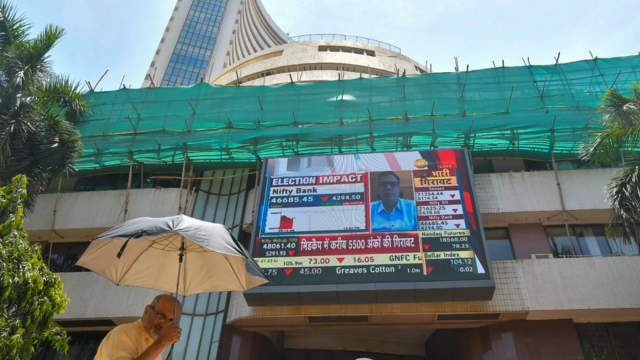
October 18, 2025 (Punjab Khabarnama Bureau) : Indian equities delivered a strong performance this week, with the SENSEX and NIFTY50 both rising more than 2 per cent, driven by renewed investor hopes of a breakthrough in the bilateral trade talks between India and the United States. According to market participants, improved clarity around the trade relationship is acting as a significant tailwind for the domestic index rally.
What happened on the markets
Over the week, the SENSEX climbed past its previous high-water marks, while the NIFTY50 advanced by over 2 per cent, buoyed by short-covering and strong buying interest from both domestic and foreign investors. The uptick coincides with reports that India and the U.S. are closing in on signing a trade deal, potentially in the first phase by November.
Sector-wise, banking, auto and consumer discretionary names led the pack. The Bank Nifty, in particular, hit new milestones as investors focused on improved loan growth and asset-quality expectations in the financial sector. The auto and FMCG sectors also benefited from festive-season optimism and renewed global demand cues.
Why the trade-deal hopes matter
The India-U.S. trade negotiations are seen as pivotal for multiple reasons. First, India is a major trading partner for the United States, and a deal could unlock tariff reductions and market access for Indian exports.
Second, the deal is expected to signal greater global confidence in India’s growth story and its integration into value chains anchored in the U.S. and other advanced economies. This affirmation tends to drive foreign institutional investor (FII) flows into Indian equities, lifting sentiment.
Third, such an agreement could reduce trade‐friction risk and the spectre of steep U.S. tariffs (recently imposed on Indian goods) being a drag on economic growth. With improved certainty, domestic sectors—especially exports—could see a boost, supporting the corporate earnings narrative.
Macroeconomic context & market mechanics
In parallel to trade optimism, other macro cues have been supportive. The Indian rupee has strengthened modestly, and the domestic inflation and interest-rate outlook remains stable, giving investors comfort in expanding their equity allocations.
Moreover, foreign investment flows, which had moderated in recent months, have shown signs of revival. This is partly attributed to shifting global monetary expectations (notably the U.S. Federal Reserve’s potential policy easing) and India’s attractiveness as a structural growth play.
Risks and caveats
Though sentiment is positive, analysts caution against excessive exuberance. Markets are now paying up for improved growth and trade expectations, meaning valuations are increasingly sensitive to disappointments. Any delay or breakdown in the trade deal, or a deterioration in global growth or interest-rate trends, could reverse gains.
Additionally, while the trade negotiation process looks constructive, both sides continue to stress their conditions. India has emphasized protection for its farmers, fishermen and MSMEs; the United States is seeking commitments on market access and tariff dismantling.
Outlook and strategy
For investors, the current environment offers an opportunity but clearly with caveats. Analysts suggest sticking to a “buy-on-dips” approach in fundamentally strong sectors such as banking, consumer durables, auto, and IT. Diversification remains important, especially given mid- and small-cap segments tend to be more volatile in these macro-driven rallies.
Technically, the NIFTY50 is being closely watched for support around the 25,000 mark and resistance near the 25,450–25,500 level. A breakout beyond that could open further upside, while a notable breakdown could prompt short-term consolidation.
Summary
Indian stock indices rose over 2% this week as optimism around a possible U.S.–India trade deal, improved macro cues and foreign flows lifted investor sentiment and fuelled broad-based gains.