

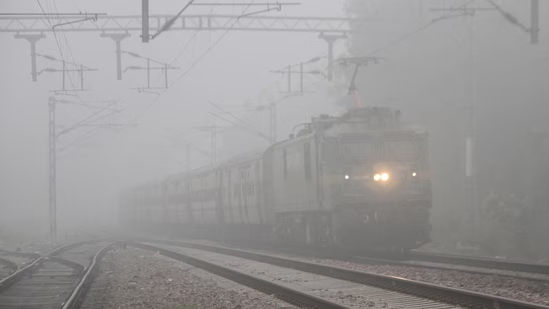
Delhi air pollution: Delhi residents woke up to ‘severe’ air quality on Thursday morning (November 14), a day after the national capital recorded the worst AQI in the country, with dense smog blanketing the NCR, reducing visibility. On Wednesday, the Air Quality Index (AQI) turned ‘severe’ for the first time this season, even as the central pollution watchdog attributed the deterioration to an “unprecedentedly dense” fog and described it as an “episodic event”.
According to the Central Pollution Control Board (CPCB) data, the AQI in Delhi’s Anand Vihar was 466 (‘severe plus’) at 10am on Thursday.
Aya Nagar, Ashok Vihar, and Wazirpur are some of the areas that recorded the worst air quality in Delhi. The air quality crosses over 400, which falls under the severe category.
The Commission for Air Quality Management (CAQM), however, opted not to enforce Stage 3 of the Graded Response Action Plan (GRAP), which includes measures like halting in-person classes for primary schools and imposing a blanket ban on construction activities.
Data from the CPCB showed that the AQI, which averaged 418 at 4pm, worsened to 436 (in the “severe” category) by 6pm and escalated to 454 (reaching “severe plus”) by 9pm on Wednesday.
Notably, Stage 4 of Grap is triggered when the 24-hour average AQI surpasses the “severe plus” threshold, based on the CPCB’s 4 pm daily bulletin. Currently, Grap Stage 2, which was implemented on October 22, remains in effect.
Stage 3 of Grap, typically introduced on “severe” air quality days, enforces a ban on construction and demolition, allows states to suspend in-person classes for students up to Class 5, and stresses the need for enhanced public transportation.
Delhi’s 24-hour AQI
Delhi’s 24-hour AQI, recorded at 4pm every day, stood at 418, up from 334 the previous day.
The CAQM, however, said owing to stronger winds, the pollutant concentration is expected to start showing a declining trend on Thursday onwards and the AQI is likely to move back to the “very poor” category.
“After a comprehensive review, the sub-committee decided to closely monitor the situation before implementing Stage-3 of GRAP and will reassess the status on Thursday,” the CAQM said in a post on X.
In another post on the microblogging platform, the CAQM said its sub-committee noted the steep rise in Delhi’s AQI owing to this “episodic event” since morning.
On Wednesday, the national capital experienced its first dense fog and lowest daytime temperature of the season, trapping pollutants.
The maximum temperature in Delhi (Safdarjung) dropped from 32.8 degrees Celsius on Tuesday to 27.8 degrees Celsius on Wednesday.
Bihar’s Hajipur, with an AQI of 417, had the second-worst reading in the country on Wednesday, the Central Pollution Control Board’s (CPCB) data showed.