

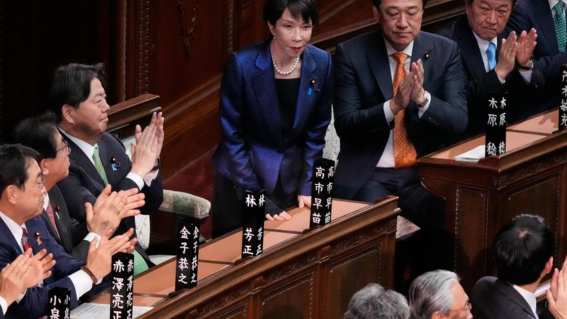
18 February 2026 Punjab Khabarnama Bureau : Japan’s parliament has reappointed Sanae Takaichi as prime minister following her ruling party’s decisive victory in the recent general election, reinforcing political continuity and consolidating her authority at the top of Japanese politics.
The decision was formalised during a special session of the National Diet, where lawmakers voted to confirm Takaichi’s continuation in office. As required by law, her cabinet resigned earlier in the day before she was officially chosen again as prime minister and tasked with forming a new government.
Strong Mandate After Election Win
Takaichi’s reappointment follows a commanding performance by the ruling Liberal Democratic Party in the lower house election. The LDP secured a clear majority, giving the prime minister a strong mandate to pursue her legislative and policy agenda. Political analysts say the election result reflects voter preference for stability amid global uncertainty and domestic economic challenges.
With the opposition fragmented and unable to mount a unified challenge, the LDP’s dominance in the House of Representatives positions Takaichi to pass key bills with relative ease. The scale of the party’s victory also strengthens her leadership within the party, reducing internal dissent and enhancing her influence over policy direction.
Historic Leadership and Political Significance
Takaichi made history when she first assumed office by becoming Japan’s first female prime minister. Her leadership has been closely watched both domestically and internationally, not only for its symbolic importance but also for the assertive policy approach she has championed.
Her political stance is widely regarded as conservative, particularly on issues of national security and economic self-reliance. Supporters argue that her leadership style projects strength and decisiveness at a time when Japan faces rising regional tensions and economic uncertainty. Critics, however, have raised concerns over her views on constitutional reform and social policy.
Economic Priorities Ahead
Economic management is expected to be a central focus of Takaichi’s renewed term. Japan continues to grapple with inflationary pressures, a weakening currency, and long-standing challenges such as an ageing population and high public debt.
The prime minister has signalled her intention to stimulate economic growth through a combination of fiscal measures, targeted tax relief, and support for domestic industries. Her administration is also expected to work closely with financial authorities to stabilise markets and ensure sustainable growth without undermining fiscal discipline.
Market reaction following the election has been cautiously optimistic, with investors welcoming political continuity and the prospect of predictable policymaking.
Security and Foreign Policy Outlook
On foreign and security policy, Takaichi is expected to maintain a firm stance. Her government has emphasised strengthening Japan’s defence capabilities and deepening cooperation with key international partners. This approach reflects growing concern over regional security dynamics and Japan’s strategic role in the Asia-Pacific.
While reaffirming Japan’s commitment to peace and diplomacy, the prime minister has consistently argued for enhancing the country’s deterrence capabilities. Analysts believe her renewed mandate could accelerate discussions on defence spending, military modernisation, and strategic alliances.
Domestic Debate and Opposition Response
Despite the decisive election outcome, opposition parties have urged the government to pursue inclusive policymaking and avoid pushing through controversial reforms without adequate debate. Issues such as constitutional revision, social welfare spending, and labour reforms are expected to feature prominently in parliamentary discussions.
Civil society groups have also called for greater attention to income inequality, gender equality, and social security reforms. How Takaichi balances her conservative agenda with public expectations for social support will be a key test of her leadership.
Looking Ahead
With a renewed mandate and a strong parliamentary majority, Sanae Takaichi enters her next term as one of the most powerful leaders Japan has seen in recent years. Her decisions in the coming months will shape Japan’s economic recovery, security posture, and political landscape.
Observers say her leadership now faces a critical phase: translating electoral success into effective governance while managing domestic expectations and international responsibilities. As Japan navigates a complex global environment, Takaichi’s second term is set to play a defining role in the country’s future direction.
Summary
Japan’s parliament has reappointed Sanae Takaichi as prime minister after her ruling party’s election victory, giving her a strong mandate to pursue economic reforms, security policies, and political stability.