

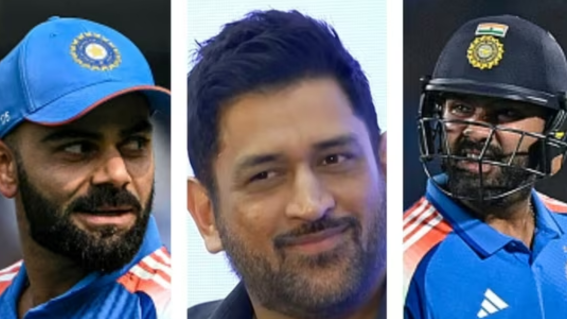
4 February 2026 Punjab Khabarnama Bureau : Former India captain MS Dhoni has once again sparked debate in Indian cricket after offering a candid take on the futures of senior players Virat Kohli and Rohit Sharma. Dhoni’s remarks are being seen as a counter to the recent stance taken by head coach Gautam Gambhir and chief selector Ajit Agarkar, who have emphasised performance, fitness, and long-term planning over reputation while shaping the national team.
Speaking in a discussion on leadership and team culture, Dhoni highlighted the fine balance between respecting experience and making tough decisions for the future. His statement — “You can chuck him out anytime” — was interpreted as a blunt reminder that no player is bigger than the team, while also underlining the responsibility of selectors and management to handle transitions with clarity and fairness.
Dhoni’s comments come at a time when Indian cricket is undergoing a generational shift. With the team management focusing on building a squad capable of sustaining success across formats, questions have been raised about how long senior stalwarts like Kohli and Rohit should remain central to the setup. Gambhir and Agarkar have publicly stressed that age or past achievements will not guarantee selection, reinforcing a performance-driven approach.
However, Dhoni offered a nuanced perspective. While agreeing that selection must always be merit-based, he cautioned against hasty decisions driven by short-term thinking or external pressure. According to Dhoni, experienced players bring more than just runs or statistics; they contribute leadership, calmness in high-pressure moments, and invaluable dressing-room presence.
“You can drop a player whenever you want, but you must also understand what you are losing,” Dhoni suggested, indicating that removing senior players without a clear succession plan could create instability. His comments appeared to push back against the perception that experienced cricketers can be easily replaced without consequence.
Virat Kohli and Rohit Sharma, both former captains, remain among India’s most influential cricketers. Despite debates around form and workload management, their performances in key tournaments and ability to handle pressure continue to make them valuable assets. Dhoni’s stance seemed to acknowledge this reality while maintaining that no player should be immune from scrutiny.
The former captain, known for overseeing India’s smooth transition phases during his tenure, stressed the importance of timing. He recalled how transitions worked best when seniors were phased out gradually and younger players were mentored into leadership roles. Abrupt changes, he implied, often lead to inconsistency and confusion within the team.
Dhoni’s views stand in contrast to Gambhir’s more uncompromising outlook. Gambhir has repeatedly stated that Indian cricket must prioritise winning major tournaments and prepare for the future without sentimentality. Agarkar, too, has echoed similar sentiments, emphasising fitness benchmarks and adaptability, especially with packed international calendars and evolving formats.
The debate highlights a broader philosophical divide in Indian cricket administration. One side believes in decisive resets and strict performance metrics, while the other advocates continuity, experience, and managed transitions. Dhoni’s intervention has reignited discussion among fans and experts about the best path forward.
Former players and analysts have weighed in, with some supporting Dhoni’s emphasis on experience, arguing that players like Kohli and Rohit still have much to offer, particularly in big matches. Others agree with Gambhir and Agarkar, insisting that Indian cricket cannot afford to delay generational change, especially with the next World Cup cycle already underway.
Dhoni also touched upon leadership accountability, pointing out that selectors and coaches must own their decisions. “If you drop someone, it’s your call — but then you must also take responsibility for what happens next,” he noted. This was seen as a subtle reminder that selection decisions should be part of a long-term vision, not reactive measures.
As Indian cricket navigates this transitional phase, Dhoni’s comments carry weight due to his legacy as one of the most successful captains in the country’s history. His ability to blend youth and experience was a hallmark of his leadership, and many believe his insights remain relevant.
Ultimately, the future of Virat Kohli and Rohit Sharma will depend on form, fitness, and team requirements. Yet Dhoni’s remarks have ensured that the conversation remains balanced — acknowledging the inevitability of change while urging respect for experience and thoughtful decision-making.
The debate is unlikely to end anytime soon, but one thing is clear: voices like Dhoni’s continue to shape how Indian cricket views leadership, transition, and the delicate art of team building.
Summary:
MS Dhoni questioned the ease of dropping senior stars, countering Gambhir and Agarkar’s hardline stance, and urged thoughtful transitions while acknowledging that no player, including Kohli or Rohit, is bigger than the team.