

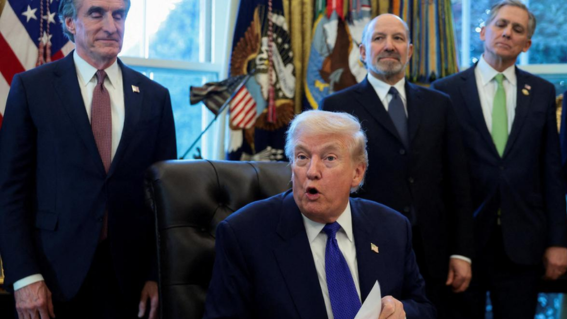
3 February 2026 Punjab Khabarnama Bureau : The Trump administration has announced plans to establish a strategic reserve for rare earth elements, a move aimed at strengthening America’s supply chains and reducing dependence on foreign sources for critical minerals. Rare earth elements are essential components used in a wide range of industries, including defence, renewable energy, electric vehicles, electronics, and advanced manufacturing. The proposed reserve is being positioned as a long-term national security and economic safeguard.
Rare earth elements consist of 17 metals that are vital for producing high-tech equipment such as missile guidance systems, fighter jets, smartphones, wind turbines, and electric vehicle motors. Despite their name, these elements are relatively abundant in the Earth’s crust, but their extraction and processing are complex, expensive, and environmentally challenging. Over the past two decades, China has emerged as the dominant global supplier, controlling a significant share of both mining and processing capacity.
U.S. officials have long warned that this reliance poses a strategic vulnerability, particularly during periods of geopolitical tension or trade disputes. The proposed strategic reserve aims to create a buffer that would protect American manufacturers and defence contractors from sudden supply disruptions, export restrictions, or price shocks. Officials have compared the concept to the Strategic Petroleum Reserve, which was created to protect the U.S. from oil supply crises.
Under the plan, the federal government would purchase and store key rare earth elements and other critical minerals. These materials could then be released into the market during emergencies or severe shortages to stabilise supply and support essential industries. The reserve is also expected to provide confidence to domestic manufacturers by ensuring access to vital raw materials during periods of uncertainty.
The initiative is part of a broader push by the Trump administration to rebuild domestic industrial capacity and counter China’s dominance in strategic sectors. Officials have emphasised that rare earth elements are not only an economic concern but also a national security priority, given their importance to military hardware and advanced defence technologies.
In addition to stockpiling materials, the administration has signalled support for expanding domestic mining and processing capabilities. This includes encouraging private investment, streamlining regulatory approvals, and supporting research into alternative supply sources and recycling technologies. The strategic reserve is expected to complement these efforts rather than replace them.
Industry leaders have welcomed the announcement, saying it could help stabilise markets and reduce uncertainty for manufacturers that rely on rare earth inputs. Many companies have struggled with volatile prices and supply risks in recent years, particularly during periods of strained U.S.–China relations. A government-backed reserve could act as a safety net while domestic production capacity is gradually expanded.
However, some experts have cautioned that creating a strategic reserve will not be a quick fix. Building stockpiles requires significant upfront investment, careful management, and long-term planning. Environmental groups have also raised concerns about increased mining activity, urging the government to balance supply security with environmental protections and community interests.
Supporters of the plan argue that the costs of inaction are far greater. They point to past instances where export restrictions or diplomatic tensions disrupted supply chains, leaving manufacturers scrambling for alternatives. In a world increasingly dependent on advanced technologies and clean energy systems, access to rare earth elements is seen as a cornerstone of economic competitiveness.
The announcement comes amid growing global competition for critical minerals, as countries race to secure materials needed for energy transitions and digital infrastructure. Several U.S. allies are also exploring similar strategies, including stockpiling, joint procurement, and cooperative supply agreements.
If implemented effectively, the strategic reserve could mark a significant shift in how the United States manages its access to essential raw materials. By combining stockpiling with domestic investment and international partnerships, the administration hopes to build a more resilient and secure supply chain for the technologies that will shape the future economy.
Summary:
The Trump administration plans a strategic reserve of rare earth elements to protect U.S. supply chains, reduce dependence on foreign sources, and strengthen national security and advanced manufacturing.