

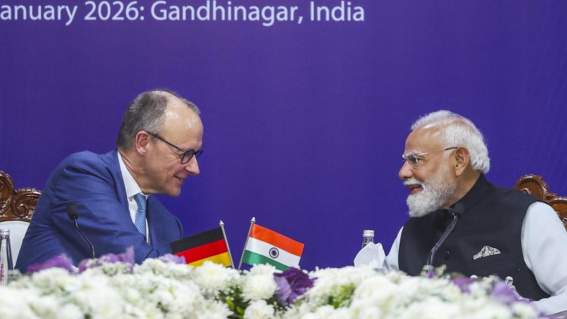
12 January 2026 Punjab Khabarnama Bureau : India and Germany are poised to enter a new phase of deep economic and strategic cooperation, with Prime Minister Narendra Modi describing the partnership between the two nations as “limitless” during the visit of the German Chancellor to India. The high-profile visit underscores the growing importance of the India–Germany relationship at a time when global economic and geopolitical dynamics are rapidly evolving.
Addressing a joint interaction, Prime Minister Modi emphasized that India and Germany share not only strong economic ties but also common democratic values, mutual respect, and a shared commitment to global stability and sustainable development. He noted that the partnership between the two countries is no longer limited to traditional trade but is expanding rapidly into future-focused sectors.
Strengthening Economic Cooperation
India and Germany have long enjoyed robust economic relations, with Germany being one of India’s most important trading partners in Europe. However, both leaders made it clear that the next phase of cooperation will go far beyond existing frameworks.
The focus is now shifting toward strategic sectors such as green energy, advanced manufacturing, artificial intelligence, semiconductors, mobility solutions, digital innovation, and critical technologies. According to Prime Minister Modi, these sectors represent enormous opportunities for collaboration, innovation, and shared growth.
German companies already have a strong presence in India, contributing to job creation, skill development, and technology transfer. With the renewed commitment expressed during the Chancellor’s visit, this engagement is expected to accelerate further, encouraging more investment into Indian markets and deeper industrial cooperation.
A Shared Vision for Green Growth
One of the central themes of the discussions was climate action and sustainable development. Both India and Germany have reaffirmed their commitment to combating climate change and accelerating the transition to clean energy.
Germany has expressed strong interest in supporting India’s renewable energy ambitions, including large-scale solar and wind projects, green hydrogen development, and energy storage technologies. India, for its part, sees Germany as a key partner in accessing advanced technologies and best practices for its green transition.
Leaders from both sides highlighted that climate cooperation is not only an environmental necessity but also an economic opportunity. Joint projects in clean energy could generate new industries, create employment, and drive innovation across both economies.
Expanding Collaboration in Technology and Innovation
Technology has emerged as another major pillar of the India–Germany partnership. Discussions during the visit focused on expanding cooperation in artificial intelligence, cybersecurity, quantum computing, and digital infrastructure.
India’s rapidly growing digital ecosystem and Germany’s strength in research and engineering make the partnership particularly promising. Both sides expressed interest in encouraging closer ties between startups, research institutions, and universities, creating an ecosystem where innovation can flourish.
The German Chancellor praised India’s achievements in digital public infrastructure and innovation, while also expressing confidence that deeper technological collaboration could benefit not just both countries, but the global community as well.
Defence and Security Cooperation Gains Momentum
Beyond economics and technology, defence and security cooperation are also gaining prominence in the bilateral relationship. Both leaders acknowledged the importance of working together in an increasingly complex global security environment.
There is growing interest in expanding defence manufacturing cooperation, joint research, and knowledge-sharing between the two countries. Such collaboration aligns with India’s push for self-reliance in defence production and Germany’s interest in building stronger strategic partnerships in the Indo-Pacific region.
The emphasis on defence cooperation reflects a broader understanding that India and Germany see each other as long-term strategic partners, not just economic allies.
Education, Skills, and People-to-People Links
Another key area of discussion was education and skill development. Germany remains a preferred destination for Indian students, particularly in fields such as engineering, technology, and applied sciences. At the same time, Indian professionals play an increasingly important role in Germany’s workforce, especially in sectors facing skill shortages.
Leaders from both nations highlighted the need to make mobility easier for students, researchers, and skilled workers. Strengthening people-to-people ties is seen as essential for sustaining the long-term partnership and building cultural understanding between the two societies.
New initiatives are expected to focus on joint research programmes, academic exchanges, and vocational training partnerships that benefit young people in both countries.
Trade, Investment, and Global Supply Chains
The visit also comes at a time when global supply chains are being reshaped. India and Germany both recognize the importance of resilient, diversified, and trusted supply networks.
There is a strong push to enhance cooperation in manufacturing and industrial production, particularly in sectors like automobiles, pharmaceuticals, electronics, and machinery. German expertise in precision engineering combined with India’s scale and talent pool presents significant opportunities for mutual benefit.
Business leaders from both countries have expressed optimism that the renewed political momentum will translate into concrete commercial outcomes, including increased investment flows and expanded market access.
A Strategic Partnership for a Changing World
The language used by Prime Minister Modi — describing the relationship as entering a “limitless” phase — signals a clear intent to elevate the partnership to a higher strategic level. The German Chancellor echoed similar sentiments, emphasizing that India is a crucial partner for Germany’s long-term economic and geopolitical strategy.
Both sides appear keen to shape a partnership that is not only beneficial bilaterally but also contributes to global challenges such as climate change, economic stability, technological governance, and sustainable development.
Looking Ahead
As the visit concludes, expectations are high that the commitments made will translate into concrete actions over the coming months. Policy dialogues, business engagements, and institutional collaborations are expected to intensify, creating a strong pipeline of initiatives across multiple sectors.
For India, the partnership with Germany represents access to advanced technology, investment, and global markets. For Germany, India offers scale, growth potential, talent, and strategic relevance in the Indo-Pacific. Together, the two nations are positioning themselves as key partners in shaping the future global order.
Summary
Prime Minister Modi says India–Germany ties are entering a “limitless” phase, with cooperation expanding across strategic sectors like green energy, technology, defence, and innovation during the German Chancellor’s high-level visit to India.