

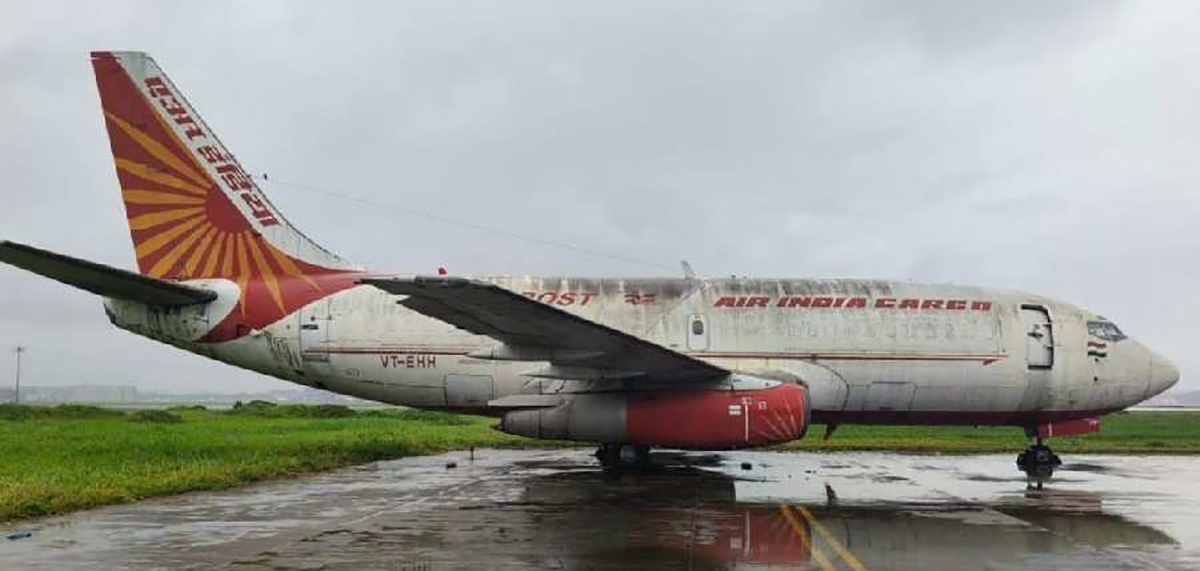
18 December 2025 Punjab Khabarnama Bureau : In an industry governed by meticulous records and constant regulatory scrutiny, airlines do not usually misplace aircraft. Yet Air India has confirmed that one of its Boeing 737 aircraft remained parked at Kolkata airport for more than a decade without appearing on the airline’s active asset registers.
The aircraft, a Boeing 737-200 registered as VT-EHH, has been stationary since 2012. During that period, Kolkata airport authorities continued to levy parking charges, eventually totalling close to Rs 1 crore. For years, the airline disputed ownership when invoices were raised.
That position has now changed. Details of the aircraft’s status have emerged from Air India statements and reporting in Indian and international aviation media.
Air India’s chief executive, Campbell Wilson, acknowledged the lapse in an internal communication that has since been widely reported.
“Though disposal of an old aircraft is not unusual, this one is — because we didn’t even know we owned it,” Wilson said.
Commercial aviation depends on documentation. Aircraft ownership, maintenance histories and component records are tracked continuously, both for safety and for compliance with national and international regulators. That makes the Kolkata case unusual, not because the aircraft was old, but because it appears to have fallen between institutional cracks.
According to Air India’s management, the aircraft was omitted from internal records during a sequence of organisational changes. The jet originally belonged to Indian Airlines, which was merged into Air India in 2007. It was later leased to India Post and configured for cargo operations before being grounded.
Wilson has said the aircraft was “repeatedly left out of internal records”, including during the airline’s privatisation in 2022. If an asset does not appear on takeover ledgers, responsibility for it can easily be overlooked, especially when it is no longer operational.
Aviation analysts note that airlines have strong incentives to avoid precisely this kind of situation. Aircraft are capital-intensive assets and grounded planes generate costs rather than revenue.
“Given the regulatory oversight, it’s hard to imagine an airline genuinely losing track of an aircraft,” aviation consultant John Strickland of JLS Consulting told British media when the case came to light. “Maintenance histories and component serial numbers are normally very tightly controlled.”
That control, however, depends on accurate inventories — something that can be disrupted during mergers, restructurings or ownership changes.
The Boeing 737-200 is a first-generation variant of a design introduced in the late 1960s and is no longer used in commercial passenger service. Industry estimates suggest the aircraft itself has minimal resale value, though some components could potentially be salvaged.
The greater cost to Air India is reputational rather than financial. The accumulated parking charges are modest in the context of the airline’s broader turnaround and fleet modernisation plans, which involve tens of billions of dollars in new aircraft orders.
There is no indication that similar cases are common in global aviation. However, Kolkata airport authorities have reportedly identified other long-abandoned aircraft over the years, suggesting that enforcement gaps do exist.
For Air India, the rediscovered aircraft is an uncomfortable reminder of the challenges involved in inheriting and reorganising a large, state-run enterprise. For regulators and airport operators, it raises questions about how unpaid fees and unresolved ownership disputes are allowed to persist for years.
The aircraft itself is expected to be removed and repurposed, reportedly for ground-based training use. Its story, however, serves as a reminder that even in tightly regulated industries, administrative blind spots can endure far longer than anyone expects.
Summary:
A Boeing aircraft belonging to Air India has remained parked at Kolkata airport for nearly 12 years, drawing attention to lapses in asset management. The long-abandoned plane highlights operational inefficiencies and has raised questions about maintenance, costs, and accountability within the airline.