

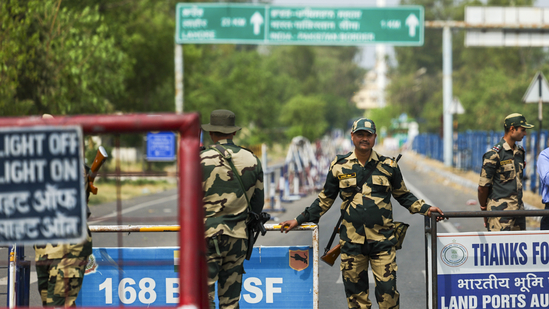
03 May 2025 (Punjab Khabarnama Bureau): Tensions between India and Pakistan continued to rise on Saturday in the wake of last week’s deadly terror attack in Jammu and Kashmir’s Pahalgam, which claimed 26 lives. The two countries have engaged in a series of retaliatory measures since then, beginning with India halting the Indus Waters Treaty processes and suspending visas for Pakistani nationals, while also expelling them.
In response to Pakistan’s continued firing across the Line of Control (LoC), Indian forces have retaliated in a timely and proportionate manner since the attack on April 22.
India, citing “cross-border linkages” to the gruesome attack, has vowed “severe punishment” for those responsible.
Meanwhile, key global players, including the United States and the European Union, have called on both nations to de-escalate the situation, while unequivocally condemning the Pahalgam terror attack. India has reiterated that the “perpetrators, backers and planners” of the assault must be held accountable.
According to a PTI report quoting individuals familiar with the developments, Pakistan has been aggressively stepping up naval alerts, conducting intensified drills in the Arabian Sea, and repeatedly violating the ceasefire along the LoC in Jammu and Kashmir since the April 22 incident.
Latest updates on India-Pakistan tensions
On Saturday, Sri Lankan authorities searched an incoming flight from Chennai after receiving a tip-off that a suspect connected to the Pahalgam terror attack might be on board, a police spokesperson confirmed. SriLankan Airlines said in a statement that the aircraft, which arrived at Bandaranaike International Airport at 11:59 am, underwent a thorough security check upon landing. The plane was cleared for further operations, although its onward flight to Singapore experienced delays due to the inspection.
Prime Minister Narendra Modi on Saturday described terrorism as the “biggest threat” to humanity and reaffirmed India’s determination to take “firm and decisive” action against terrorists and those supporting them. His remarks came against the backdrop of growing tensions with Pakistan over the Pahalgam terror attack.
Modi made the comments following his extensive talks with visiting Angolan President Joao Manuel Goncalves Lourenco. During the meeting, he announced a USD 200 million defence credit line for Angola. It is understood that the recent terror attack in Pahalgam was a significant point of discussion during the Modi-Lourenco dialogue.
Jammu and Kashmir chief minister Omar Abdullah met Prime Minister Narendra Modi on Saturday to discuss a range of issues, including the recent Pahalgam terror attack. The meeting, which took place at the PM’s residence, lasted about 30 minutes and marked the first interaction between the two leaders since the April 22 attack that claimed 26 lives, mostly of tourists.
Officials said Abdullah gave a detailed account of the prevailing situation on the ground, highlighting the widespread public anger and spontaneous protests against the violence, which was described as unprecedented since terrorism began in the region in 1989. He also pointed to the heroism of Syed Adil Hussain Shah, a pony ride operator who tried to grab a weapon from one of the attackers to protect tourists.
Amid heightened Indo-Pak tensions after the Pahalgam attack, Pakistan successfully carried out a training launch of the Abdali surface-to-surface missile, which has a range of 450 km. The Inter-Services Public Relations (ISPR), the media wing of the Pakistani military, stated that “The launch was aimed at ensuring the operational readiness of troops and validating key technical parameters, including the missile’s advanced navigation system and enhanced manoeuvrability features.”
According to PTI, sources familiar with the matter in New Delhi said India views Pakistan’s ballistic missile launch as a “blatant” act of “provocation”. They termed it a “desperate attempt” to escalate tensions with India. However, India has not issued any official statement in response to the launch. Sources indicated that Islamabad did inform New Delhi in advance about its intention to conduct the missile test, in line with established protocols and obligations.
In response to the cross-border links to the Pahalgam terror attack, India on Saturday took punitive steps against Pakistan by suspending all postal services from that country and banning the entry of Pakistani-flagged ships into Indian ports. Additionally, Indian ships have been restricted from visiting ports in Pakistan. These measures, effective immediately, were confirmed by the Directorate General of Shipping (DGS).
The Central Reserve Police Force (CRPF) has terminated the service of jawan Munir Ahmed for hiding his marriage to a Pakistani woman, citing national security concerns. Sources revealed that Ahmed, who served in the CRPF’s 41st battalion, was dismissed under special rules that allow removal without a formal inquiry. His actions were deemed “detrimental to national security,” and the decision was taken swiftly, according to officials.
The Intelligence Bureau (IB) and other security agencies had previously alerted local officials in Jammu and Kashmir about a possible terror attack targeting tourists around the time of Prime Minister Narendra Modi’s scheduled visit to the Union Territory on April 19, people with knowledge of the matter said. In response, security was beefed up around Srinagar, especially near tourist-frequented areas and hotels, as well as sites like Dachigam National Park. However, the PM’s visit was cancelled due to bad weather. The actual attack took place days later on April 22 in Pahalgam, about 90 km from Srinagar, killing 26 people, mostly Hindu tourists, in what appeared to be a targeted assault.
Summary: India-Pakistan tensions escalate after the Pahalgam terror attack, with missile tests, trade bans, and cross-border violations intensifying the crisis.