

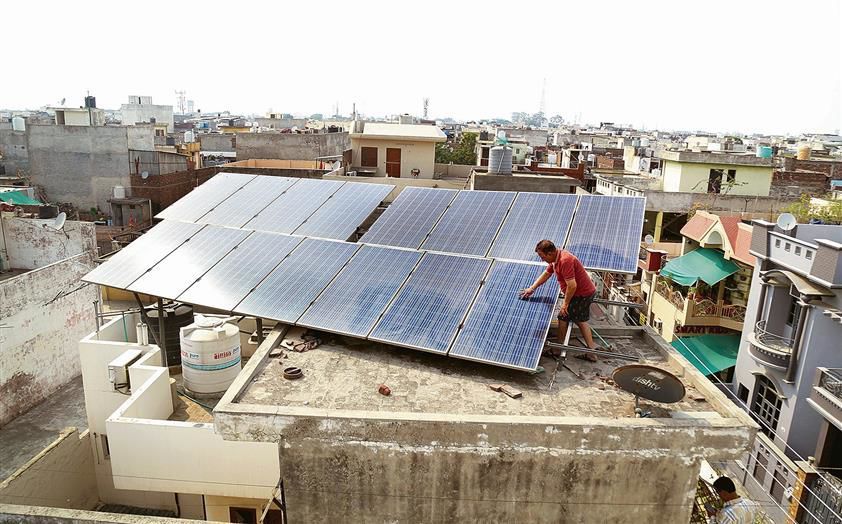
Chandigarh 25 June 2024 Punjab Khabarnama : While the world makes giant strides towards shifting to renewable energy sources, populist decisions taken by the Punjab Government to give free power to agriculture sector and 300 units of free power to domestic consumers have led to a fall in number of domestic consumers going in for solar power generation on their rooftops.
There are also no takers for the solar power generation for running the agriculture pumpsets since power to the farm sector is also free. Nearly 24 per cent of the total power generated is consumed by 14 lakh agriculture pumpset consumers and they use power during the day, which are the peak load hours.
Gujarat on top in green energy
As per information, given by former Union Minister for New & Renewable Energy and Power RK Singh, in written replies to two separate questions in Lok Sabha on December 21, 2023, Gujarat has highest 3174.04 MW cumulative RTS, followed by 1852.22 MW in Maharashtra, 1067.25 MW in Rajasthan, 591.17 MW in Kerala, 518.49 MW in Haryana, 497.37 MW in Karnataka, 489.32 MW in Tamil Nadu, 367.18 MW in Telangana, 316.51MW in Madhya Pradesh and 396.84 MW RTS power generation capacity in Punjab, which includes 159.10 MW domestic and 237.74 MW on commercial buildings.
How do RoofTop Solar plants work
- The grid connected rooftop solar (RTS) photovoltaic power generation plants generate electricity at the consumer point and hence contributes to reducing the network losses of the distribution. It also contributes to meeting the demand and supply gap
- RTS generates power during the daytime and feeds excess power to the grid. This system does not require battery back-up as the grid acts as the back-up for feeding excess solar power and vice-versa
When was net metering introduced
- To promote the RTS plants, the state government had notified the Net Metering Policy in August 2014, offering all consumers to install the RTS on the rooftops up to 80 per cent of their sanctioned loan
- In this on-grid system, it uses the existing service lines for injection and drawl of power from the grid. It is accounted for through bi-directional meters, installed by PSPCL. The RTS is known as a clean and climate-friendly energy
Consumers not getting subsidy
- Consumers are not getting the subsidy, which has a ripple effect. Residential consumers installing grid-connected RTS avail the Central Financial Assistance (CFA)
- Under the CFA, Rs 14,588 per kW for first 3 kW RTS capacity and Rs 7,294/kW for RTS capacity beyond 3 kW and up to 10 kW is provided in Punjab
- However, Rajinder Kumar of Tagore Nagar, Jalandhar, says that he and almost all other consumers, have been waiting for the subsidy to be released for 10 months of 2019
With domestic consumers getting 300 units of free power every month, or 600 units in a billing cycle, they are unwilling to make an investment of Rs 1.5-Rs 2 lakh for installing the on grid rooftop solar (RTS) system, ever since the free power to domestic consumers was started in July 2022.
Data available with The Tribune shows that the number of domestic consumers opting for the RTS grew by 14,978 between 2019 and 2022 (when the free power scheme began). The generation capacity then was 107.31 MW. Between March 2022-2024, only 7,508 consumers opted for solar power and the generation capacity reached 159.10 MW.